Tag Archive for: high quality signals

One of the greatest ‘myths‘ out there (or mis-information) is price action on the lower time frames (below 1hr charts) is just ‘noise‘. This is a highly confused notion of price action trading and nothing could be further from the truth.
Prop traders are often trading below the 1hr time frames every day, oftentimes on the 1m, 3m or 5m charts. Bank traders will often be highly active, also trading on the lower TFs. They do this while also building up large swing positions they hold for weeks, perhaps months to trade with the trend. Same goes for desk traders and institutional ones alike.

The bottom line is, professional traders are trading off all time frames. There is no ‘holy grail’ of time frames. There is no bastion of good signals that only exist on the higher TFs (daily and 4hr charts) while anything below the 1hr chart is just ‘noise’ or garbage. High quality signals exist on all time frames, and traders are making money on virtually every time frame you can imagine. The ‘noise’ idea you’ve been told is a myth.lower time frame noise myth busted chris capre 2ndskiesforex
Sorry to kill the sacred cow – but those espousing the freshman idea only good signals exist on the daily/4hr charts clearly do not understand price action.

The idea of noise existing on a particular time frame comes down to the lack of one thing – training. I will use an analogy to demonstrate this point.
Foreign Tongues & Cryptography
If I am walking down a street in my home country, I will understand what people are saying. Why? Because I speak the language. I have been trained to.
Now put me on a busy street in Finland or Mongolia, and I will have no idea what they are saying. Their conversations will sound like noise to me. In fact almost any language that is unrecognizable to me will sound like ‘noise’.
Why? Training.
But give me six months to a year learning that language, and what before sounded like ‘noise’, will now sound like a conversation. It will have information, meaning and a familiarity to it. I will be able to understand and recognize what they are saying. The only difference between the two scenarios, is training.
Same goes for cryptographers (those who translate coded communications). What may sound like noise to me and you, is actually a hidden message or code for them. Again – the only difference between us and them is training.
cryptography training intra-day time frames 2ndskiesforex
It Comes Down To This
If you have been only trading the higher TFs, then for a little bit, the lower TFs will look like ‘noise’ to you. You will not understand the differences, the rhythms, and how the information is expressed a little differently. But through training, practice and experience, you will start to understand the code.
What you will find are great intra-day signals, key levels, and how the intra-day price action flows. You will spot opportunities and see patterns. With a little effort, practice and training, the ‘noise’ of those time frames will start to become clear and trades will start to pop out to you. With proper training comes an improved trading mindset.
That is not to say you should or have to. I always recommend finding what is most natural to you, your availability, and inclinations. That could be only on lower TFs, higher ones, or a mix of both. Everyone will have a sweet-spot. It is up to you to find that.
To be clear, I am not saying this comes easily, but nothing in trading ever does. It takes patience, work, practice and training, but it certainly can be done.
Hence do not believe the confused freshman ideas there are boogeymen down there. I have many students trading the intra-day charts successfully several times a day while maintaining accuracy and profitability. There is no reason why you cannot do the same.

About three days ago, I was given an interesting question by a student. They asked the following;

“Out of curiosity, how many trades do you take in a month? Is it like sniper trades, as in one trade a week or so?”

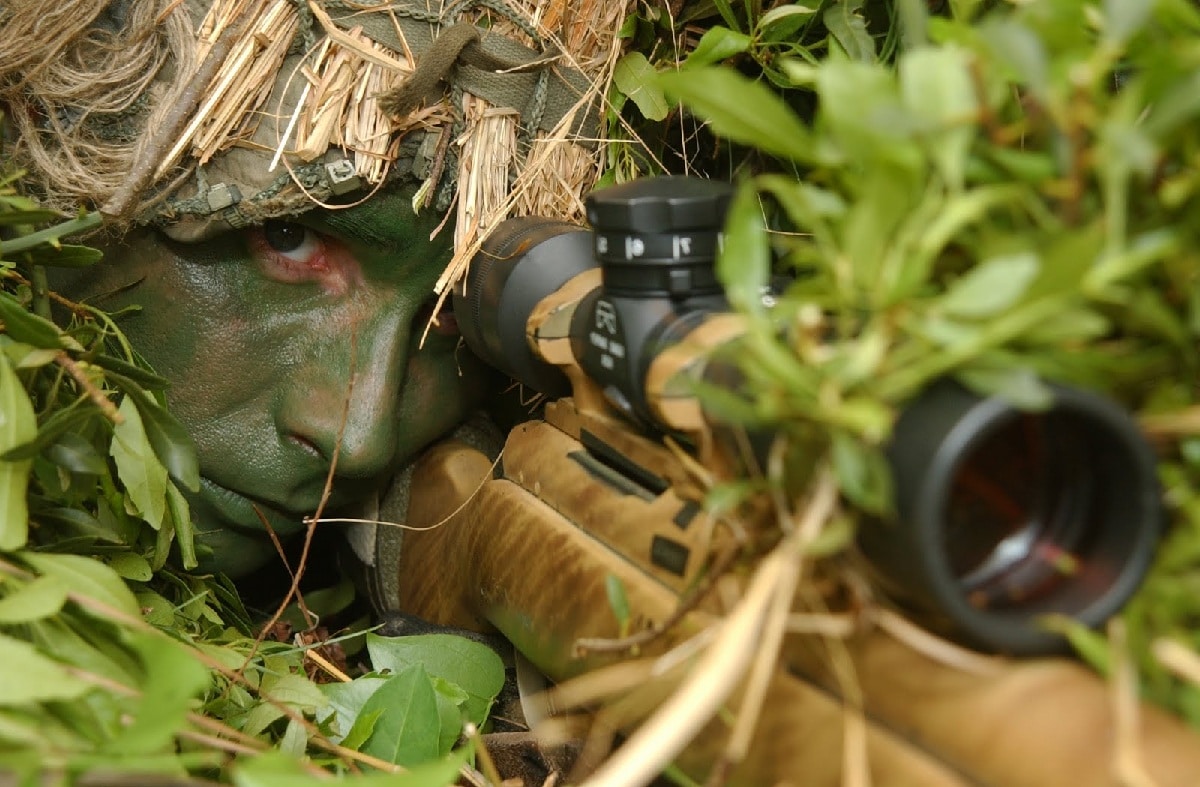
After reading the question, I realized they had a confused assumption about what it actually means to trade like a sniper. There have been all kinds of forex trading frequency articles written around this vein, such as trade like a sniper, not a machine gunner. It should be known that if there are machine gunner traders out there, they are HFT’s. And FYI – the top HFT firms are making millions, but I digress.

The Confusion
There seems to be this confusion trading like a sniper means you only trade a few times a week, perhaps even a handful a month. This is furthered by the idea of only trading on higher time frames, such as the daily and 4hr charts. But this is highly inaccurate of what it means to trade like a sniper.
Now, before we get into the subject of foreign exchange trading frequency and how it has nothing to do with time frames, I’d like to share a few interesting facts about snipers.
 
Fact #1:
Most snipers going through training will fire 1000’s of rounds. This is referred to as their ‘rounds down range‘ training. General estimates are about 1800-2000 rounds over a 35 day period. If you do the math, that’s about 50+ shots per day every day for 35 days straight.
trading like a sniper - what it really means 2ndskiesforex
Now try and bridge the gap for the daily chart trader that only does 2-3 trades per week, maybe 5-6 per month. At that pace, a daily chart trader doing 10 trades per month on average would have to trade for +180 months (or 15 years) before they accumulate the same amount of basic training a typical sniper does in 35 days.
There is a reason in sniper training you do so many shots in a day. Because shooting only 2-3 per week doesn’t build your skill set. In fact, for 99.99% of all skill based endeavors, executing something only 2-3x per week will not build your skill set. Trading is no exception.
You cannot fire three shots in a week and expect to be proficient. You cannot do three free throws and expect to be a good free throw shooter. Why would you ever expect this to be the same for trading? However, doing something over and over again dozens of times a day does build your skill set.
building your skill set - trading like a sniper 2ndskiesforex
Keep in mind, a sniper doesn’t just do their 2000 rounds and stop shooting from there. They continually train day in-day out to sharpen their skill, shooting dozens of times per day. Thus, before a sniper will ever be given that chance to make a single shot in a real world situation, they will have taken thousands of shots prior. Food for thought.
 
Fact #2:
Sometimes you will have to pull the trigger quite often as a sniper. Some examples of famous snipers in history;
1) Simo Hayha – had 505 confirmed sniper kills in the Winter War, which lasted only 100 days. Do the math: 505 kills over 100 days = 5.5 kills per day. Obviously quite active on a daily basis.
2) Vasily Zaytsev – over 225 kills over a 5 week period during the Battle of Stalingrad: 225 kills / 35 days = 6.42 kills per day. Again, quite active on a daily basis.
3) Clive Hulme – Fought in the Battle of Crete (11 days), and is credited with 33 confirmed kills (of German Snipers!): 33 /11 days = 3 per day.
What does all this mean? When engaged in an active environment, they can and will pull the trigger many times.
 
Translating This to Trading
Anyone who is properly trained will find several high quality signals a day. Only someone who is improperly trained will be unable to trade below the 4hr or 1hr charts.
This idea of only trading on the higher time frames to be a sniper trader is a confused logic. If you have setups according to your system, you pull the trigger – period. If that happens 1x / day, or 10x / day, its irrelevant. And do you really think bank traders are being paid to sit on their hands all day to only trade 2-3x per week? Do you think prop-traders are only pulling the trigger a few times throughout the week? In what fantasy-land does that world exist?
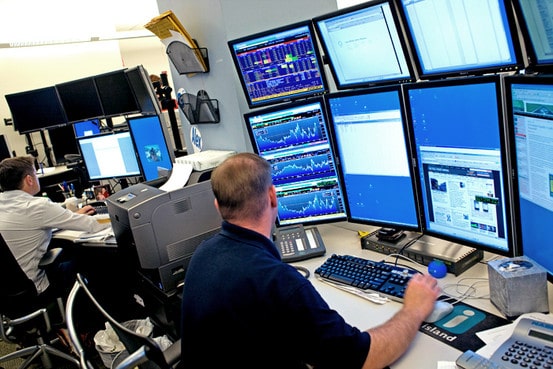
bank and prop traders actively trading 2ndskiesforex
I consider myself a ‘sniper’ in terms of trading. I observe, I stalk, I study my targets, and when the opportunity arises, I pull the trigger. On average, this happens to me 3-5x per day, sometimes over 10 trades in a really active day.
If you are actively engaging multiple markets, there is no reason why you shouldn’t be finding several high probability setups every day. Even if you just focused on forex, across the most liquid pairs daily, you could easily trade several times per day.
 
The ‘Noise’ Argument
One thing commonly heard from the trade like a sniper camp is anything below the 1hr chart is just ‘noise‘. I have one thing to say to this;
Put me in some strange country on a busy street where everyone is speaking a foreign language. Most of what I will hear will be ‘noise’. Now give me 6 months to learn that language, and it will no longer be ‘noise’, but a conversation full of information.
What is the difference between the noise I heard earlier, and the conversations I clearly hear later? Training. What seemed like ‘noise’ on that 30m or 5m chart will start to sound like a conversation – one you can translate.
 
In Closing
You will not become a ‘sniper’ if you are only pulling the trigger 2-3x per week. To become one (or a highly trained individual at anything), it takes thousands of reps. And it should be known snipers become less accurate the longer the distance.

The ‘sniper’ difference comes down to training. If you do trade on the daily/4hr TF’s only, there are ways to accelerate your learning curve. So consider alternative forex trading frequencies and methods to building your skill set.

There seems to be some fascination with newer/beginning traders to find this perfect setup, this small set of circumstances that give price action the appearance of a great trade opportunity. You’ve probably heard about these patterns and setups before, often referred to as Pin Bars, Engulfing Bars, Inside Bars, etc.

Beginning traders become hypnotized, thinking these price action patterns are all you need learn to trade the market, as if trading were a fashion contest, and your goal is to find the best dressed setup.

The problem is, this is a really confined view as these patterns are more often the result of order flow – not the cause of it.
 
A Means, Not the Reason
These price action setups discussed above, are a means to get into the market, not the reason why you should be. And it’s often the case, they are the secondary reason why you should be entering the market.
The reason why you should be getting into the market, is because your understanding of the price action & order flow in the overall market, gives you an over-weighted picture as to a clear direction in the market.

This direction could be for 20 minutes, hours, or even days.  The amount of time it will likely maintain that direction is not important.  That the price action gives you an over-weighted picture of the direction IS!

And when this happens, there is a trade opportunity.  If that opportunity offers you a good mathematical reward/risk play, then you should be trading it – not because of some picture perfect setup.

trading is not a beauty contest 2ndskiestrading.com jan 21st

 
Trading is Not A Fashion Contest
How many times have you seen a picture perfect setup that completely failed?  I’m willing to bet dozens of times, and if you trade long enough, hundreds or thousands of times.
Why is that?
Because trading is not a fashion contest where you are looking for the best dressed setup.  Because price action setups can and will fail, which should communicate to you – not to become fascinated with finding the perfect price action setup.
What it should mean, is you want to develop your ability to read the overall picture of the market, understand the order flow behind it, learn to read the impulsive and corrective price action.  Then, look for an over-weighted scenario.  Once you find it, check the math to see if it’s favorable.  If so, then take the trade.
 
Missing High Quality Signals
If you are always on the hunt for the perfect setup or trade, you will likely be completely missing high quality signals passing by right in front of you.
The greatest mistake of higher time frame traders is they often do not take great trades that are right in front of them, because they are waiting for the ‘perfect‘ setup – one that will hit them over the head.
The problem is in passing up these trades, they are also passing up high quality signals that offer a mathematical edge and profits.

missing good trade opportunities

Ironically, the greatest fallacy of intraday traders is they will often take trades that are not there, or not of high quality.  Although it may seem like the former is better than the latter, both are the same!
The higher time frame trader makes a lot less profit because they pass up really high quality signals, looking for their perfect match.
Meanwhile, the intraday trader while often having more profits, generally has slightly more losses, because they are taking trades that are not there.  Their upside is higher for executing their edge more, but the extra losses pull them back.
Thus, when you really see this clearly, these are two sides of the same coin!  The trick is to find the balance and wisdom of the two, not to stay on one side of it.  This is the knot of trading you have to untie.
 
A Fantasy World
Spending your time looking for the perfect setup is living in a fantasy world.  It’s like looking for the perfect partner – how many people have you really met that have one? How many people have you met thought they found one, & were completely wrong? Food for thought – but trading is not a fashion contest, and it’s not about looking for the perfect setup.
 
Same Setup – Different Result
There are many times several of my price action traders spot the same exact setup, yet end up with completely different results.
How could that be?

same setup different results 2ndskiestrading.com

Because they managed the trade differently. One took profits a little early (but still ended up profitable), while the other caught a huge portion of the move.
Although it may seem like this one trade may not mean much – it means a lot if its repeated.
When trader A encounters a series of losses (and you will, regardless of your strategy), their downside will be more severe and they will take more time to recover.  However when trader B encounters the same downside period, their recovering will be faster, because they padded on more alpha to their trading account.  For them, it only takes a few large wins to erase a lot of losses.
Keep in mind, they both spotted the ‘perfect price action setup‘, yet they both had different levels of profits.
What was the difference?  In how they managed the trade.
This should be communicating to you, what is far more important than finding the ‘perfect’ price action setup, is learning how to manage the trade.  And this really comes down to three things;
1) Understanding Risk Management
2) Learning to Read Price Action In Real Time
3) Managing Your Emotions/Mental State
bells ringing in your head 2ndskiestrading.com
Perhaps you can find the perfect setup, but fail to do the three above, & your perfect setup is powerless to deliver consistent profits.  Bells should be going off in your head now about what you should be spending your time studying.  It’s not how to spot a pin bar, or engulfing bar, or some other magical bar.  It’s about setups, price action and context.
These pin bars, engulfing bars, or any bars are easy to find, and take little mental effort.  The learning process for this should be short.
But the learning process for the three things I listed above prior, should be never-ending.
I understand why many of you have made this mistake.  There are these so called ‘authorities‘ and ‘masters‘ (notice self-labeled as no peer will call them that), who claim you only need 3 of these ‘setups’ to understand the market.  That these great setups only occur on higher time frames, that intraday price action trading is to be loathed, that accuracy and profitability has a linear relationship with time frames.
Ah yes, and don’t forget the three golden setups – how convenient!  As if a market with over a million participants, composed of retail & institutional traders, hedge funds, banks/brokers, pension funds, HFTs, intraday traders, swing traders, long term position traders, etc. are all subdued by these overlords of price action patterns.
High quality signals occur on every time frame, and there are profitable traders across the world trading on almost every time frame.  Intraday price action trading is not to be loathed – that is just a personal feeling of some, while a ATM machine for others.
Who is right?  Neither – thus don’t hate intraday trading because it doesn’t work for you. The greatest mistake a trader can do, is to think their world and thoughts about reality – ARE REALITY!  As if your wisdom and insight is so brilliant, so total, so complete, that it has a monopoly on the truth about trading.
Does that sound reasonable to you?  Or does it seem more likely there are many ways to trade successfully, and the best way is what’s comfortable for you.
Just remember, what may be comfortable for you, may not be for another, and neither one individually is reality by itself.

obi wan kenobi 2ndskiestrading.com

Heed the wisdom of Obi-Wan Kenobi who once said, ‘Only a Sith sees in absolutes‘. Don’t be the Sith in trading, or follow a Sith.
Find wisdom in things, then find what is most comfortable for you, while constantly challenging yourself to take things to the next level.  Rarely ever where you start this journey (both in trading and in life) is where you end up.  Thus remember, trading is not a fashion contest, but it is about managing risk, your mental state, and learning how to read and trade price action in real time.
 

Over the last two weeks, I wrote on the subjects of ‘Quality vs Quantity – Which is Better For Trading?’ and ‘What is A High Quality Signal‘.

The main theme has been around dispelling some freshman arguments and confusions others have written espousing the quality is better than quantity argument, and what really constitutes a high quality signal.

One question that should have arisen out of this is ‘what is the ideal trading method and frequency‘ based on what I have now explained.

That is what I will focus on today – the ideal trading frequency (or what I think is the ideal trader).  In other words, what kinds of trading strategies and frequency would offer you to make the most profits.

the ideal trader 2ndskiestrading.com forex trading
I will first talk about time and how that plays a crucial role in trading (and life).  Then I will unpack a few trading strategies to give you the maximum punch for your efforts.

Time Is A Currency

I was recently traveling internationally walking down the streets, and I noticed a huge line leading up to this machine.  I asked my local friend what all those people were waiting for.  They told me if they punch their tickets, they get $.30 off their subway fare.

I then went up to someone in line and asked them how long they wait on average.  “About 15 minutes”. I could tell immediately this person misunderstood how valuable time was.

They waited there 5x per week on average of 15 minutes (1.25 hours) all to save $1.50.  If they really valued time, they would work an extra 1.25 hours to make more money than the $1.50 they were saving waiting in line.

This extra effort in overtime pay certainly outweighs the $1.50 gained.

Or they could use this extra time to figure out new ways to do what they do, likely leading to a promotion and thus higher pay.

time is a currency time frames forex trading 2ndskiestrading.com
There are plenty of more effective ways to use their time.  But the reality is, when you do not have money, you think money is more valuable than time.  When you have money, you think time is money and is really more valuable.

Why?

Because you can replace lost money, you can always make more money (an almost unlimited amount), and you can multiply money exponentially.

But…you cannot replace, make or multiple time.  Once time is spent, it is gone forever and cannot be replaced, re-done or re-used.
Thus in reality, time is a currency, and often mis-spent.

Using your time well in a highly efficient and intelligent manner will almost always lead to having more time and more money.  Find someone really successful and active, and I’ll find you someone who understands time is a currency.

So How Does This Relate To Trading?

The only way one can possibly ‘multiply’ time is to be able to do two things at once.

When it comes to trading, the only way to do this is to trade set and forget strategies on the 4hr and daily time frames. These are strategies where you do not need much time to manage them.

Real set and forget strategies are rule based systems, meaning there are rules for entries, exits, stops, limits, taking profits – everything.

You do not have to make discretionary decisions to use them.  All you have to do execute the rules using minimal time and effort to trade them.

set and forget strategies 2ndskiestrading.com
While the trade is playing itself out, you are off doing something else (reading a book, learning a new language, training in a brain gym, etc).  This allows you to get maximum effect for the least amount of time used.

But I thought you said trading in quantity can be more profitable?

I did, and it is a fact, that if you can take your systems edge, and execute it a few more times a month with similar accuracy, you will make more profit then executing it less.

In fact, in my prior article dispelling the quality is better than quantity argument, I showed that the system with over 15% higher accuracy trading less, was still making far less profits and pips than the system trading more frequently and less accurately.

So quantity does matter.

Thus, trading set and forget strategies is useful because it allows you to do other things while making money.  Being able to make money while sleeping is incredibly potent for building financial abundance.

But…and I mean but…trading only a handful of times per month does two negative things to your trading;

  1. Limited Feedback Loop = Slower Learning Curve
  2. Not Multiplying Your Edge = Making Less Money

Let me unpack these two briefly.

Limited Feedback Loop = Slower Learning Curve
It is a Neuroscientific & Cognitive fact that if you are under-stimulated, or become bored with your trading process, that it will interfere with your learning process.  Being bored means you are not challenging yourself enough, nor getting enough feedback from the markets.
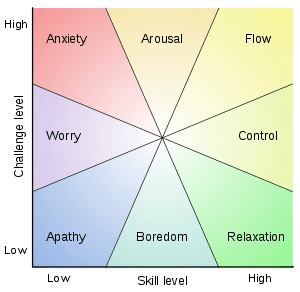
neuroscience of learning limited feedback learning process forex trading 2ndskiestrading.com
Every time you make a trade, it gives you feedback on your abilities, on how you find entries and exits, how you control risk, read price action signals, and make trading decisions.

You don’t become a good golfer or quarterback by sitting on the sidelines most of the time.

You become better at trading, by trading and making trading decisions – win or lose.  Each trade is a feedback loop from the markets which offers you information that can bring you closer towards your goal, re-enforcing good habits while negating bad ones.

But if you don’t trade often or enough, you are missing out from seeing how much you really understand. There is a reason bank traders often have to make 4,000 trades before the bank lets them trade money. Without being challenged enough in relationship to your skill level, being bored or under-stimulated will not induce development, and it will actually hurt the learning process.

Thus, if you are only trading around 4-5x a month, you are hurting your learning process and curve, as you are missing plenty of high quality signals every day.

Not Multiplying Your Edge = Making Less Money

Although I’ve already demonstrated this in my prior article on quality vs quantity, the bottom line is your system should have an edge and expectancy.

If you are trading at 60% accuracy, making on average 2:1 reward to risk per trade, ask yourself who makes more money;

Trader A using that system 5x a month?

or

Trader B using that system 10x a month?

The answer is obvious – it’s a mathematical fact that if you can multiply the amount of times your edge plays out, you will make more money.

trading quantity more money 2ndskiestrading.com
So in summary, trading more often while keeping your edge, will not only challenge you and stimulate you more, but will also help you make more money and profits.

What About Set and Forget Strategies?

The downside with set and forget strategies on the 4hr and daily time frames, is they do not come as often as intraday trading setups will.

Ask yourself how many signals offering 100 pip targets and 50 pips stops come in relationship to 60 pip targets and 30 pip stops?

Obviously more of the latter.  And since daily signals only come once per day per pair, mathematically there are less of them than signals on the 4hr, 1hr or smaller time frames.

Although you may think only high quality signals come on the 4hr and daily time frames, you simply have not been trained to see them, as there are plenty of them coming daily on lower time frames.

learn to trade the market read price action 2ndskiestrading.com
A quality signal has nothing to do with time frame, but having three things;

  1. Is a pattern that repeats itself with consistency and accuracy
  2. Is a signal that offers low risk and high reward potential
  3. Is a pattern that offers itself a clear entry and exit pattern

That is all a signal needs to be high quality, and this is not time frame dependent.  If someone tells you otherwise, they do not understand trading and you should run away from them.

Although set and forget strategies can allow you to use your time efficiently, they do not allow you to multiply your account at the same pace as trading intraday will offer you more signals, and plenty of high quality ones.  The one downside in trading intraday is you usually have to be there and manage the trade.

With training, this is not stressful, and becomes quite enjoyable.  It also offers you a greater opportunity to learn, as you are observing more candles and price action formations, thus seeing more patterns and gaining more chart time.  The latter two will without a doubt increase your learning curve, but only spending a few hours per week will take you a long time to log your 10,000 hours or really master reading price action patterns.

Thus, trading intraday signals and setups allows you to generate more opportunities for profit.
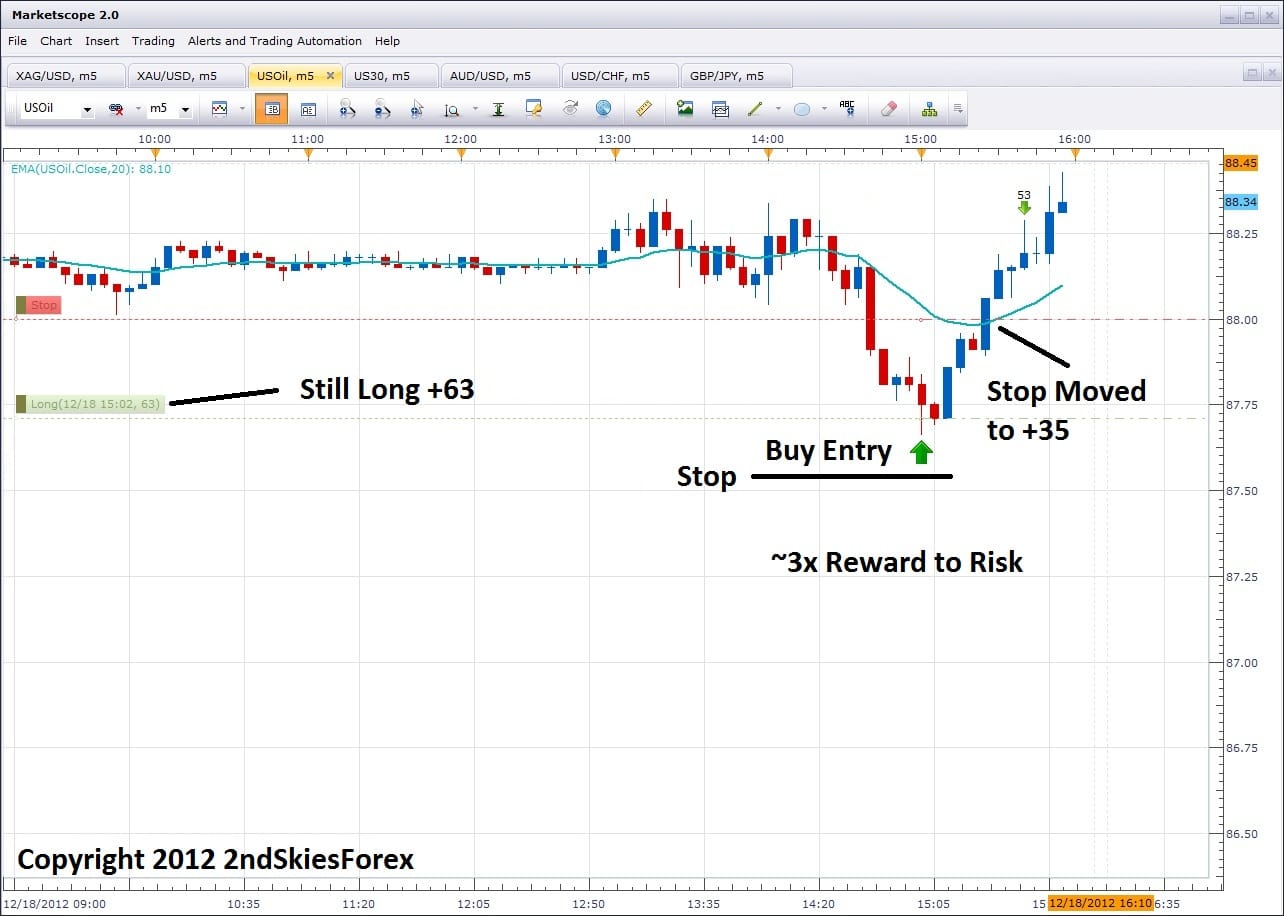
live intraday price action trading chris capre 2ndskiesforex oil trade dec 18th

Which Is Better Then, and What Is The Ideal Trader?

In reality, the best combination is to trade both set and forget strategies, along with trading intraday setups. This is the ideal way to generate the most profits in the least amount of time.

You really get the best of both worlds as you can make money sleeping, also finding great intraday price action setups each day, and I have students doing exactly that, week in-week out.

Now I do not recommend sitting at your computer for 8hrs per day just trading intraday, then spending another 1-2 hours per day finding your set and forget setups.

The brain really can only achieve maximum concentration for short periods of time, often less than a few hours.  Luckily, the best intraday trading setups are during peak times of volatility, so you only need to be around for a few segments of the trading day to capture some serious pips and profits.

I recently did a live intraday price action trade banking +1415 pips of profit in about 4 hours with over a 4.75x reward to risk play.  How many days will it take you to make +1415 pips of profit, or 4.75x your risk trading daily price action setups?  Food for thought, but i’m pretty sure you won’t do that in a day, or even a week for that matter.

In Summary

The bottom line is, the ideal trader can trade a few hours of the day highly concentrated, finding a few high quality intraday price action setups, while also making some set and forget plays.  This allows them to multiply their profits and edge from the intraday trading, in concert with making money while sleeping.

This really is the ideal trader and offers you the most opportunities – not just for making profits, but for accelerating your learning process as you are constantly in the feedback loop from the markets, and learning at a faster pace.

Now there are other critical factors for helping the learning process, along with finding what is ideal for you, and what is the ideal trader mentality.  These things I will discuss in the next article which will be coming soon so stay tuned.

Until then, no matter what religion you are, or wherever you are in the world, I wish you all the best of holidays, and that good health, abundance and a ocean of good things come to you, and those you care about.

Kind Regards,
Chris Capre

I recently wrote a controversial article dispelling some of the misconceptions about the ‘Quality vs Quantity‘ argument, the ‘Less is More‘ being better for your trading.  It has already garnered a lot of questions and responses on the web, which was its purpose.

But there are still some lingering and freshman ideas floating around there.  Thus, I wanted to write a brief article to end the week highlighting some of the key takeaways, and what not to be fooled by.
 
High Quality Signals Only Come From Higher Time Frames
The idea that high quality trades, setups and signals only come from higher time frames really comes from an inability to see and read price action.
high quality signal higher time frames trading like a sniper 2ndskiestrading.com
Ask yourself – what constitutes a high quality forex signal?
Some of the main components (regardless of time frame) should be;
1) a pattern that repeats itself with consistency and accuracy
2) a signal that offers low risk and high reward potential
3) a pattern that offers a clear entry and exit pattern
Let’s break down each one here so you fully understand them;
 
1) A pattern that repeats itself with consistency and accuracy
high quality patterns that repeat themselves 2ndskiestrading.com
If you haven’t noticed, the markets are changing with daily ranges contracting massively and currently at 5 year lows.  HFT algos now comprise 28% of the daily volume, but 3 years ago were 10%.  So this would change how the price action unfolds considerably as they are using different techniques, technology, and patterns than traditional human traders would (or could).
Even though the patterns are changing, they are patterns that repeat themselves nonetheless, and for someone who is a real student of price action, you will be able to see these patterns on all time frames.
As long as the price action pattern is relatively consistent with both the formation and outcome, this is a key ingredient for a high quality signal, and thus a tradable event.
 
2) A signal that offers low risk and high reward potential
quality vs quantity which is better 2ndskiestrading.com
The size of my stop in relationship to my target is what constitutes a high quality signal.  The greater this is above 2x reward v. risk, the better the quality of the signal.  I still have to figure accuracy into the equation, as profit is really a measurement of risk, reward and accuracy.
Regardless, a 200 pip winner with a 100 pip stop offers the exact same profit potential as an 60 pip winner with a 30 pip stop.  Assuming you risk the same on each trade in terms of % equity, they offer the exact same profit potential.
Now one thing should be pointed out;
Risking 100 pips, how many times would I be able to grab a 9x, or 11x reward play, meaning I could grab 900 or 1100 pips from that trade?  I’m assuming not many at all, and something you’ve likely never done just risking 100 pips.
But what about risking say 10 pips and gaining 90?  Since 900 pip straight moves are not common on a daily chart (maybe 5-6x a year), but 90 pip moves occur everyday, the latter once again offers more profit potential.
Just the other day, one of my price action course students did just that, snagging 128 pips on the day, grabbing a 9x reward play, an 11x reward play, and a 2+x reward play.
So you trading the daily charts only risking say 100 pips, would have needed to bank a 900 pip runner, an 1100 pip runner, and a 250 pip runner, just to equal what my student did in < 24hrs!
making money trading price action with chris capre 2ndskiestrading.com
Ask yourself Mr. (or Mrs.) Daily Chart Trader Only, how many times will you be able to do that in one single day, let alone a year?
If you are on avg. banking 2x reward plays, and trading 3x per week, you would need an entire month of perfect trading just to equal his half day of trading.  Add 3-4 losses in there, and you are talking 1.5-2 months to achieve what my student did in 24hrs.
Which would you rather do?  Work for an entire month to make what you could in a day?  Wait for months on end to find something  you could achieve almost daily?
Food for thought, but high quality signals happen everyday.  If you are not seeing it, you just haven’t learned how to yet, but with proper training in price action or ichimoku, you could.
 
3) A pattern that offers itself a clear entry and exit pattern
For any signal to be high quality, as discussed earlier, it has to be 1) repeatable and solidly accurate, 2) offer low risk/high reward potential, and 3) offer a clear entry and exit pattern.
For those that have read my article on understanding impulsive and corrective price action, you will remember my key model is to find impulsive moves and trade in that direction, as the next legs are likely to be a corrective move, followed by another impulsive move in the same direction.
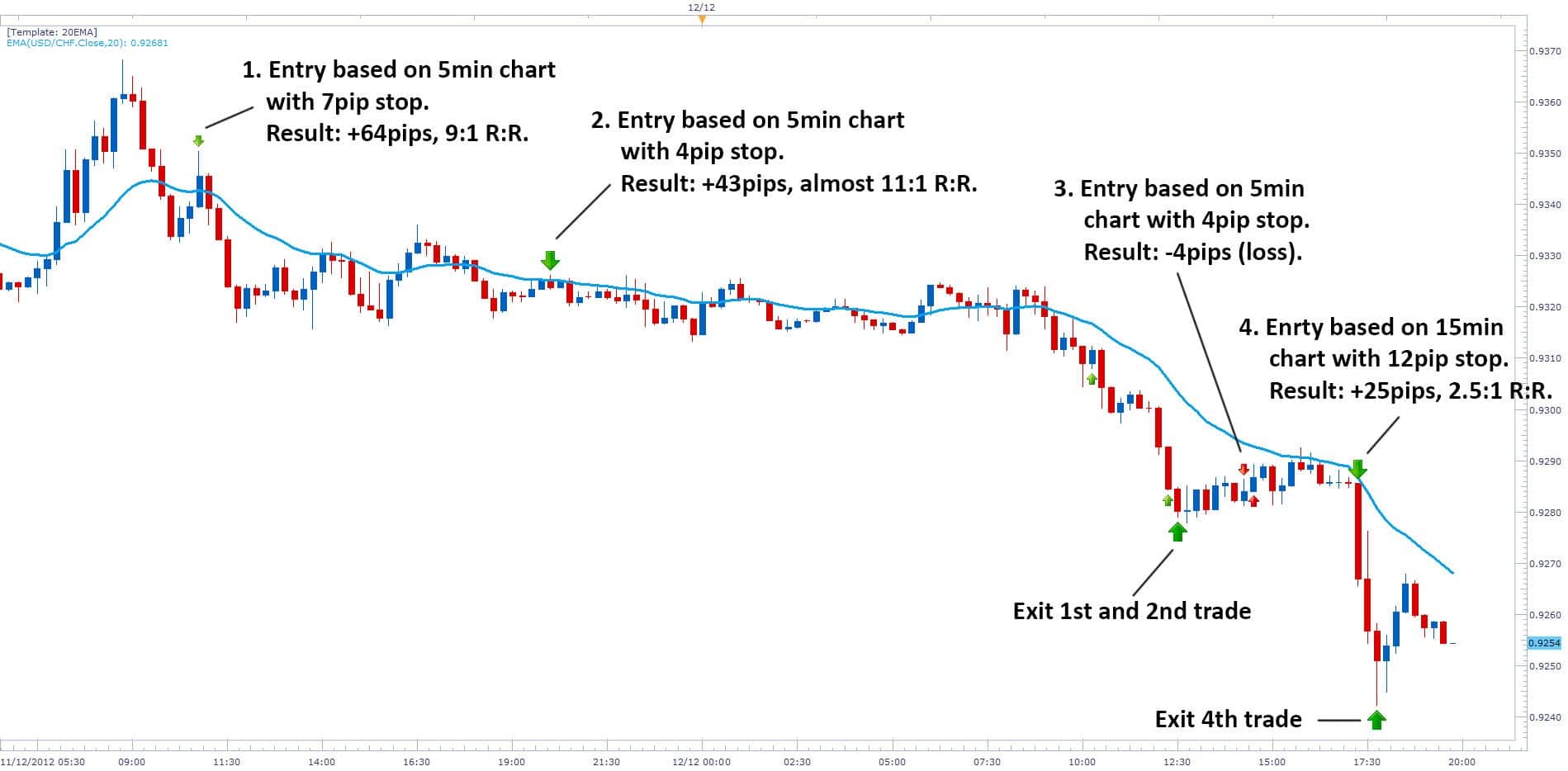
Now using the same chart from my student below, look at the 4th trade which is the last one on the day (chart below).
price action trading top student 2ndskiestrading.com usdchf
Notice how he was using my model of following the impulsive and corrective price action, looking to short with trend on a corrective pullback and trade with the institutional money.
His first attempt failed for a small 4pip loss, but his second attempt caught a really opportune moment to get in, and immediately after his entry, the sellers came in with force, bottoming out with a pin bar setup that he recognized as a likely bottom, along with a few other clues from my price action course.
He ended up banking +25 pips on a 12 pip stop for a 2x+ reward to risk play, all in 15 mins.
Notice how he controlled the risk exceptionally well with precision and confidence, almost like a sniper would taking out his targets.  For those with eyes, he had a clear entry and exit pattern, which is needed to have a high quality signal.
This was a high quality A+ setup that was obvious and was begging to be shorted.  You will also notice he had a good strike rate, hitting 3 out of 4 trades for 75% accuracy, all while trading < 1hr charts.
To do this he had to be patient and disciplined.  You don’t have to wait for days to find these trades, as they come daily.  You just need to learn how to spot these high quality intraday price action setups.
He was looking for easy opportunities, acted with complete confidence, swiftness, precision and without hesitation.
less is more trading with precision like a sniper 2ndskiestrading.com
He also avoided any risky situations, and used highly effective risk management, never risking too much per trade or more than necessary.  He never interfered with his trades as you can see on trade 2, he had to be patient for the trade to mature.  When it did, he took profit, but he never exited early.
And if you look at the 2nd and 4th trades, he was looking for the easy prey – the most obvious setups out there.
 
In Summary
As I stated in my prior article on quality vs. quantity – which is better for trading?, the ‘less is more‘ doesn’t apply mathematically and always hold up, as I’ve already demonstrated.  Unless your accuracy is significantly higher, your ‘less is more‘ theory is actually a lot less profit mathematically.
Food for thought.
Now it should be stated I am not saying you should trade intraday only, or abandon the 4hr and daily charts.  For those of you with full time jobs, families, and busy lives (many of you), I recommend trading the daily and 4hr strategies as these will be most suited to your situation and availability.
I always advocate finding what is most natural to you, your mindset and situation.  This will always be the most profitable strategy you could engage in.  For some that will be on the higher time frames and the ‘less is more‘ approach which has some advantages.
But for others, it will not be, as you have the skill set, mental aptitude, and availability to trade intraday. The key is to finding what would work best for you, and then learning that to the best of your abilities.
Just don’t fall prey to the ‘one size fits all‘ or ‘less is more‘ approach, because it may actually be ‘less’ for you.
To argue high quality forex trading setups only manifest on higher time frames is a sophomore understanding of trading price action, or trading as a whole.  They manifest on all time frames, you just have to learn how to see them.  That does not mean you should trade them all – just find a method of trading that fits you best.
Make sure though, you don’t fall for any one sided arguments saying quality is better than quantity, or vice versa, as the answer lies somewhere in between, and in reality – a balance of both!
Kind Regards,
Chris Capre