
3 Tips for Day Trading Options

With the options market exploding in terms of volume and trading activity, we’ve seen the increase of multiple option expiries per week. This has only increased the number of participants day trading options. Combining this with the fact that hedge funds, prop firms and institutions are actively day trading options, it should be no surprise ITD (intraday) volatility is offering up some very profitable trade setups.
In this article, I’m going to share with you 3 tips for day trading options. If you’re wanting to learn or expand your day trading skillset with options, make sure you pay attention to these 3 tips as they will help maximize your day trading edge.
Day Trading Tip #1: Trade ATM (at the money) options with the closest expiry
When you’re day trading options, we recommend starting off trading single legs, particularly buying calls or buying puts. However, what EXP (expiry) and moneyness (ATM, ITM, or OTM) matters.
Whether you’re trading a momentum, breakout or mean reversion strategy, we recommend trading ATM (at the money) options with the closest expiry. Why? In one word – gamma.
Gamma is the Greek variable that accelerates your delta. If you’re trading an ATM option, you’re likely around a .50 delta. If you buy a call with a .50 delta, and the stock goes up $1 in price, your option premium will increase by .50 deltas. But…the delta will also increase based on your gamma.
Since gamma is highest for ATM options with the closest EXP, you will increase your delta the most with ATM options.
Looking at the option chain below for TOS (Think or Swim), you can see the Feb 25th EXP for $AMZN, the ATM options have a gamma of .07. The next OTM option strike (210) has a gamma of .05, and the higher you go on the strikes (down the chain) the lower the gamma is.
Option Chain (TOS) for $AMZN
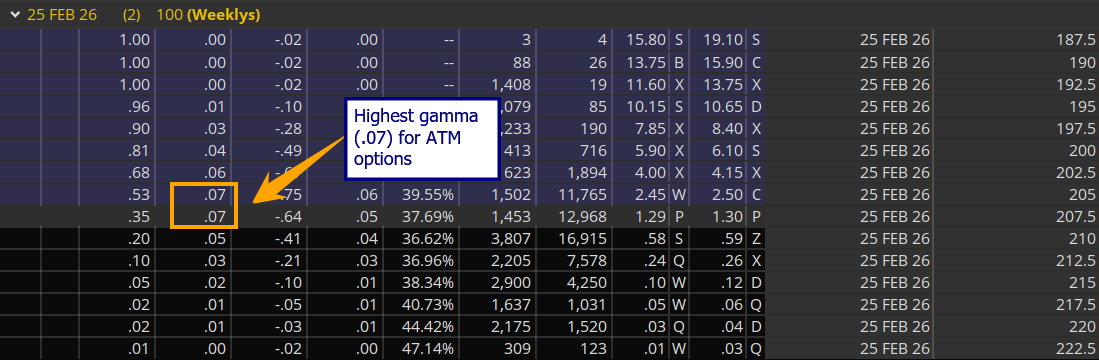
Remember, gamma accelerates your delta, so you’ll accelerate your delta profits by having a high gamma. And you’ll get a high gamma by trading the closest EXP and ATM options.
Day Trading Tip #2: Trade momentum, breakout or mean reversion strategies to start
Most day traders starting out try too much. They try to trade momentum strategies, along with breakout setups, along with mean reversion strategies. This becomes problematic for your brain because you’re building too many cognitive maps (1 for momentum, 1 for breakouts, and 1 for mean reversion) to start.
Instead, we recommend picking one of these strategies to get your feet wet, build confidence, and a really solid cognitive map for what works with that strategy. The price action patterns, order flow and option positioning will be markedly different for each of these strategies.
My recommendation is to start with mean reversion. It has the least volatility, gives you more time + opportunities to capture a setup, and is in many ways, a default expression of the markets.
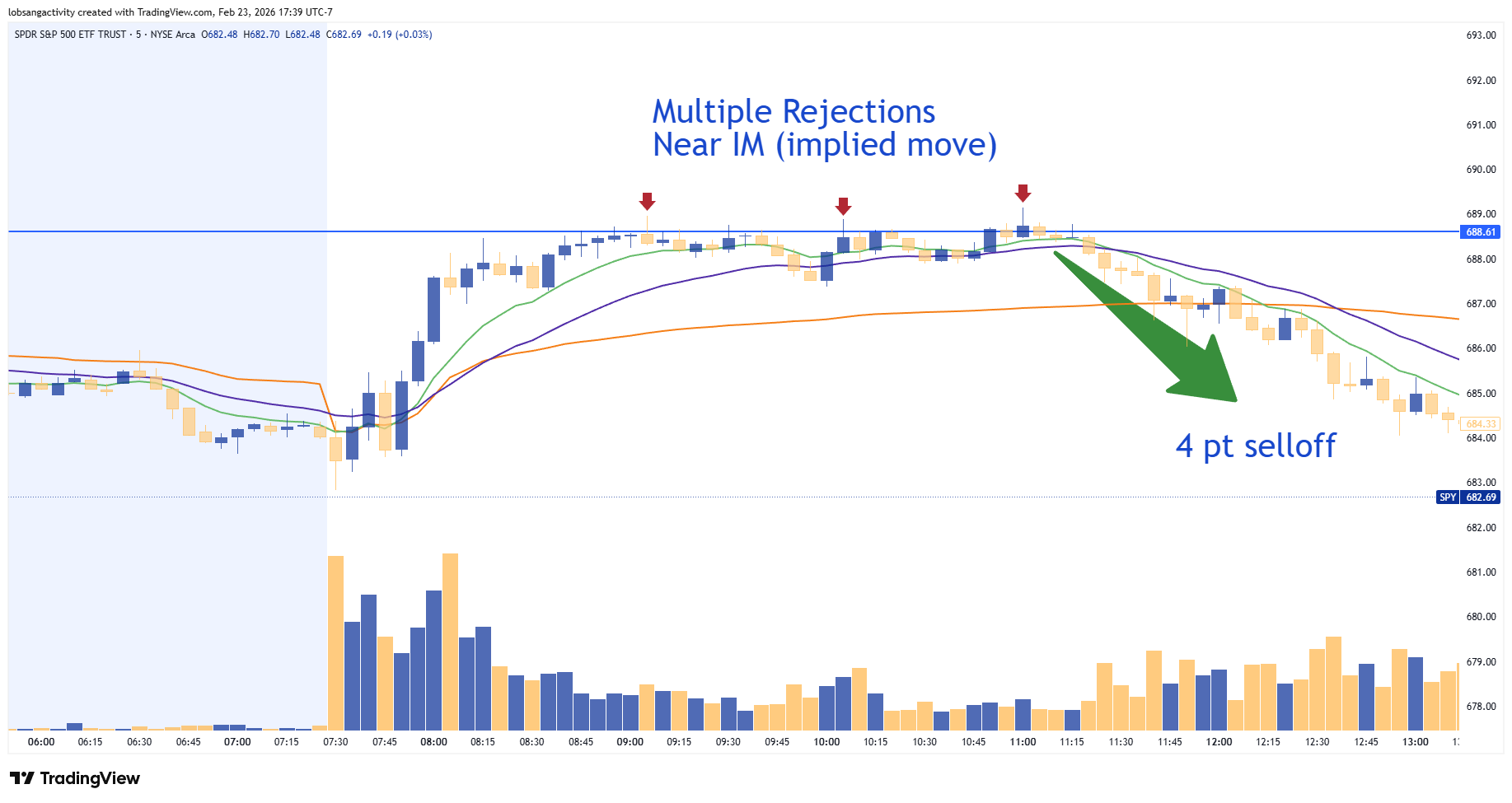
Try looking for mean reversion setups using PFP (positioning, flows and price action) around the IM (implied move for the day). If the conditions are right, you’ll find a lot of setups around these key levels.
Below is an example of one I called out live with my private mentoring student that reversed 4pts for a very profitable trade.
$SPY 5min chart mean reversion setup at implied move
Day Trading Tip #3: Know the BBP level for each ticker you trade
This is one of the most important day trading tips we can share. The BBP (bull/bear pivot level) is the level where the option positioning changes hands from calls to puts. Above the BBP, calls are in control. This is key if you want to be bullish on the day as you’ll want the option positioning and flows around your trade to be more bullish than bearish. Below the BBP, puts are in control. This is also key if you want to be bearish.
Looking at the chart below on $TSLA, you can see the pink lines on the left (puts) and blue lines on the right (calls). You’ll see TPS (top put strike) at $400. Below this though, you’ll see the pink lines (puts) are dominant and much bigger than calls.
$TSLA gamma chart BBP (bull/bear pivot level)
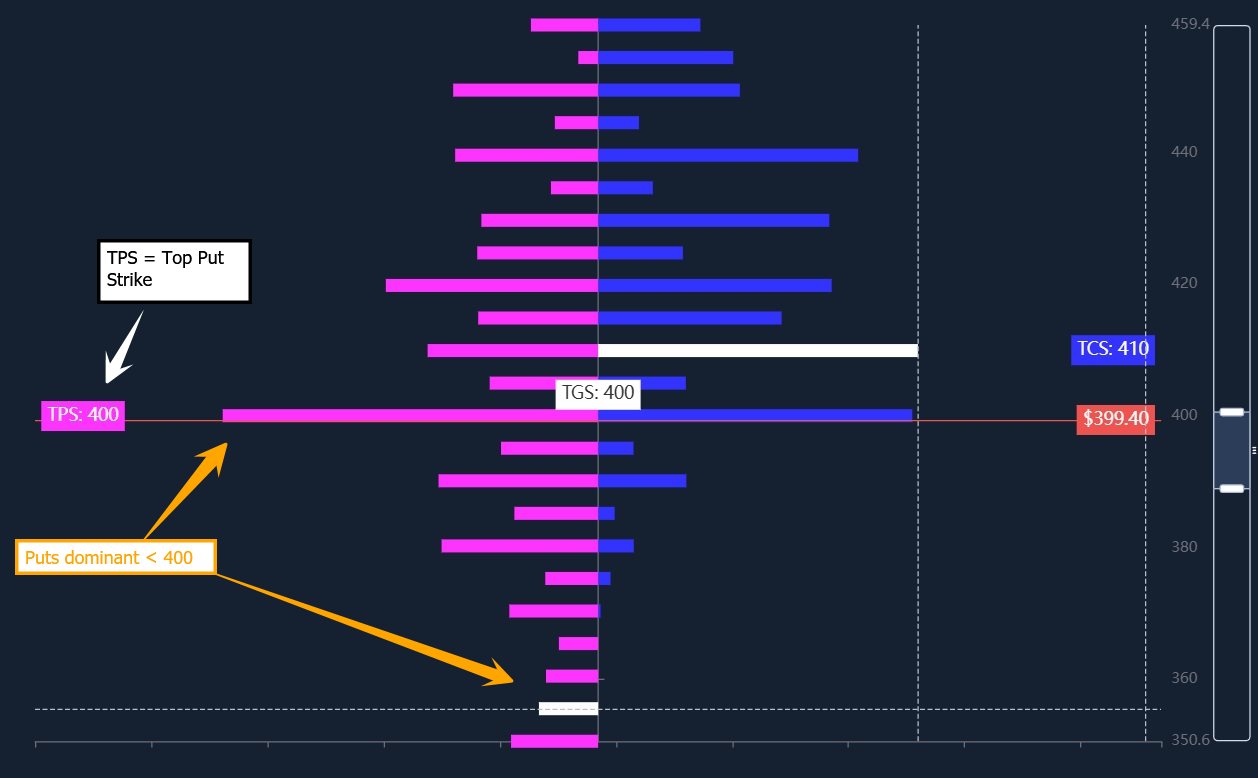
This means below $400 for $TSLA, puts will be in control. When puts are in control, it means a greater chance for volatility (both ways) to express itself as dealers will trade with the market, not against it.
Thus, you have to know at what price the BBP level is, as it will be critical for telling you who’s in control, and who’s not, along with where that control shifts.
In Closing
Day trading options can be quite profitable as you can multiply your edge several times a day while avoiding overnight risk. In a market where sentiment and narrative are changing frequently, sometimes avoiding overnight risk is a blessing, and day trading options allow you to avoid that risk.
Combining this with the fact 0 DTE (0 days to expiration) options are exploding in volume, while long term forward guidance is not set yet, being able to day trade, make money in a few hours, then leave for the day is appealing.
We’ve outlined 3 tips for day trading options here and will write another article soon with another 3 tips, so stay tuned. Until then, go out and practice these tips on demo, get some reps in, build your cognitive maps, and let me know how your day trading is going as I’m guessing we can improve your profitability.