
Tag Archive for: engulfing bars

What’s Inside?

A key topic that orbits around price action trading is “how do I trade with candlestick wick patterns in the forex market?” The problem with this question is it comes with some misunderstandings about price action, order flow and what wicks really communicate.

The goal of today’s article is to give you a new perspective on trading price action wicks that most ‘internet gurus‘ won’t tell you. It is to give you an understanding of candlesticks, what they communicate and how to relate and trade them.

Understanding Candlesticks

We’ll give you this understanding and how to trade with candlesticks through 4 key points on forex price action wicks.

But before we get into trading wicks, we have to understand the foundation of where our approach comes from.

Key Point #1: The Difference Between Price Action & Candlestick Trading

I approach trading from a particular perspective that a) order flow is the proximate driver of price action, and b) all activated orders in the market are based upon ‘information‘.

NOTE: If you want to learn more about how I trade price action context, click here.

But to simplify it, trading price action ‘context‘ is trading the overall ‘structures‘ or ‘Gestalt‘ of the market. And you cannot get this through 1, 2 or 3 candles.
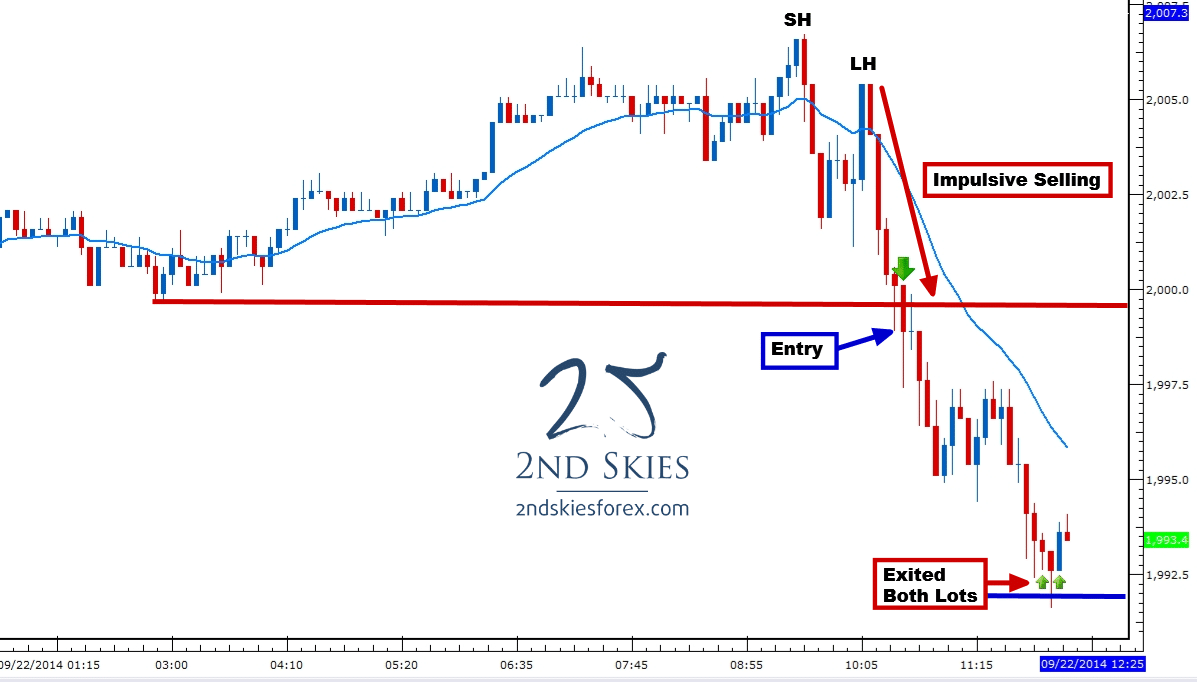
price action trading-sp500-sep-22-2ndskiesforex

People who trade based upon 1, 2 or 3 candlestick patterns, such as pin bars, or fakey’s, or engulfing bars are candlestick traders.

Fun Fact: The fakey pattern or setup, is really called the Hikkake pattern, given that name decades ago, which today many forex ‘gurus’ have renamed to make them sound like their own.

Regardless, candlestick pattern traders are not ‘price action traders‘. They are ‘candlestick traders’. Essentially, candlestick pattern traders believe 1, 2 or 3 candlesticks define the price action context and order flow in the market, and thus give you trade setups.

But ask yourself, why do many key support or resistance levels hold without a pin bar rejection. Why would it do that if the pin bar is such a superior tool for recognizing and ‘confirming‘ whether the key support or resistance level will hold? Why do banks, hedge funds, and prop traders place orders at particular prices well before a pin bar has ever formed, and not based upon the New York close daily charts?

NOTE: If you want to learn why a typical pin bar entry is a retail entry, click here.

When you start to ask these questions, the foundation for trading pin bars and candlestick patterns breaks down. That leaves you with trying to understand the underlying order flow in the market. And you do this by learning to read and trade price action context.

This is how we approach the market.

Now that we have this foundation, we can move on to how do we relate to forex price action wicks (or any wicks)?

Key Point #2: All Wicks Are Rejections of Value

When you look at the essence of what a wick represents in terms of the price action and order flow, you come to the conclusion that all wicks are a communication. They communicate that the order flow was rejecting that pricing and value.

rejection

If the market accepted it, it would close there, and remain there.

However, there is a ‘but’ in there. The ‘but’ is while wicks in the forex market = a rejection of value, they are not for defined periods of time or defined moves in pips.

What I mean by ‘not for defined periods of time‘ is a) beyond the close of their candle, and b) they are not going to define how long the market will reject that move or value from that moment forward.

What does give you this information? Price action context.

The goal of price action context is to give you a ‘probabilistic framework‘ for what the market is more likely to do. Wicks will not give you this information, nor give you a probabilistic framework for how to trade this.

Hence you have to come back to price action context.
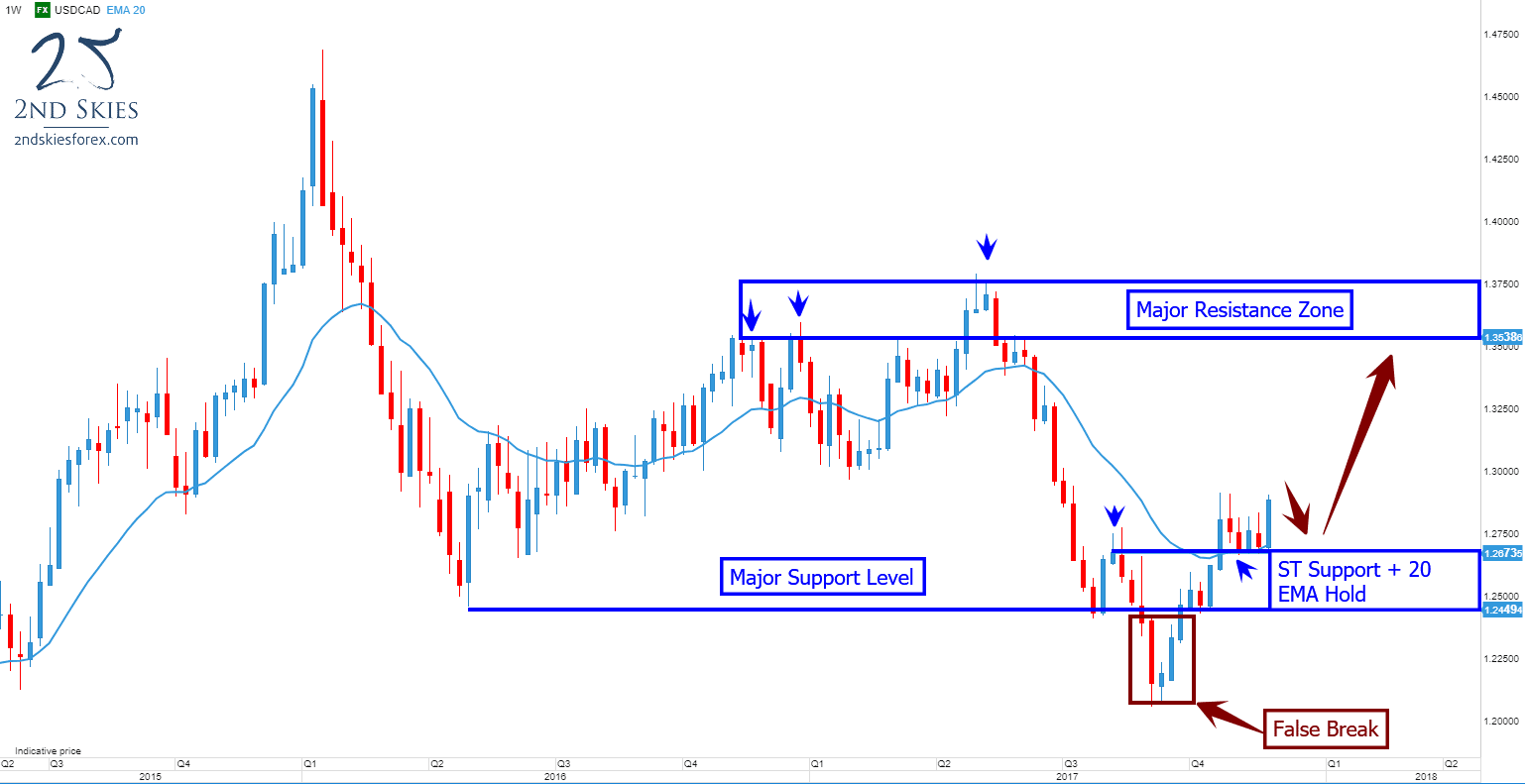
price action context 2ndskiesforex

The most essential point to understand here is forex price action wicks (or any wicks) = a rejection, but we cannot understand how that rejection will manifest, so we have to take these as a grain of salt.

What this also means is that 1, 2 or 3 candlestick wicks will not ‘confirm’ a rejection of a specific kind (which is what we want if we’re going to trade said ‘confirmation’ or rejection).

If you want to understand why confirmation price action signals will crush your account, click here.

Key Point #3: Opening And Closing Of Candlesticks Do (And Do Not Matter)

Wait a minute, how can the opening and closing of candlesticks ‘matter’ and ‘not matter’? Let me explain.

In very ‘particular’ circumstances, the opening and closing of candlesticks will matter. Such as:

  1. if you are trading some sort of ‘opening’ gap strategy
  2. if you are trading specific types of breakouts
  3. if you are trading specific candlestick patterns
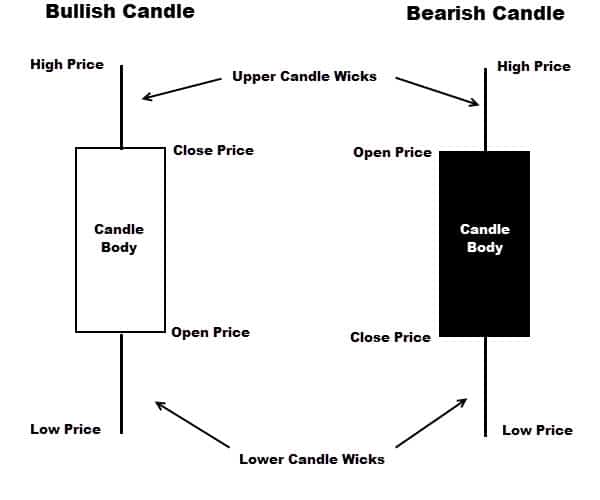
candlstick wicks rejection 2ndskiesforex

There could be a few more circumstances, but by and large, the majority of time, the opening and closing of candlesticks do not matter.

What matters more is order flow and price. This is why most institutions, hedge funds, and prop firms know their price ahead of time, regardless of the close. They know where they want to get in, and where they want to get out, regardless of the candle being open or closed.

Hence the opening and closing of candlesticks matter, but on a limited scale.

Key Point #4: How Do You Trade Forex Price Action Wicks?

There are many ways I relate to forex price action wicks (or any wicks) in my trading, but I’ll give you a couple wick trading strategies below.

Trading Strategy For Wicks #1: With Trend Wicks Will Be More Reliable (or ‘probable’) Trading With Trend vs Counter Trend

If a wick represents on a base level some sort of ‘rejection’, which side is most likely to ‘reject’ the price or value? The with trend players, or counter trend players?

With trend is the answer. With trend players are more often controlling the market and order flow, so they’re more likely to reject a price effectively cause they’re largely in control.

I personally like seeing with trend rejections on pullbacks heading into a level because they are showing a more ‘probabilistic framework’ of order flow in the market.

Below is an example of a good chart showing this on the USDCAD 4hr chart.
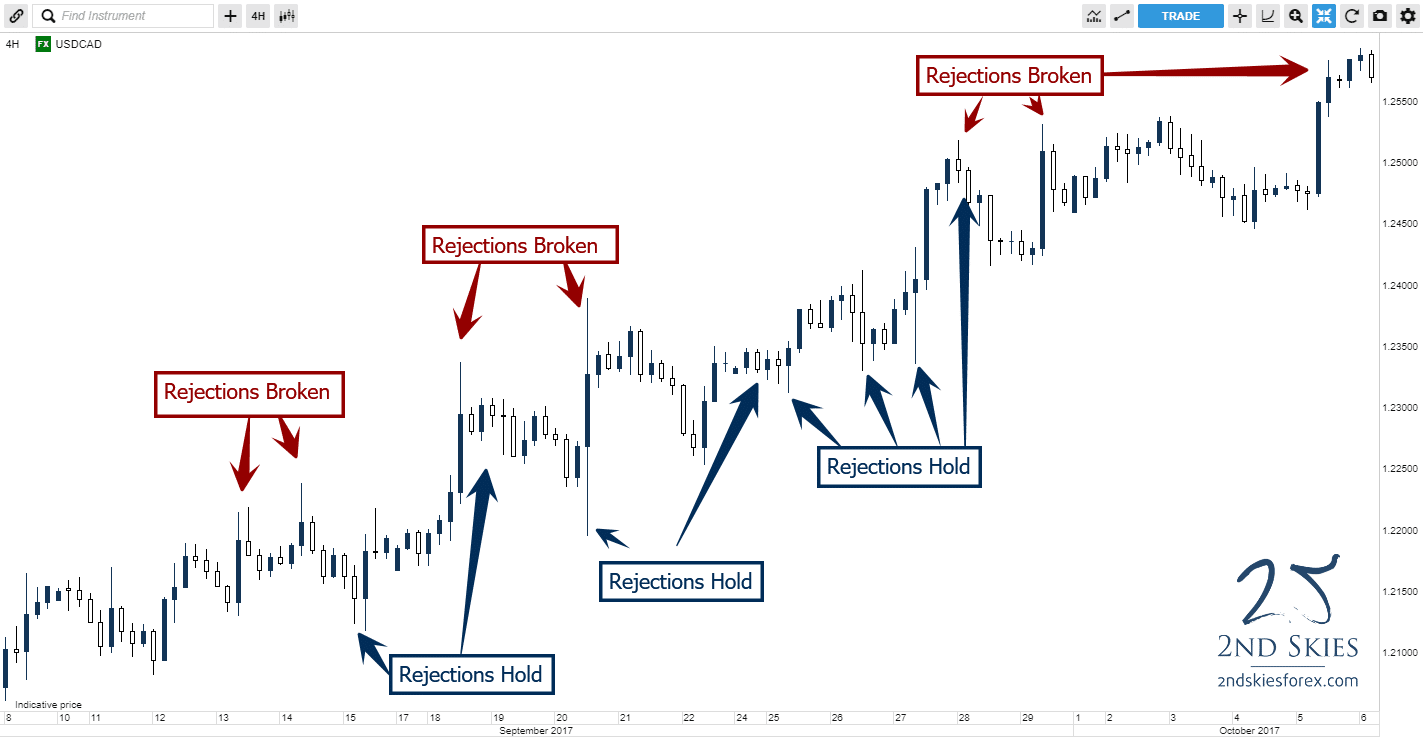
forex price action wicks holding with trend 2ndskiesforex

Notice how the majority of the wicks and rejections with trend hold, while the counter-trend rejections fail?

Below is another good example of a chart on the 4hr USDJPY chart.
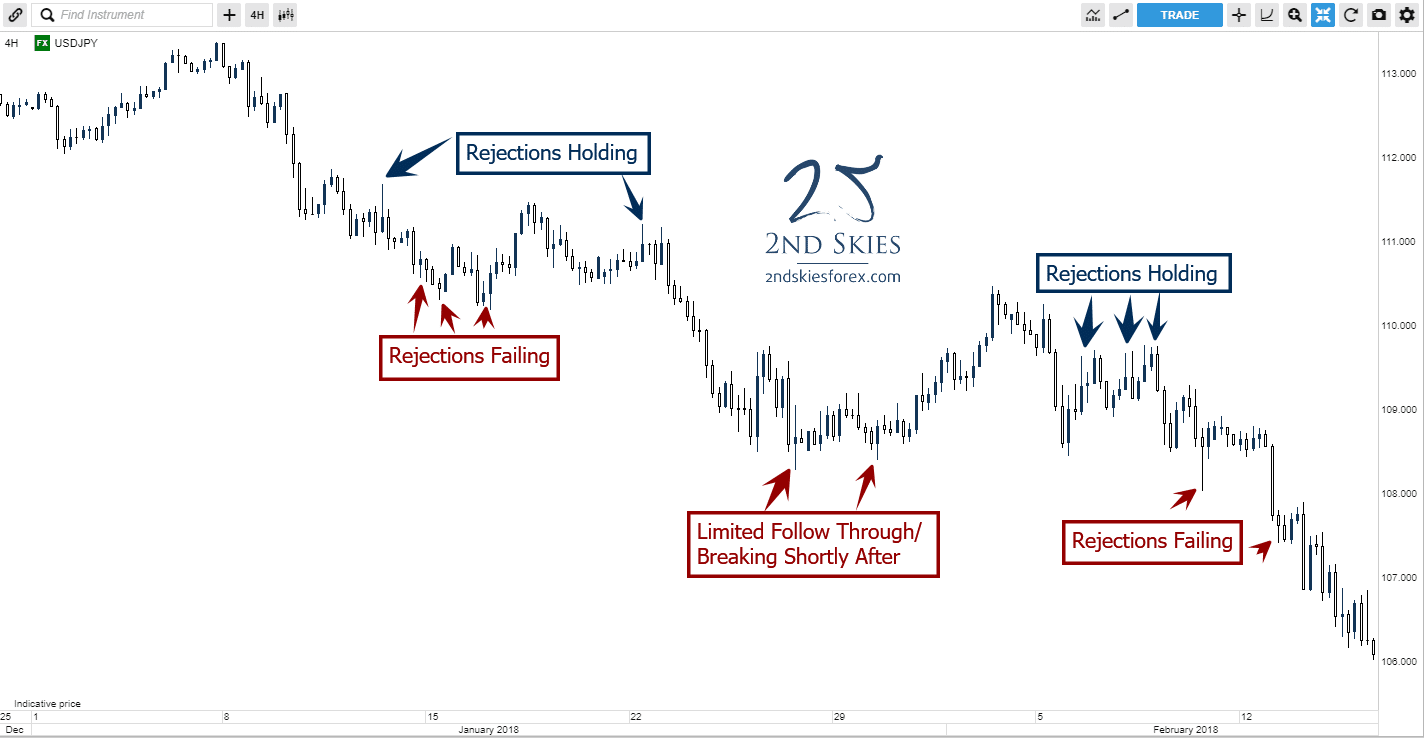
forex price action wicks holding with trend v2 2ndskiesforex

Hence when trading, if you are trading with trend, wicks rejecting price in your favor make your trade more ‘probable’, while trading counter trend are less ‘probable’.

If you wan to learn more about trading with a probabilistic mindset, click here.

Trading Strategy For Wicks #2: Clean Wick Rejections Off Key Support or Resistance Levels Are Best

What do you mean by a ‘clean’ rejection or wick off of a key support or resistance level?

While I relate to support and resistance as ‘zones‘ of order flow, sometimes they line up super well to where you can clearly see price is rejecting off a very specific price and value.

Case in point, take a look at the USDCAD 4hr chart from mid-October last year to mid-Jan this year (~3 mos).

super clean rejections wicks off of resistance 2ndskiesforex

You can see in the chart above, the price action rejected off of the key resistance level near 1.2913 six times in a 3 month period with almost every rejection happening within a few pips of each other, and the biggest break being only 7 pips.

When price rejects very ‘cleanly‘ off of a key support or resistance level, they become more ‘probable‘ of a legitimate rejection.

Not all charts and key levels will look like this, but they do often in many price action structures, and can be good for building your ‘probabilistic framework‘ for understanding price action context and the order flow behind it.

You can see another example of this below with the USDJPY daily chart.
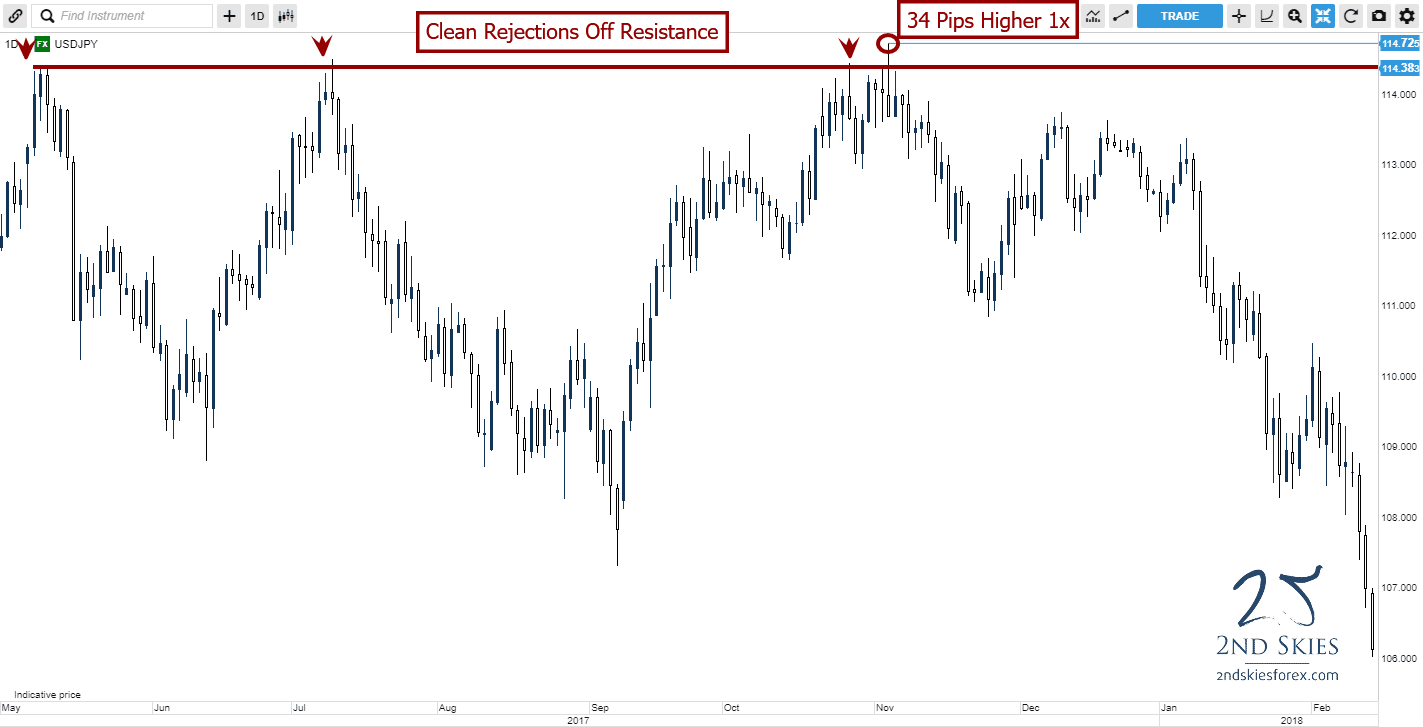
clean rejections wicks off of resistance 2ndskiesforex

Notice how 3 of the 4 rejections were almost at the same price with only one breaking by a small amount?

There are many other ways to understand wicks and rejections in the price action, but these are two good methods to work with that I use personally and trade profitably with my own money.

In Summary

Forex price action trading wicks (or wicks in any market) are important to understand, particularly from the perspective of order flow and price action context. Wicks ‘communicate‘ at a base level ‘rejection‘, but they do not by nature determine any rejection to follow through.

However there are ways you can use wicks in your trading price action, particularly the two methods I mentioned:

  1. with trend wicks add to your ‘probabilistic framework’ better than counter trend wicks
  2. clean wick rejections off of key support and resistance levels also add to your ‘probabilistic framework’ for trading

Now Your Turn

What did you learn from this free trading article? Do you feel you understand candlestick trading wicks, rejections and how they work in forex applications?

Make sure to leave your comment below, along with share this via Twitter or Facebook with those you think can benefit from this.
Key Talking Points:

  • False Breaks Offer Great Price Action Trading Setups
  • You Can Trade the False Break Strategy with Pin Bars and Engulfing Bars
  • Look for False Break Setups Trading With the Trend

Ever tried to enter on a forex false breakout breakout setup, only to have the trade immediately reverse on you? I’m guessing this has happened to you many times (present trader included).
With the market volatility declining over the last several years, false breaks can and will happen all the time. The key to avoid getting stopped out, and actually profit from these false break setups, is to understand the price action context which often precedes them.
In this two part article series, I will begin today’s discussion by defining a false break. Next, I’ll go over a common false break setup, which is trading the false break with trend. Then I will go over a fundamental false breakout strategy, and conclude by recapping the key points.
What is A False Break?
I would prefer to define a false break as one of the following two scenarios: 

  1. A break above/below a prior candle that fails to close above/below that candle
  2. A break above/below a key level, quickly reversing that level, and sparking a counter-trend move

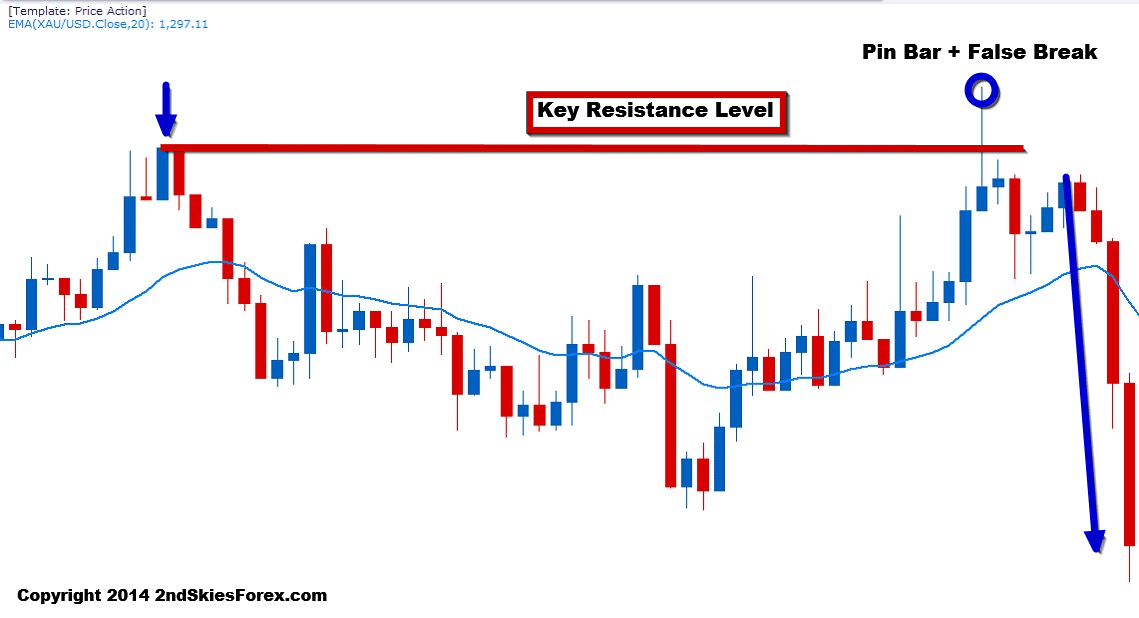
Below is an example of the first type with a pin bar + false break:
trading the false break strategy 2ndskiesforex c1
In the chart above, you can see the arrow to the top left, showing a bullish move running into resistance. The pair then settles back, and makes a second attempt to take out this key level.
But on the top right, you can see it forms a pin bar + false break.
From an Order Flow Perspective
Looking at this from an order flow perspective, the bulls were in control leading up to the level, and were able to push past it. Either there was massive profit taking on their part, or they ran into heavy sellers a few layers deep behind the level.
Regardless, the sellers over-whelmed the buyers, and pushed the pair back below the key resistance level. After a second attempt to regain the level, the sellers realizing they had control, sold even more, pushing the pair down impulsively.
Trapping Traders
In most false breaks, there are ‘trapped traders‘, meaning traders who are caught long when the pair is about to go short, or vice versa. Those trapped traders once the trade goes negative, will likely be stopped out, & further fuel the counter-trend move.
The more savvy traders will exit manually when they realize they are trapped, while the slower traders will likely get hit for the full stop. There are price action clues to tell when you’ve been trapped, but that is for another article.
Trading The False Break Setup With Trend
It should not be surprising, one of the best false break setups occur when trading with the trend. This is because the underlying order flow is heavily imbalanced, meaning it’s heavily bullish or bearish.
When a false break setup forms counter-trend, it usually runs into buyers or sellers who are happy to take the pullback getting a better price. Their overall strength in the market makes it harder for counter-trend false breaks to be maintained.
This is why false breaks present such great trade opportunities.
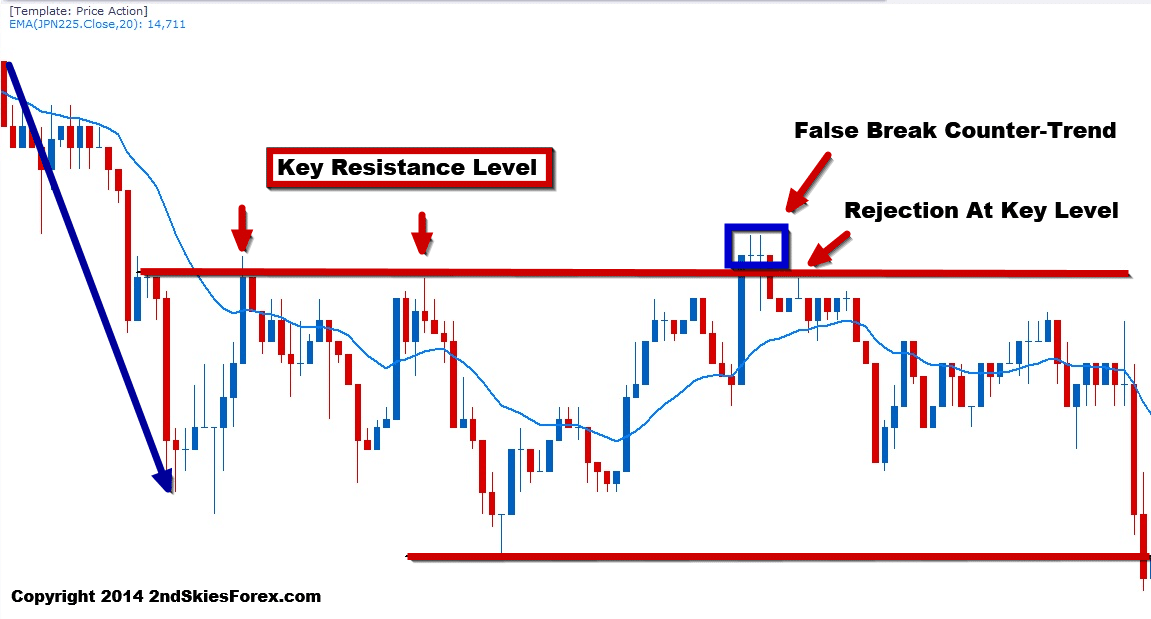
Below is a classic example of trading the false break setup with trend:
trading the false break strategy 2ndskiesforex c3
In the chart above, starting with the top left, we can see the heavy impulsive selling. Eventually this leads to a bounce which hits the key resistance level 2x (marked by two red arrows). After forming a new low (red line at bottom), the pair bounces to retest the bears at the same resistance level.
Now note how the pair breaks above this level with a really large blue bar, closing at the highs. Ask yourself, if the bulls were really in control, how come they did not produce any follow through?
The next two doji candles showed no real strength or follow up buying, which should have been a warning sign to any bulls already long. Bears wanting to trade with trend, should have been looking for the false break and close below which they got on the 3rd candle.
Entry, Stop & Take Profit
With such a clearly defined trend and resistance level, there are two general entry techniques;

  1. Sell on Break back below the key level
  2. Wait for pullback setup to the key level

More aggressive traders who feel confident in their price action skills may sell on the break back below the key level. This may or may not offer the best price, but you may not get a second chance to enter if the sellers came in hard on the false break.
More conservative traders can wait for a pullback setup to the key level. If the false break is real along with the level, then the trade should hold and not go much into the negative.
I generally recommend placing the stop above the high (or below the low) of the false break by a few pips, depending upon the volatility and liquidity of the instrument.
The first target should be the other end of the consolidation. If you want to go for multiple targets, then the next key support or resistance level would be suggested.
To Recap
In today’s forex false breakout article, I talked about the price action and order flow behind a false break setup, and why it can be a powerful trade opportunity. I discussed the two types of false breaks and how to generally define one.
Lastly, I covered why to look for with trend setups trading the false break, giving the entry, stop and take profit methods.
When you learn to read price action in real time, you will begin to spot these false break setups more easily. As you get skilled in identifying them, you will avoid the common traps, and profit heavily from them as they offer great opportunities.
In the second part of this article, I will talk about using a false breakout strategy with pin bars and engulfing bars.

There seems to be some fascination with newer/beginning traders to find this perfect setup, this small set of circumstances that give price action the appearance of a great trade opportunity. You’ve probably heard about these patterns and setups before, often referred to as Pin Bars, Engulfing Bars, Inside Bars, etc.

Beginning traders become hypnotized, thinking these price action patterns are all you need learn to trade the market, as if trading were a fashion contest, and your goal is to find the best dressed setup.

The problem is, this is a really confined view as these patterns are more often the result of order flow – not the cause of it.
 
A Means, Not the Reason
These price action setups discussed above, are a means to get into the market, not the reason why you should be. And it’s often the case, they are the secondary reason why you should be entering the market.
The reason why you should be getting into the market, is because your understanding of the price action & order flow in the overall market, gives you an over-weighted picture as to a clear direction in the market.

This direction could be for 20 minutes, hours, or even days.  The amount of time it will likely maintain that direction is not important.  That the price action gives you an over-weighted picture of the direction IS!

And when this happens, there is a trade opportunity.  If that opportunity offers you a good mathematical reward/risk play, then you should be trading it – not because of some picture perfect setup.

trading is not a beauty contest 2ndskiestrading.com jan 21st

 
Trading is Not A Fashion Contest
How many times have you seen a picture perfect setup that completely failed?  I’m willing to bet dozens of times, and if you trade long enough, hundreds or thousands of times.
Why is that?
Because trading is not a fashion contest where you are looking for the best dressed setup.  Because price action setups can and will fail, which should communicate to you – not to become fascinated with finding the perfect price action setup.
What it should mean, is you want to develop your ability to read the overall picture of the market, understand the order flow behind it, learn to read the impulsive and corrective price action.  Then, look for an over-weighted scenario.  Once you find it, check the math to see if it’s favorable.  If so, then take the trade.
 
Missing High Quality Signals
If you are always on the hunt for the perfect setup or trade, you will likely be completely missing high quality signals passing by right in front of you.
The greatest mistake of higher time frame traders is they often do not take great trades that are right in front of them, because they are waiting for the ‘perfect‘ setup – one that will hit them over the head.
The problem is in passing up these trades, they are also passing up high quality signals that offer a mathematical edge and profits.

missing good trade opportunities

Ironically, the greatest fallacy of intraday traders is they will often take trades that are not there, or not of high quality.  Although it may seem like the former is better than the latter, both are the same!
The higher time frame trader makes a lot less profit because they pass up really high quality signals, looking for their perfect match.
Meanwhile, the intraday trader while often having more profits, generally has slightly more losses, because they are taking trades that are not there.  Their upside is higher for executing their edge more, but the extra losses pull them back.
Thus, when you really see this clearly, these are two sides of the same coin!  The trick is to find the balance and wisdom of the two, not to stay on one side of it.  This is the knot of trading you have to untie.
 
A Fantasy World
Spending your time looking for the perfect setup is living in a fantasy world.  It’s like looking for the perfect partner – how many people have you really met that have one? How many people have you met thought they found one, & were completely wrong? Food for thought – but trading is not a fashion contest, and it’s not about looking for the perfect setup.
 
Same Setup – Different Result
There are many times several of my price action traders spot the same exact setup, yet end up with completely different results.
How could that be?

same setup different results 2ndskiestrading.com

Because they managed the trade differently. One took profits a little early (but still ended up profitable), while the other caught a huge portion of the move.
Although it may seem like this one trade may not mean much – it means a lot if its repeated.
When trader A encounters a series of losses (and you will, regardless of your strategy), their downside will be more severe and they will take more time to recover.  However when trader B encounters the same downside period, their recovering will be faster, because they padded on more alpha to their trading account.  For them, it only takes a few large wins to erase a lot of losses.
Keep in mind, they both spotted the ‘perfect price action setup‘, yet they both had different levels of profits.
What was the difference?  In how they managed the trade.
This should be communicating to you, what is far more important than finding the ‘perfect’ price action setup, is learning how to manage the trade.  And this really comes down to three things;
1) Understanding Risk Management
2) Learning to Read Price Action In Real Time
3) Managing Your Emotions/Mental State
bells ringing in your head 2ndskiestrading.com
Perhaps you can find the perfect setup, but fail to do the three above, & your perfect setup is powerless to deliver consistent profits.  Bells should be going off in your head now about what you should be spending your time studying.  It’s not how to spot a pin bar, or engulfing bar, or some other magical bar.  It’s about setups, price action and context.
These pin bars, engulfing bars, or any bars are easy to find, and take little mental effort.  The learning process for this should be short.
But the learning process for the three things I listed above prior, should be never-ending.
I understand why many of you have made this mistake.  There are these so called ‘authorities‘ and ‘masters‘ (notice self-labeled as no peer will call them that), who claim you only need 3 of these ‘setups’ to understand the market.  That these great setups only occur on higher time frames, that intraday price action trading is to be loathed, that accuracy and profitability has a linear relationship with time frames.
Ah yes, and don’t forget the three golden setups – how convenient!  As if a market with over a million participants, composed of retail & institutional traders, hedge funds, banks/brokers, pension funds, HFTs, intraday traders, swing traders, long term position traders, etc. are all subdued by these overlords of price action patterns.
High quality signals occur on every time frame, and there are profitable traders across the world trading on almost every time frame.  Intraday price action trading is not to be loathed – that is just a personal feeling of some, while a ATM machine for others.
Who is right?  Neither – thus don’t hate intraday trading because it doesn’t work for you. The greatest mistake a trader can do, is to think their world and thoughts about reality – ARE REALITY!  As if your wisdom and insight is so brilliant, so total, so complete, that it has a monopoly on the truth about trading.
Does that sound reasonable to you?  Or does it seem more likely there are many ways to trade successfully, and the best way is what’s comfortable for you.
Just remember, what may be comfortable for you, may not be for another, and neither one individually is reality by itself.

obi wan kenobi 2ndskiestrading.com

Heed the wisdom of Obi-Wan Kenobi who once said, ‘Only a Sith sees in absolutes‘. Don’t be the Sith in trading, or follow a Sith.
Find wisdom in things, then find what is most comfortable for you, while constantly challenging yourself to take things to the next level.  Rarely ever where you start this journey (both in trading and in life) is where you end up.  Thus remember, trading is not a fashion contest, but it is about managing risk, your mental state, and learning how to read and trade price action in real time.
 

This lesson is focused on one of the least discussed topics in trading – price action. In this forex price action training video we teach you how to identify a critical component of price action – Impulsive vs. Corrective moves.