Tag Archive for: false break setups

What You’ll Learn In This Article:

-Trading in the summer
-What are two unique factors affecting trading this summer
-What preferred strategies and instruments I’m watching this summer

As traders, our job is to constantly adapt to an ever changing environment of price action, liquidity and volatility. Trading markets in the summer often experience a decrease in volatility and liquidity whereby many professional traders go on vacation, spend time with their kids, thus affecting market liquidity and volatility.

summer trading forex 2ndskiesforex

In today’s trading article, I’m going to talk about how this summer is different for two reasons you need to understand, along with how you can profit during the summer months, adjust your trading strategies, and maximize your time + profitability behind the charts.

How Trading This Summer Is Different (Trading Insight #1)

This summer has an additional element contributing to the typical summer trading conditions.

It has the World Cup, which is only hosted every 4 years. Because of this, and being such an international event, there is extra impetus for traders to be less active and order flows to change drastically as 3-4 billion people globally are watching the games (myself included :-).

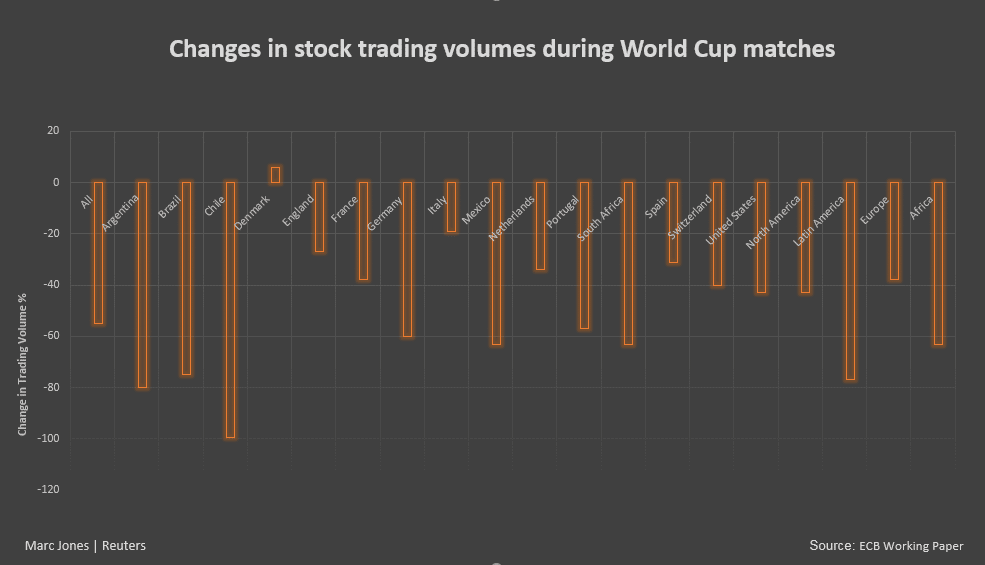
When there is a World Cup, the stats are very clear. In a research paper by Ehrmann & Jansen, during the 2014 World Cup, when a country played during normal trading hours, volumes dropped by as much as 48% in that country’s stock market. On top of it, prices tended to ‘decouple‘ from what’s happening in the global markets.

Below is a good image to show how volumes during the world cup drop (source: reuters).
market volatility during summer and world cup trading

Hence, when your team is playing, local stock market volumes will drop.

On top of it, when your country (or your opponent) scores a goal in your game, the number of trades goes down by 10% and will often take 30-60 mins after the game before trading volumes resume to their pre-game levels.

In this year, more than 2/3’s of the games will be during European or New York trading hours. So expect forex, stocks, futures and bond markets in both Europe and the US to be subdued (less in the US since their team didn’t make it).

And another interesting fact – your country getting knocked out of the World Cup can knock off almost 50 bps from your national index that day, while your country winning the World Cup translates into your country’s index outperforming the global benchmark by 3.5% on average, so some potential trading opportunities on both sides there.

How Trading This Summer Is Different (Trading Insight #2)

Unlike many previous summers, trading has taken on a different tone because of the events happening globally. A trade war between China & the US has spooked global markets (i.e. risk off), and the emerging market space (EM) has been quite volatile while the DM space (developed markets) has been much more muted.

You’ll notice in our members daily trade ideas, we’ve often been holding positions or doing our price action analysis moreso outside the majors simply due to DM volatility being low while EM volatility has been high.

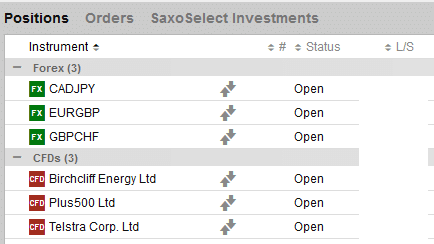
Below you can see my active open positions with none of them being a major.
chris capre's current open trades

Hence I’ve been taking advantage of the increased volatility in the EM markets & crosses to capture these large moves and changes in the price action.

With that being said, how can you use this information to help adjust your trading strategies?

Summer Trading Tip #1

With decreased liquidity as a whole, markets tend to move less. Hence you have to expect trades to take more time to play out. 

Thus try to be a little more patient with your trading hold times as they may simply take more time to get to your target.

Summer Trading Tip #2

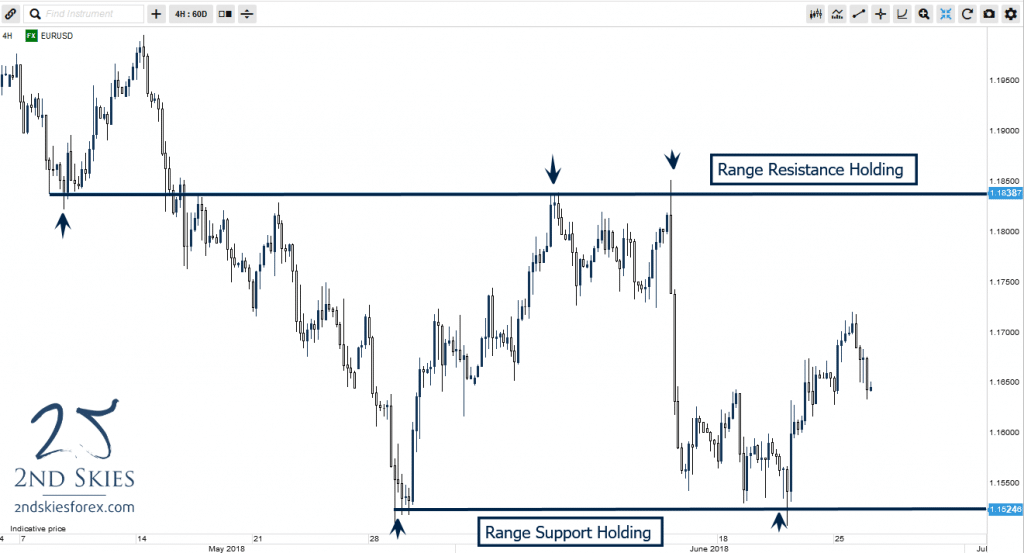
Along with tip #1, expect ranges to hold more, and trading breakouts to work out less during these periods.
range price action 2ndskiesforex

When ranges hold, and liquidity is less, I avoid trading breakouts because many will fail.

Instead, I often look for false breaks which become more common during lower liquidity times, so make sure you’re watching for potential false break setups.

NOTE: If you want to learn more about false break setups, watch my video of me doing a live false break trade for +350 pips of profit.

Summer Trading Tip #3

Try expanding some of your instruments to move beyond the forex majors, like looking at the exotics and EM currencies. Some of EM forex pairs I’m watching right now are: EURNOK, USDSEK, USDTRY, USDZAR, USDMXN, USDRUB, and USDPLN.

As for the DM forex pairs, I’m currently most interested in: CAD, AUD, JPY, CHF and NZD pairs (note: 3/5 are commodity currencies).

In terms of the global markets, I’m heavily watching Russian stocks, UST’s (US Treasuries), commodities (gold, Oil), and EM bonds.

If you’d like to learn more about what live trades I’m in at any time, make sure to check in with our members daily trade ideas for updates.

And if you’d like to learn about another summer trading tip, check out another article I did on trading forex in the summer.

Now Your Turn

Did you learn something about trading in the summer? Have new options for finding high quality trading opportunities?

And the toughest question of them all – who do you think is going to win the World Cup?
Key Talking Points:

  • False Breaks Offer Great Price Action Trading Setups
  • You Can Trade the False Break Strategy with Pin Bars and Engulfing Bars
  • Look for False Break Setups Trading With the Trend

Ever tried to enter on a forex false breakout breakout setup, only to have the trade immediately reverse on you? I’m guessing this has happened to you many times (present trader included).
With the market volatility declining over the last several years, false breaks can and will happen all the time. The key to avoid getting stopped out, and actually profit from these false break setups, is to understand the price action context which often precedes them.
In this two part article series, I will begin today’s discussion by defining a false break. Next, I’ll go over a common false break setup, which is trading the false break with trend. Then I will go over a fundamental false breakout strategy, and conclude by recapping the key points.
What is A False Break?
I would prefer to define a false break as one of the following two scenarios: 

  1. A break above/below a prior candle that fails to close above/below that candle
  2. A break above/below a key level, quickly reversing that level, and sparking a counter-trend move

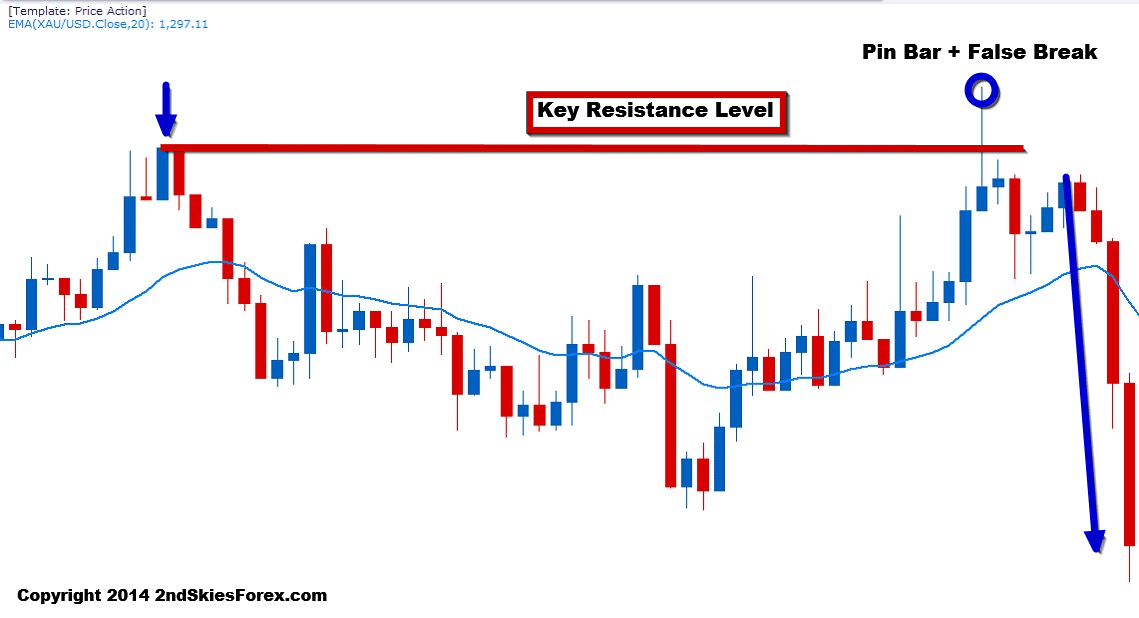
Below is an example of the first type with a pin bar + false break:
trading the false break strategy 2ndskiesforex c1
In the chart above, you can see the arrow to the top left, showing a bullish move running into resistance. The pair then settles back, and makes a second attempt to take out this key level.
But on the top right, you can see it forms a pin bar + false break.
From an Order Flow Perspective
Looking at this from an order flow perspective, the bulls were in control leading up to the level, and were able to push past it. Either there was massive profit taking on their part, or they ran into heavy sellers a few layers deep behind the level.
Regardless, the sellers over-whelmed the buyers, and pushed the pair back below the key resistance level. After a second attempt to regain the level, the sellers realizing they had control, sold even more, pushing the pair down impulsively.
Trapping Traders
In most false breaks, there are ‘trapped traders‘, meaning traders who are caught long when the pair is about to go short, or vice versa. Those trapped traders once the trade goes negative, will likely be stopped out, & further fuel the counter-trend move.
The more savvy traders will exit manually when they realize they are trapped, while the slower traders will likely get hit for the full stop. There are price action clues to tell when you’ve been trapped, but that is for another article.
Trading The False Break Setup With Trend
It should not be surprising, one of the best false break setups occur when trading with the trend. This is because the underlying order flow is heavily imbalanced, meaning it’s heavily bullish or bearish.
When a false break setup forms counter-trend, it usually runs into buyers or sellers who are happy to take the pullback getting a better price. Their overall strength in the market makes it harder for counter-trend false breaks to be maintained.
This is why false breaks present such great trade opportunities.
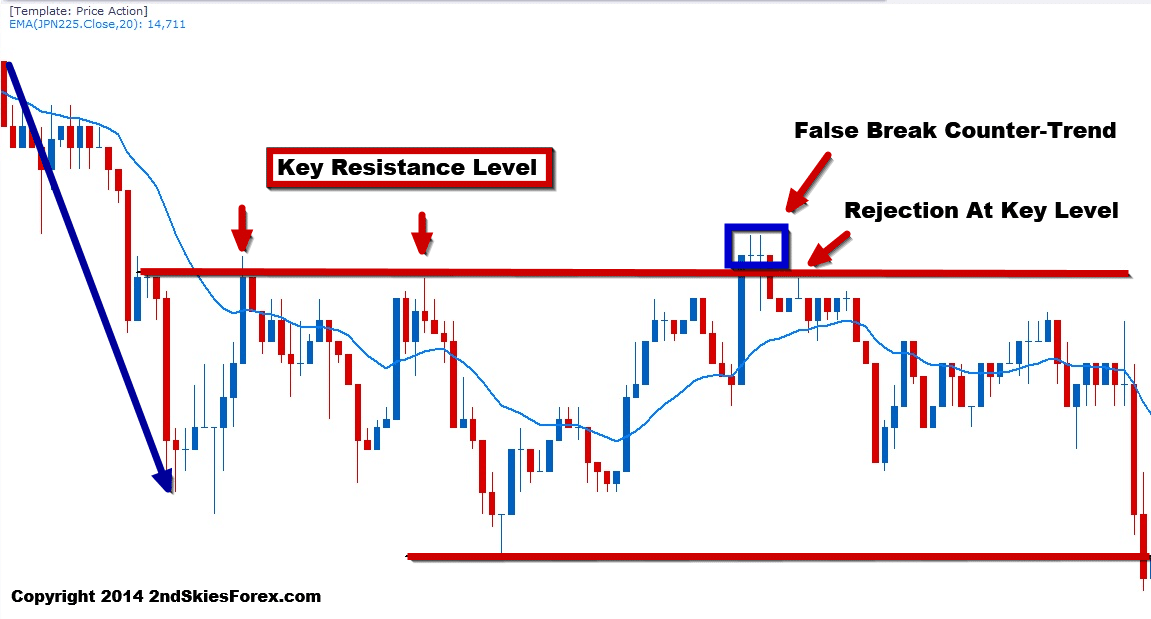
Below is a classic example of trading the false break setup with trend:
trading the false break strategy 2ndskiesforex c3
In the chart above, starting with the top left, we can see the heavy impulsive selling. Eventually this leads to a bounce which hits the key resistance level 2x (marked by two red arrows). After forming a new low (red line at bottom), the pair bounces to retest the bears at the same resistance level.
Now note how the pair breaks above this level with a really large blue bar, closing at the highs. Ask yourself, if the bulls were really in control, how come they did not produce any follow through?
The next two doji candles showed no real strength or follow up buying, which should have been a warning sign to any bulls already long. Bears wanting to trade with trend, should have been looking for the false break and close below which they got on the 3rd candle.
Entry, Stop & Take Profit
With such a clearly defined trend and resistance level, there are two general entry techniques;

  1. Sell on Break back below the key level
  2. Wait for pullback setup to the key level

More aggressive traders who feel confident in their price action skills may sell on the break back below the key level. This may or may not offer the best price, but you may not get a second chance to enter if the sellers came in hard on the false break.
More conservative traders can wait for a pullback setup to the key level. If the false break is real along with the level, then the trade should hold and not go much into the negative.
I generally recommend placing the stop above the high (or below the low) of the false break by a few pips, depending upon the volatility and liquidity of the instrument.
The first target should be the other end of the consolidation. If you want to go for multiple targets, then the next key support or resistance level would be suggested.
To Recap
In today’s forex false breakout article, I talked about the price action and order flow behind a false break setup, and why it can be a powerful trade opportunity. I discussed the two types of false breaks and how to generally define one.
Lastly, I covered why to look for with trend setups trading the false break, giving the entry, stop and take profit methods.
When you learn to read price action in real time, you will begin to spot these false break setups more easily. As you get skilled in identifying them, you will avoid the common traps, and profit heavily from them as they offer great opportunities.
In the second part of this article, I will talk about using a false breakout strategy with pin bars and engulfing bars.