Tag Archive for: traders mindset

What’s Inside?

  • The 4 stages to becoming a millionaire trader
  • What is the most important stage to making money trading?
  • What trading and mindset skills you need to become a profitable trader?

Since February of 2018, I’ve been envisioning how I want to build a complete trader training program that will teach you the stages, skills and mindset you’ll need to build to become a highly profitable trader who can pull a million dollars out of the market. I actually started working on this article over 6 months ago, and it has finally come to fruition.

If there was only one trading article you could read on my site, this would be it, so grab the popcorn as it’s a heavy hitter.

The goal of this article is to teach you about the 4 stages to becoming a millionaire trader. It’s designed to be a roadmap and structure for how to get from where you are now (likely struggling) to becoming a professional trader who can make a million dollars trading the markets.

millionaire-trader 2ndskiesforex

Before I get into the stages and roadmap, I have to explain a fundamental component and basis for this article.

Buddhism And Trading?

For the last 18 years, I’ve been training in Tibetan Buddhism, particularly in the Nyingma tradition. One of the amazing components of training in Buddhism is the ‘structure‘ and ‘stages‘ they clearly lay out for you. And a fundamental aspect of Buddhist practice has to do with the following formula:

Base, Path & Fruit

To explain this simply, the ‘base‘ is the starting point and foundation you build everything else upon.
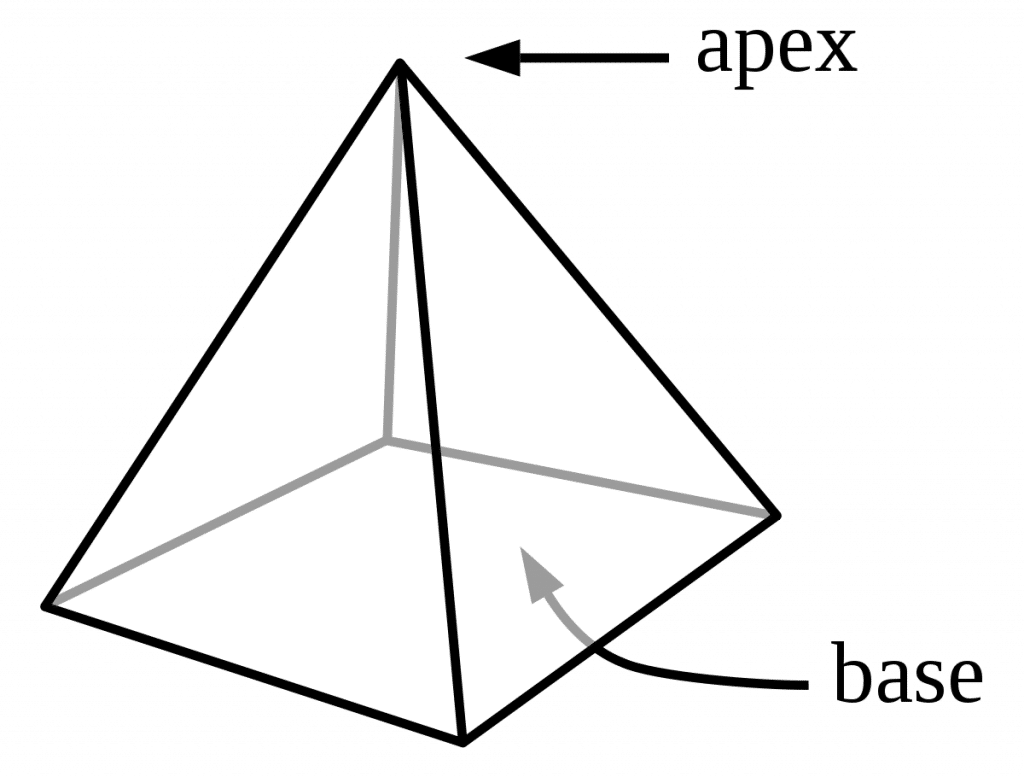
base of pyramid

It’s a fundamental level of direct experience and understanding you need to have to complete a specific aspect of your training. It’s arriving at the base which is what makes any practice, training or method work. Without this, you’re just wasting your time.

Keep in mind, it is not something you can arrive at ‘conceptually‘. What I mean by this is, it’s not something you can just read in a book and understand. You have to have the actual direct experience before you can progress any further.

Think of it like this:

Who would you trust more? Someone who’s lived in Buenos Aires (Argentina) their whole life, and knows the city, streets, traffic patterns, restaurants, various barrios, how ‘corruption’ affects their daily business, local customs, etc? Or someone who’s spent the last several years ‘reading‘ about Buenos Aires, looking things up on google, and watched youtube videos about it?

I’m guessing every time you’ll take the former hands down, which you’ll notice has nothing to do with ‘intelligence’. The person who’s lived in the city has a ‘direct experiential‘ knowledge about Buenos Aires that cannot be read in a book, watched in a video, or learned ‘conceptually’. It has to be a direct experience!

The same goes for the ‘base’ in trading. If it’s not a direct experience, you simply cannot progress any further. This is what I mean by ‘base’.

The ‘Path‘ is the practice, methods and training you use to get you to the direct experience. It needs to be a specific path which takes you from point A to B.

path

The path needs to be very specific and clearly demonstrated to produce real results.

The ‘Fruit‘ is what you get when you fully complete the ‘path‘ by using those practices, methods and trainings. It’s the ‘result‘ of what you get when you do the work, and it also should be specific.

lots of money 4

If you have the base in place, then you can begin the journey. If not, you’ll need to arrive at the base (just like you have to arrive at ‘base camp’ to climb Mount Everest), before you can proceed any further. There is absolutely no way to skip steps here.

This entire training and article is built upon these principles of Base, Path and Fruit. Simply put, if you follow the structure I’m laying out here for you, your progression will naturally follow and you’ll see the results in your trading performance, mental execution and mindset.

Each of the 4 stages to becoming a professional trader has it’s own ‘Base, Path and Fruit’. Before you can progress to the 2nd stage, you’ll have to complete the first. There is no way around this! So if your goal is to make a million dollars trading, you’ll want to go straight for the first stage.

Becoming A Millionaire Trader (Stage 1)

The very first stage to becoming a millionaire trader is what I call the ‘Stage of Discipline‘.

discipline

The ‘base’ of this stage is having the direct experience and realization that:

a) your brain is currently not wired to trade successfully
b) you’ve had the experience of how your mind, emotions, and skill-set are currently not sufficient to consistently make money
c) have a real passion for trading, and
d) a mindset focused on growth

If you have those 4 things in place, you have the sufficient ‘base’ to begin the first stage.

By now, you’ve probably witnessed how your emotions affect your trading decisions (FOMO, not pulling the trigger, fear of losing money, risking too much/too little, etc). You’ve probably also noticed how you’re not consistently disciplined in your approach (system hopping, changing instruments, not sticking to your trading plan, etc).

Sound familiar?

If you’ve realized what you’re doing isn’t working, and that you’re lacking certain skills + training, but still have a passion to make money trading + are focused on growth, then congratulations – you’ve arrived at the base of the first stage. You’ve accepted the fact you (by yourself) cannot make this work, that you need a trading mentor + build new habits to succeed.

chris capre bw main foto

If you’re here, then you’re ready to actually begin the first stage, which is the stage of discipline.

The only thing you need to pack in your bags from here on out is a commitment to getting past this first stage. You don’t need to have the commitment to become a billionaire trader. Just having the commitment and openness to train is the minimal requirements to begin the first stage. Consider this stage to be your ‘apprenticeship‘ in becoming a successful trader.

The ‘fruit’ of the 1st stage of discipline is ‘consistency‘. If you don’t have consistency, you’ll never a) succeed in trading, and b) make it to the 2nd stage.

I say ‘consistency‘ is the ‘fruit’ of this stage, because it’s what you get when you have a solid level of discipline in place. Without this, there is no progression in trading, and you’ll continue to make the same mistakes over and over and over again.
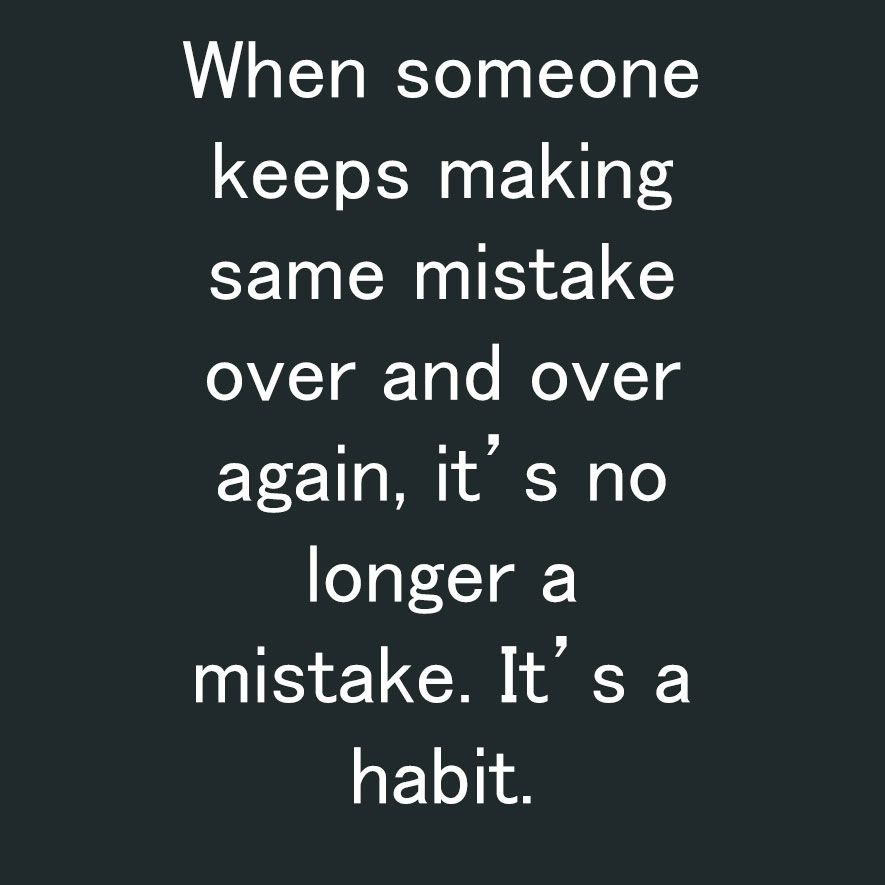
making same mistakes

Does this sound like your current experience?

Thus, discipline is what helps you exit out of that cycle (repeating the same mistakes). It’s the force which allows you to break through your current bad habits around trading. It’s what allows you to execute the same things over and over again, regardless of the emotions you feel, or obstacles you come against.

Consider discipline a type of ‘armor‘ against that which will knock you off your horse and derail your progress. Essentially, it protects you against yourself, and is absolutely necessary in trading..

armor

From my experience, both in Buddhism, and in trading, it actually has to get worse before you give up your current approach (which likely isn’t working). You actually have to suffer to the point you realize “I no longer want to suffer like this. I’m open to trying it differently.” This realization creates the first real opening for you to get out of that vicious cycle of repeating the same mistakes over and over again.

The ‘path‘ of the stage of discipline is the most intricate and nuanced part of your trading progression. It’s the hardest part of the mountain to climb, and requires the most effort on your part. This is because you’re going to be fighting against much of what you currently are, which by definition, is insufficient to consistently make money trading. If you were already there, you’d be doing it.

The ‘path’ has to consist of a series of methods and skills (trading and mindset wise) you’ll need to build to get to the ‘fruit’.

path to fruit

Practices & Methods For the Stage of Discipline

As stated before, the goal or fruit of the stage of discipline is consistency. This means consistency in your execution, decision making process, trading strategies you are using, what instruments you trade, risk management, etc.

Consistency, however, has a ‘root cause‘, meaning the root of what it grows out of. As I’ve stated before, consistency can only come from the mind. If you do not have consistent thoughts, thinking patterns, neurological structures, mindset, (etc) there will be no consistency in your trading. Hence your focus for building ‘consistency’ has to primarily consist of (and begin with) your mind.

summary

If you are currently not experiencing any sort of consistency in your trading, then congratulations, you’ve discovered the root cause of your inconsistency (your mind). Now your initial goal in trading and becoming consistent may seem counter-intuitive, but I’m guessing you’ll find it makes sense when you fully understand it.

Your initial goal in trading should be to become a ‘consistentlylosing trader. Now many of you are likely thinking “I consistently lose now, why would I want this?” While that may be true in ‘form’, it’s not true in ‘essence’. What I mean by this is, while you may be consistently losing money, there are likely many components of your performance which are not ‘consistent’.

Some of these components can be:

  1. Risk Management – are you consistently risking the same % per trade? If not, then you’re not ‘losing consistently’.
  2. Trading Instruments – are you consistently trading the same instruments till you have a sufficient baseline to make a quantifiable decision? If not, then you’re not ‘losing consistently’
  3. Times of the day – are you consistently trading the same times of the day? If not, then you’re not ‘losing consistently’
  4. Pre-trade preparation – are you consistently preparing mentally for your trading day with the same routine? If not, you’re not ‘losing consistently’
  5. Pre-trade analysis – do you have the same consistent routines and methods (price action, ichimoku cloud trading, etc) for finding trading setups? If not, then you’re not ‘losing consistently’
  6. Post-trade analysis – do you have the same consistent routines and methods for analyzing your completed trades? If not, you’re not ‘losing consistently’
  7. Reinforcing successful trading habits – do you have the same consistent routines and methods for reinforcing successful trading habits? If not, then you’re not ‘losing consistently’
  8. Trading plan – do you have a detailed trading plan which has clear instructions for how to trade, how to train, and how to progress in your trading? If not, then you’re not ‘losing consistently’

I could go on as there are many other variables you’ll need to ‘lose consistently’, but my guess is, when you read the above and really take it all in, you’ll realize that you’ve been ‘losing money’ consistently, but not ‘losing consistently’. There a difference.

It takes discipline and a courage to say “I’m going to focus on consistently losing”, just like it takes discipline and commitment to not hit the target consistently in archery. But that is your initial goal in archery (not just hitting the target), but ‘consistency’ in your technique, process and movements. If there is no consistency in your stance, alignment, breathing, holding of the riser (main bow structure), how you grip the bow string, how far you pull it back, etc…there will be no consistency in where your arrows land.

(Image: Brady Ellison – #1 US Archer – Recurve Bow)
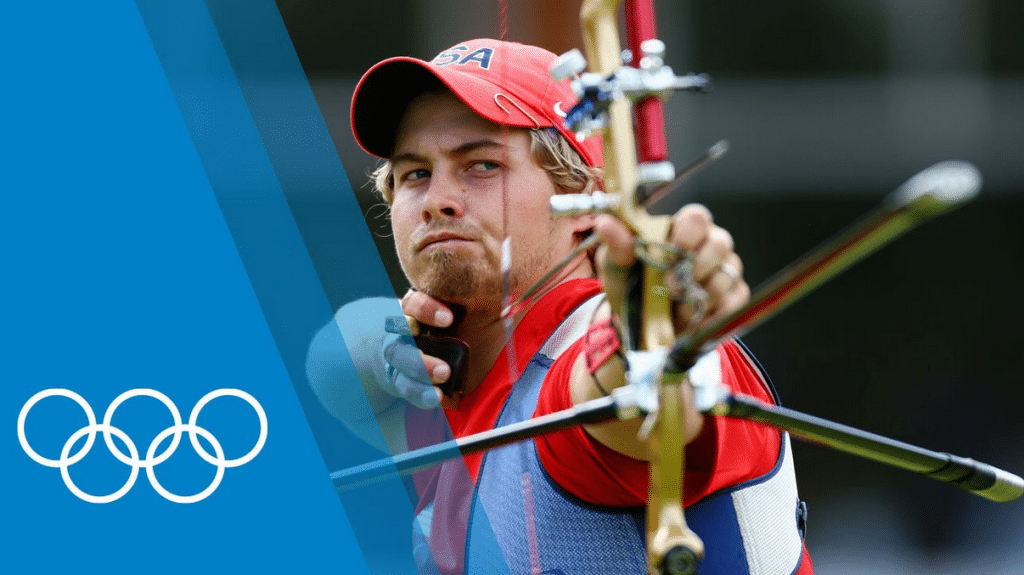
brady ellison archery

Trading is no different!

Hence in sounding somewhat masochistic, your initial goal in the first stage of discipline is to learn to ‘lose consistently’. By doing this, you’re building the foundation which the entire house you want to build will rest upon. Then you can focus on being a consistently break-even trader. Then you can focus on being a consistently profitable trader.

But before all this, you’ll need to focus on building the prerequisite trading skills, which can be defined as the following:

1) Trading Methodology & Approach

There are only 4 major trading methodologies, or approaches to the markets. They can be any of the following; 1) technical, 2) fundamental, 3) sentiment, 4) flow based.
trading for a living1

Now any one of these can fall into broad categories, such as (discretionary, rule-based, hybrid, quantitative).

The approach I teach is a ‘technical‘ model based upon understanding price action context and the order flow behind it. I teach this method because it can be applied to any instrument, time frame or environment, and is based upon what all trading decisions are based upon (*information).

Regardless of whether you are a technical, fundamental, sentiment or flow based trader, all trading decisions are derived from ‘information’. Eventually that information has to be converted into an actual trade (and thus order). All ‘activated’ orders become ‘actualized’ order flow. And order flow is the most proximate driver of price action.

This is why I teach price action context and the order flow behind it, because I’m teaching you a ‘root’ method which communicates the footprint of all orders and trading decisions. By understanding these, you can give yourself the highest probability for trading with the dominant order flow in the market, which is what drives all price action. By doing this, you can learn to trade with the larger players who will most likely dominate directional price movements (which is what we want to capitalize on).
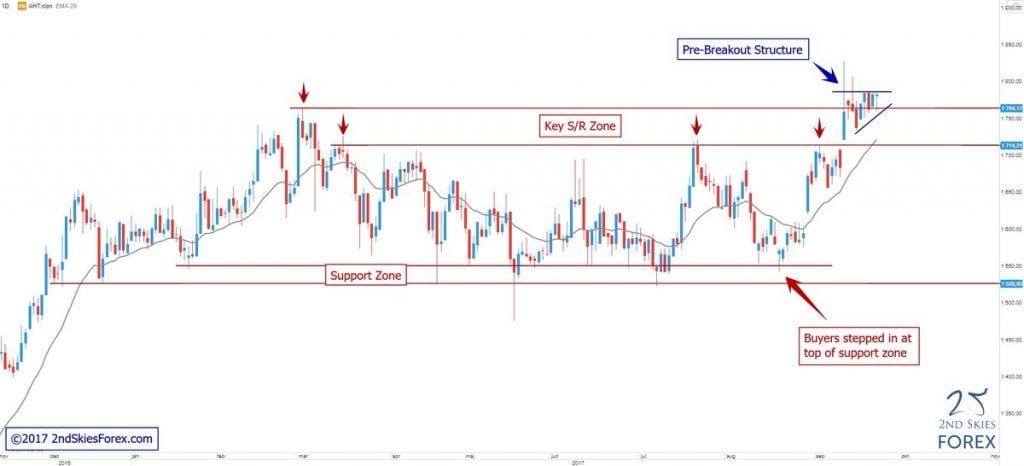
price-action-2ndskiesforex

Price Action Trading Skills

There are many price action trading skills you’ll need to build, and it is important not to learn these skills out of order. I often find traders trying to learn more advanced skills before they’ve built a solid set of foundational skills. One common example is struggling traders trying to trade counter trend before they’ve learned to trade with trend (with the latter being easier).

Now assuming you understand what candlestick charts are, time frames, and what the basics of price action are, then you’ll need to build your core skills of price action. In price action trading, the first set of ‘core’ skills you’ll need to learn is what I call the 3 pillars of price action context.

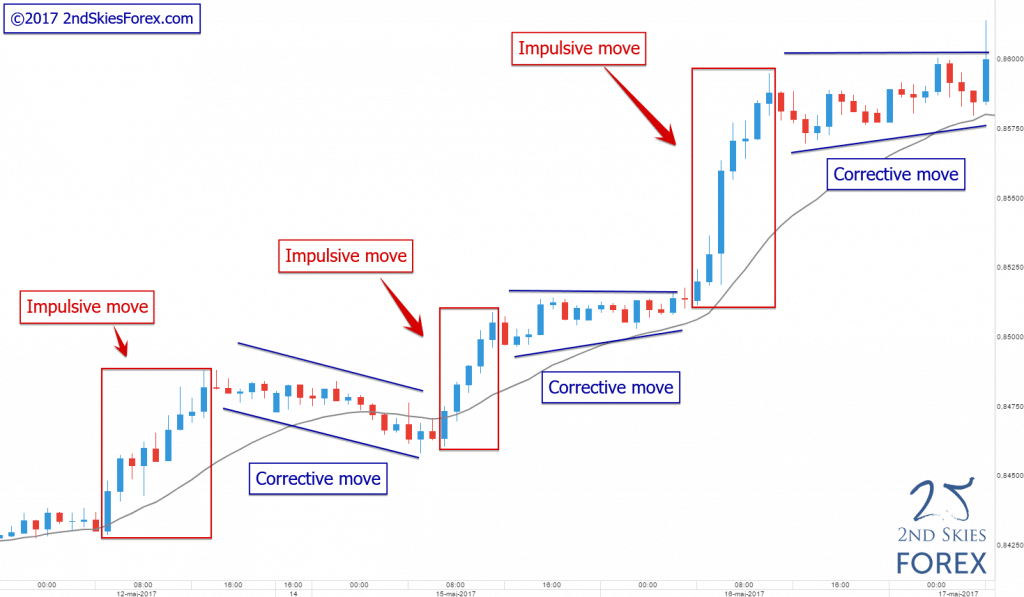
I’ve talked about the first pillar of price action context, which is being able to identify impulsive and corrective moves. The reason why this is the base pillar is it gives you the most amount (and most nuanced) information about the price action and order flow happening right now.

It tells you who’s in control of the market (buyers/sellers), and who’s not. It tells you how to read momentum in the price action without any indicators. It tells you when are optimal times to take profit, and not take profit. It tells you when you’ll need to be patient, and when you need to make a quick decision. It tells you when trading breakouts are more likely (or more probable) to occur, and when they are less likely to succeed.
impulsive-and-corrective-price-action 2ndskiesforex

There is a lot more impulsive and corrective moves can tell you about price action, but by learning these, you start to learn how to think like a price action trader, and see the dominant order flow behind it. This is why it’s the first pillar. If you want to learn about the other two pillars of price action context and the order flow behind it, then check out my price action course where we talk about this extensively.

Now before you can even practice these skills and making actual trading decisions, you’ll need to first be able to identify (with 90+% accuracy) these 3 pillars of price action context. My formula for how to build your trading skills (and price action skills) is simple:

Sim, then Demo, then Live

What this means is, after you’ve watched videos and understood (conceptually) the components of an impulsive and corrective move, you’ll want to start building your pattern recognition skills in the charts. You build these pattern recognition skills so you can identify them automatically, and thus, sub-consciously.

If you’ve ever looked at a chart and had the thoughts, “Is this a such and such pattern? I’m not sure, how do I know? I know it said it has to have x, y and z, but is this part the same, or is it different…

Have you had this experience before? If so, then your skills are not ‘sub-conscious‘. The reason why this is important is you want to use your cognitive thinking, analysis and bandwidth for finding profitable trade setups. If you have all those thoughts going through your mind, then congratulations – you’ve now realized your skills are not sub-conscious, so that should be your next goal.

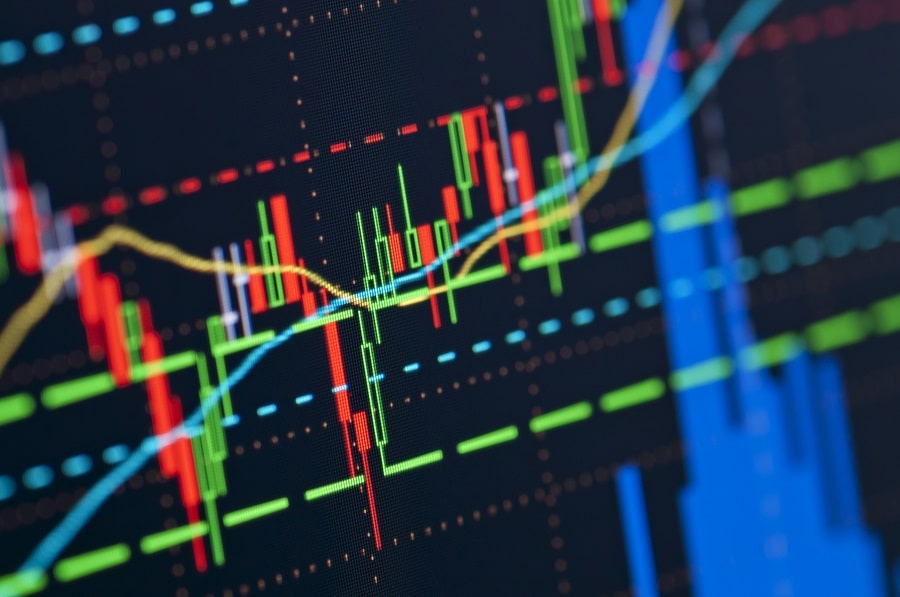
By starting with a trading simulator, you can have the opportunity to watch the price action unfold, pause it, take time to read it correctly, then resume the historical price action on the chart unfold.
trading simulator 2ndskiesforex

This is why sim is the best place to start, because on demo, the charts just keep moving on whether you got the analysis correct or not. Just like pilots start off in a flight simulator to make sure they have the basic functional skills to fly a plane, you also need to start off on a simulator.

By looking over thousands of candles and charts in a short period of time via a trading simulator, you can increase your learning curve, and accelerate your pattern recognition skills, particularly being able to identify impulsive and corrective price action.

Once you’ve seen enough impulsive and corrective moves, your brain will eventually assimilate these patterns into its database, and be able to identify them on any instrument, time frame or environment with ease (and without doubt).

After you’ve mastered all 3 pillars individually, the next step is to assimilate them together into one cohesive picture (or gestalt). The goal here is to be able to easily identify all three of the pillars of price action context, then be able to come up with a ‘most probable’ direction of the market.

I say ‘most probable’ because this is a mindset you’ll need to develop to make it out of the first stage of trading. Beginners try to use ‘confirmation price action signals‘ because they think they ‘confirm’ the trade and direction. But 1, 2 or 3 candles is a small amount of price action + order flow, and rarely ever dictates the next move (~1% of the time).

Hence you have to shift your mindset from ‘confirming‘ (because there is no certainty in the market) to ‘probabilities‘, because probabilities is all you are ever dealing with. There is no certainty, and never will be when it comes to price action and the next direction. This is why I say confirmation price action signals will crush your account. If these so called ‘confirmation price action signals’ actually ‘confirmed’ anything, there would be ample statistics and data to back that up. Yet nobody to date has been able to provide this (which should tell you everything you need to know about them).
losing money trading

Now while you’re building your core price action trading skills, you’ll also need to build your mindset skills. To succeed in trading, you’ll need a successful mindset which will keep you on track when things are challenging, and help you execute what you need to when your trades and emotions are really affecting your thoughts and trading decisions.

Mindset Skills to Build Consistency In Your Mind

If you’re working towards consistency in your mind, there are several core mind/mindset skills you’ll need to build. For the purposes of brevity and not turning this into a long novel, we’ll talk about the 3 most important mindset skills you’ll need to build consistency in your mind and make money trading.

The first mindset skill you’ll want to build is understanding how the brain works. By understanding how your brain and mind work, you can accelerate your learning process by working with how your brain functions, not against it.

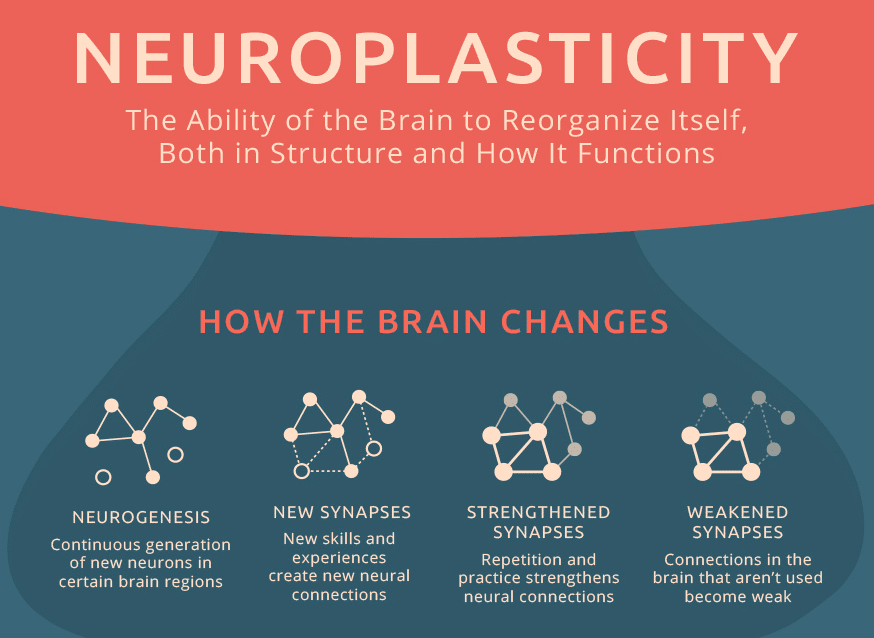
One of the most fundamental aspects of the brain is its ability to re-wire itself. This principle is called neuroplasticity. 
neuroplasticity

Neuroplasticity can be summed up by the following phrase:

“Neurons that fire together, wire together”

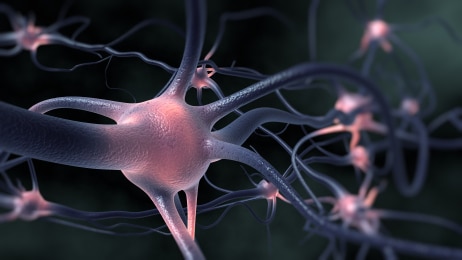
Neurons are the basic neural cells you have in your brain. They connect to each other through axons and dendrites. By connecting to each other, they can pass information via electrical signals.

If you want to wire in a new trading habit, you’ll have to activate neural circuits which do this over and over again. By doing this over and over again, they strengthen those connections till they become ‘dominantly wired‘. Another term for ‘dominantly wired’ is ‘habit‘. Anything you have dominantly wired in your brain is a habit. So by firing the same neurons together, they wire together and form specific habits you’ll want and need to build a successful mindset.

rewiring your brain

This is where understanding how the brain works helps.

There are 7 components to neuroplasticity, but there is one fundamental ‘root‘ component behind all neurological wiring: Repetition.

By repeating the same thing (and thinking pattern) over and over again, you can wire in the trading habits you’re looking for.

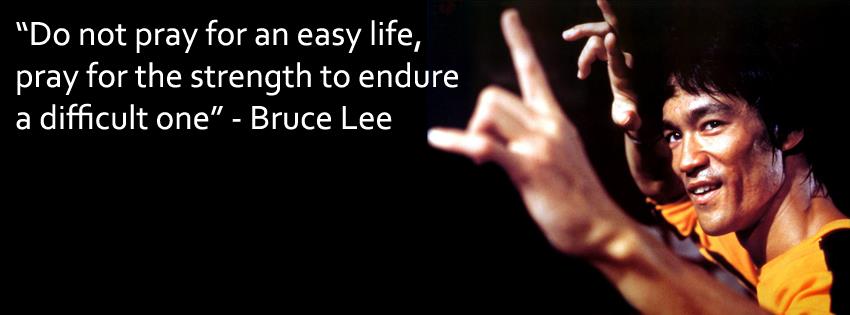
It’s why basketball players will shoot free throws every day in practice. It’s why quarterbacks (American football) will practice throwing the football over and over again, so that their mechanics are automatic and sub-conscious. It’s why Bruce Lee said “I fear the man who practices one kick 10,000 times“, because such a person has that has practiced a kick 10,000x likely can throw it with speed, precision and power.

Repetition is the most fundamental building block to wiring new trading habits. Thus, understanding how the brain works is a fundamental mindset skill you’ll need to develop.

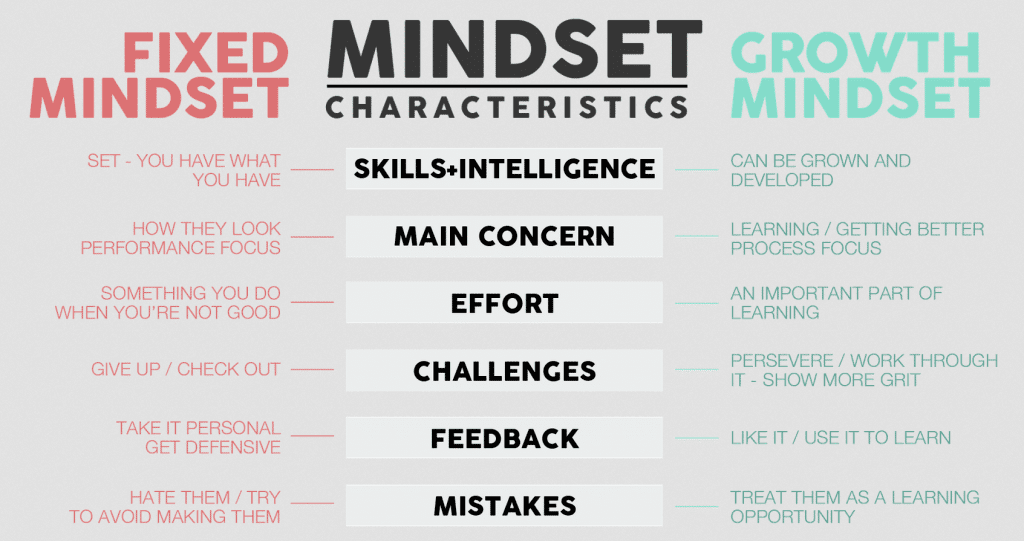
The second mindset skill you’ll need to build is what I call the GBT mindset. GBT = getting better today (also known as a ‘growth’ mindset).
growth-mindset 2ndskiesforex

Notice the focus here isn’t ‘profitable trading now‘. It’s a trading mindset that works every single day to get better. By getting better today at your skills, you eventually build enough skills and competence to make money trading.

The GBT mindset is one that is focused on the process, and has a well designed process + skills + goals they are focused on. The process aspect is the methods and plan of action you engage to build your skills, which allow you to reach your goals.

If you’re just focusing on the results “dang, I’m still not profitable yet“, then you’re jumping too far ahead and not focused on what you need to succeed (skills: 1) technical, 2) risk management and 3) mindset). Hence your ‘goal’ right now if you’re not a profitable trader should be to build the skills to make money trading.

This is why you need the GBT mindset, and an approach which focuses on building your skills step by step, and getting better today at your current level of skills. Then once these are sub-conscious, you take on the next challenge.

The third mindset skill you’ll need to build to become a consistently profitable trader is ‘self-awareness‘.
lao tzu self awareness

Now I’m not saying you have to become a zen monk to become a good trader. But you’ll need to develop a minimum level of self-awareness to make money trading.

Why?

Because if you really understand how the brain works, you’ll realize you are actually fighting your own brain and evolution to build a successful trading mindset.

How so?

Let me demonstrate this with a few key brain facts:

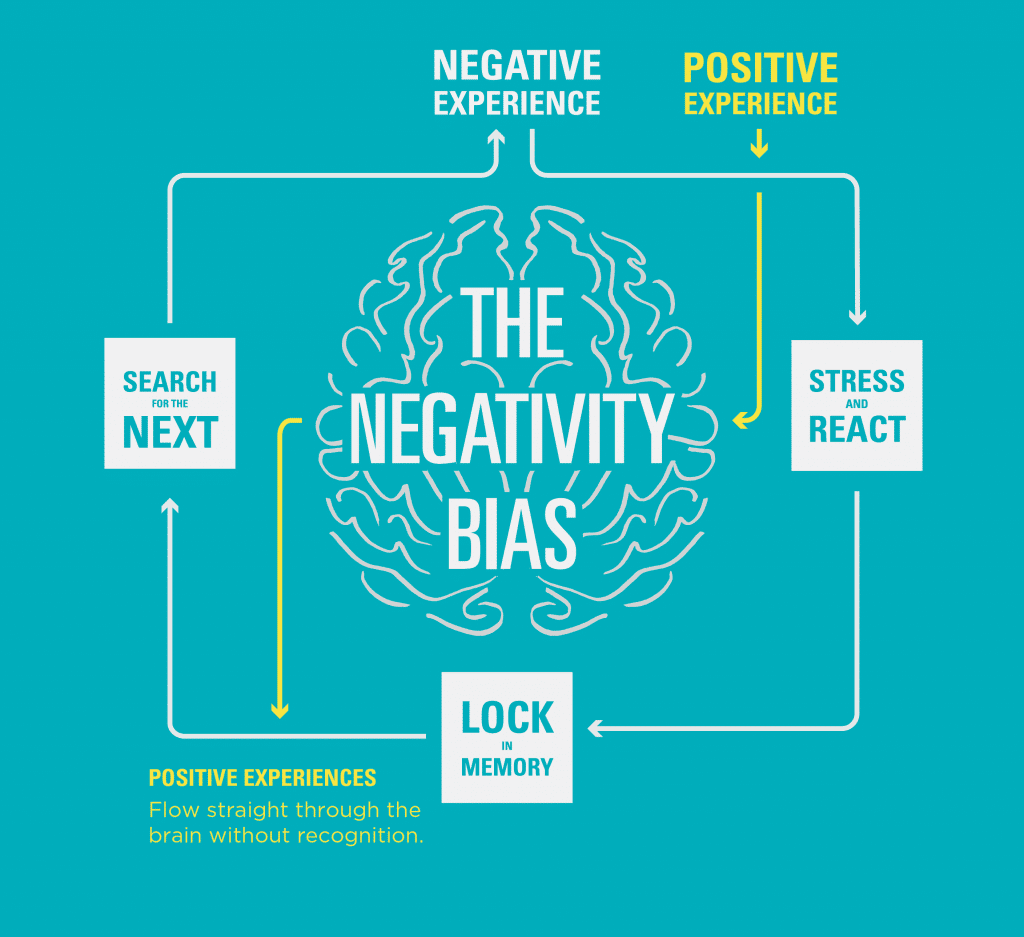
  1. You have about 500% more neurons for finding the negative vs the positive
  2. You are more likely to choose an immediate reward (even if it is a lesser reward) than delay gratification (for a larger reward)
  3. Your emotions heavily influence how you interpret (and code) an experience, memory or event

Now lets examine these 3 brain facts.

The first one should be obvious as to how it can affect your trading. If you are 5x more likely to notice the negative vs the positive, what do you think that means when you make a mistake, or a trade starts to go against you? How do you think that will affect your thinking in real time when you have to make clear, calm trading decisions? Do you think it will help, or hurt your decision making process?

Ever experienced a trade that was a winner but starts to go against you? Were you totally relaxed, or feeling ‘stress’ when it started to pull back? And do you think that stress affected your analysis and decision making? This tendency to notice the negative vs the positive is called the negativity bias.
negativity bias in trading 2ndskiesforex

What about the 2nd brain fact? Ever chose to exit a winning trade too early? This is your brain working against you. If you’re more likely to choose a lesser immediate reward, don’t you think that will become problematic in making decisions which will lead toward long term success and trading habits?

In terms of the 3rd brain fact regarding emotions, just think about the majority of emotions you’ve experienced in trading. Have they been mostly positive or negative? Have they mostly helped or hurt your trading process, thinking and mindset? Do you even know how to use emotions to your advantage in trading? My guess is no.

Hopefully it is becoming clear why self-awareness is key. You can determine if the self-talk that’s going through your mind is accurate (“something doesn’t feel right about this trade“), misleading (FOMO, fear of pulling the trigger, etc), or not important (“I wonder how many people liked my last tweet”).

By building self-awareness, particularly around trading, you can learn to know when you need to stick to your discipline and/or trust your gut instincts. You can also learn how to self-regulate your mind, emotions and psychophysiology so you can make the most optimal trading decisions.
self awareness

Simply put, if your biology and psychophysiology is off (heart rate, breathing, skin conductance, etc), the chances of you making a bad trading decision go up exponentially! And more often than not, the difference between making money trading and losing money trading comes down to the trading mistakes you make.

Becoming A Clutch Performer

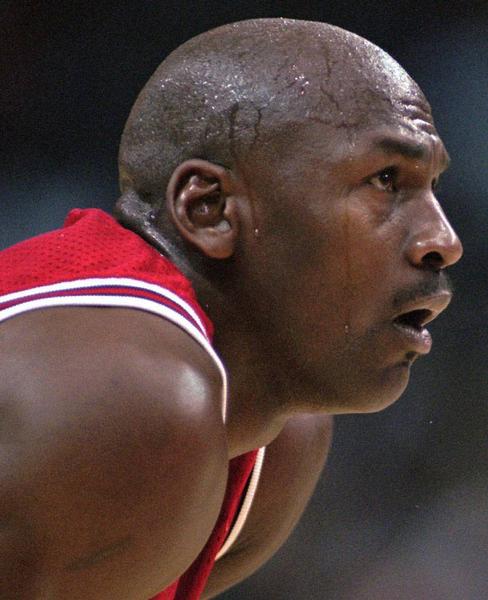
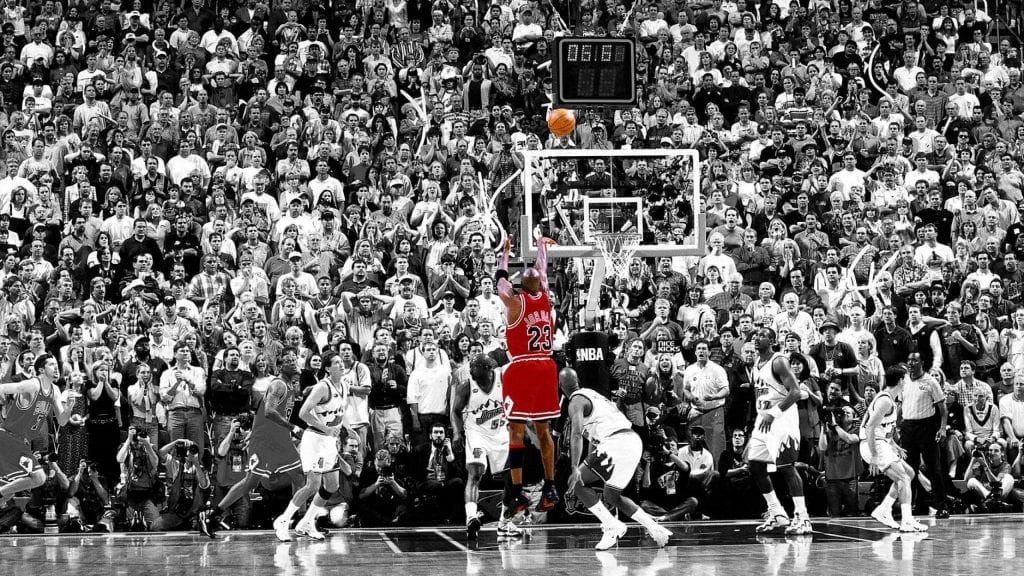
The term ‘clutch athlete‘ is actually misleading. When the game is on the line, the statistics are clear. The best performers are not performing at their peak, or above their baseline. They’re actually performing below their baseline. The difference is, they make the least amount of mistakes compared to their baseline, while the non-clutch performers make more. This is why specific athletes are clutch, because when the game is on the line, they make the least amount of mistakes, and thus outperform everyone else.
mjh game winning shot

Trading is a peak performance endeavor that is skill based. There is no way around it!

This means you’ll have to learn how to become self-aware when trading gets intense. If you want to make a million dollars trading, you’ll need the 3 mindset skills I’ve listed above when you have 5 or 6 figures on the line.

By becoming more self-aware, you’ll start to build the psychological and mindset skills to become a consistent trader who makes ‘consistent’ trading decisions, regardless of the pressure or challenges you’re experiencing while trading. You’ll be able to direct your cognitive and mental activity in the right direction, while avoiding getting swept up by your emotions, or negative self-talk.

There are many ‘methods’ and practices you can use to build self-awareness. I teach several of these in my traders mindset course. But one method we focus on in our traders mindset course is meditation, which is scientifically proven to help improve your neurological and cognitive performance in a variety of trading activities.

meditation for trading 2ndskiesforex

I’ve been practicing meditation since 2000, done over 10,000 hours of meditation practice. I’ve completed a 1 year meditation retreat. I’ve completed 3 one month retreats, about 150+ weekend meditation retreats, and trained with the same meditation teacher since 2001. Needless to say, it seems fair to say I have a ‘solid’ training in meditation.

I recognized early on how important meditation is to my trading mindset, and thus created a 12 lesson meditation series specifically for traders. The goal of this practice is to build self-awareness, increase your emotional IQ, and help you enhance your brain’s functioning, which meditation has been scientifically proven to do. If you want to learn more about how to use meditation to become a better trader, then check out my traders mindset course.

Now there are many techniques you can use to build a successful trading mindset, but these are three most ‘fundamental‘ I’d highly recommend you focus on. There are other mindset skills you’ll need to complete the first stage of trading (discipline) and get to the fruit (consistency), which could take me an entire book to write and flesh out. But I feel I’ve given you a glimpse of the first stage of trading.

Getting Past the Hardest Stage (*And Not Jumping Ahead)

From my experience in working with thousands of traders, helping many traders become profitable, I’ve seen how every trader which has failed to become a profitable trader has never completed the first stage. They’ve either a) never built the mindset skills to become a ‘consistent’ trader, b) never built the core foundational skills, or c) tried to skip various aspects of both.

From all the students I’ve trained that have become profitable traders, they’ve all completed the first stage without fail. I’ve yet to meet a profitable trader who is able to make money consistently while skipping the first stage. There is no way around it!

Now if you want to learn about the other 3 stages to becoming a million dollar trader, I’m doing a private member webinar this weekend (Dec. 22nd) for all my course members. After the webinar, I’ll be making this webinar available to all my members so they can follow this road map and become consistent traders.

If you want to learn how to become a member, click here.

Now I hope you’ve gotten a tremendous amount of value out of this article, and use it as a guide and road map to your successful and profitable trading.

Please make sure to leave a comment, and share this with any friends or forums you feel will benefit from learning about the stages to becoming a million dollar trader.

Until then, may you see real growth in your trading and mindset.

4 Stages To Becoming A Millionaire Trader

What’s Inside?

  • How did a monk produce brain activity 40x longer than the avg. human being?
  • Are there ways to command your focus, attention and brain to improve your trading?
  • What simple exercise can wire your brain for trading success?

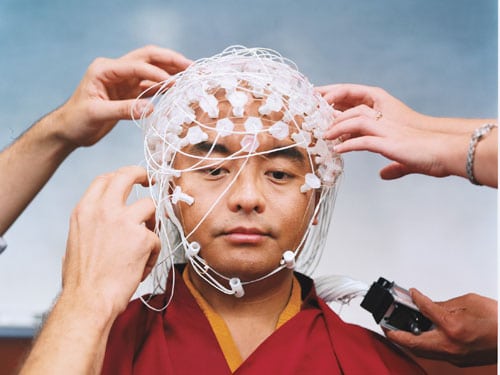
There was a monk who had traveled 7000 miles, over 3 days, 10 time zones and after one night’s rest, opened a glass door and walked into a science lab. He was going to be given a simple test over 6 minutes with 256 sensors monitoring his brain’s activity. The experiment was simple:

For 1 minute, this monk would have to meditate on compassion. Then on cue, he’d have to relax his mind for 30 seconds with no focus on his mind, then repeat another 1 minute focus on compassion. He’d repeat the cycle between focus on compassion and a mental resting period 4x.
mingyur rinpoche 23
The monk being tested is Mingyur Rinpoche. He’s completed a 3 yr meditation retreat where he was meditating 8+hrs per day every day for 3 years, 3 mos and 3 days. Over his entire life, he’s completed 62,000 hours of meditation, by far the highest of any other meditators tested (normally 12-24K hours).

In the first test, his brain was measured via an EEG machine which measures brain activity over time. What the scientists found had astonished them. They had never seen anything like this in any human being they’d ever tested (or known to be tested).

Never Before Seen Brain Activity

During the second the 1 minute focus on compassion began, Mingyur Rinpoche’s brain activity lit up and shocked the scientists. He had instantly transformed his neural activity to produce high levels of gamma spikes.

Gamma spikes are intense bursts of brain activity that often represent a major ‘insight‘ where everything clicks in your brain and you see things in a completely new light. Think of those moments where you felt confused, but then had a sudden burst of clarity and insight into a particular problem, like finding two pieces of a puzzle you couldn’t find before.

insight
Normally these gamma spikes last .5 seconds for the average human brain. In contrast, Mingyur’s brain produced high level gamma spikes for the entire minute! This is 40x longer than the average human being. So for that entire minute, Mingyur’s brain was experiencing a level of insight, where his brain was working in harmony, creativity and clarity.

Changing Mental States At Will

What was fascinating the scientists during the experiments was how Mingyur Rinpoche could change in his neural activity at will. Normally for solid meditators like myself (well over 6000 hours), it takes me a few moments to relax my mind and change mental states. Not with Mingyur who could command his focus and attention at will.

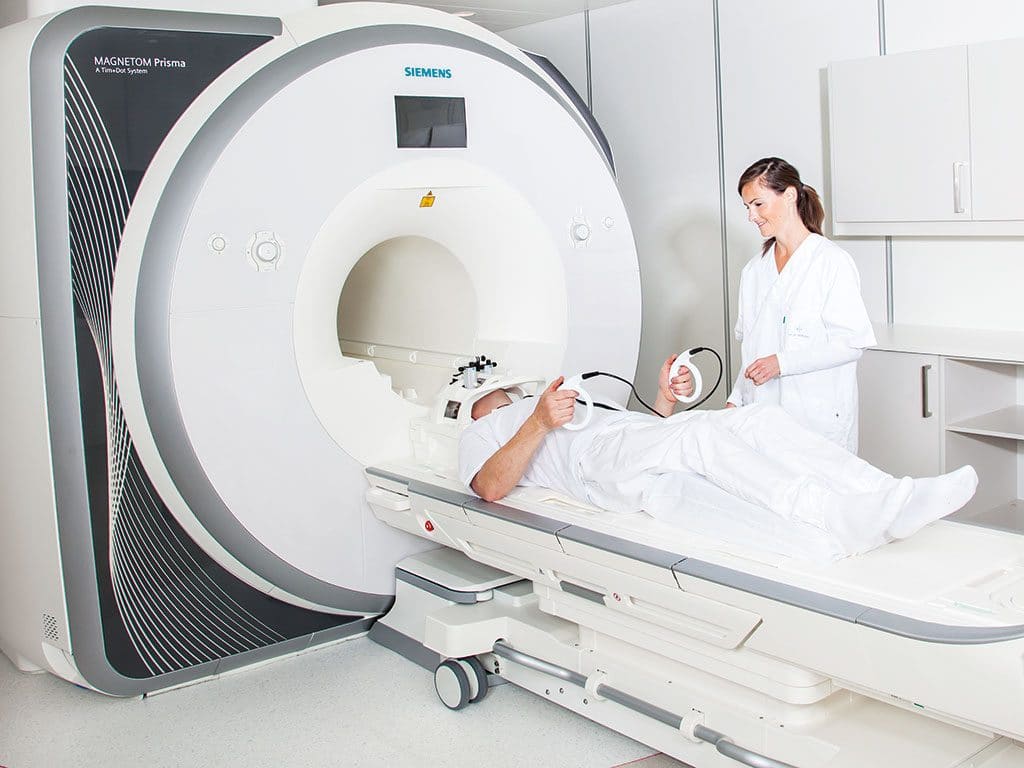
Now the problem with the EEG machine is it doesn’t tell you where in the brain this activity is happening. So the scientists decided to test Mingyur on an fMRI machine which will light up regions in your brain that become active during any tests in a 3D visual.

fMRI (image below)
fMRI
The moment they started testing Mingyur’s brain under the fMRI, again, they were shocked at what they found.

Repeating the same exercise and focusing on compassion, the neural networks which light up when experiencing empathy and compassion were showing activity levels 700-800x greater than during the 30 second resting period.

How Could This Exercise Affect Your Trading Mindset & Performance?

I want you to think about that for a moment…what would it be like if you could, on cue, activate a neurological state in your brain that was 700-800x stronger than when your mind was at rest?

What other corollary benefits could this level of focus and mental control give you in other aspects of your life (trading, studying, training, making money, reading, at work, etc)?

Oh and those gamma spikes that were initially measured in the EEG? Normally those are only found in singular or small isolated regions of the brain for us mere mortals, lasting about .5 seconds. In Mingyur, they were happening all over his brain for an entire minute!

Lastly, when the scientists looked at the resting period before they began the experiments, they noticed the experienced meditators they had tested showed 25x more gamma oscillations and activity than your average joe.

In other words, they had a 2500% greater chance to experience insight, creativity and clarity in their brains and minds than you and me. It’s as if his entire brain was synchronized and working in complete harmony (which is not how your brain works right now).

whole brain synchronization
Think about what benefits this would do for your trading performance, mindset, finances, work, relationships and your life. Do you think these could be useful to help wire your brain for trading success?

If you want to learn the basics of how to use meditation for your trading success, click here.

Also we have a great infographic on meditation for trading.

And for those who are more serious about their brain, health and success, check out my traders mindset course where I teach you a 12 lesson meditation series to help give you the same benefits Mingyur experiences in his brain and life.

Now Your Turn

Do you think meditation can help you trade more successfully? Do you think meditation can help change your brain and mindset?

Make sure to leave a comment below, and share this article with others you think can benefit from it (as sharing is caring).

Are you wondering whether market makers and institutional players are hunting your stops and shaking you out?

As a former broker on Wall Street (FXCM) and a former hedge fund trader, I share my 20 years trading experience on potential ‘stop hunting’ by market makers.

Read more

In the month of October, I had planned to do a big article on price action and ichimoku. However, I had a significant life changing event which took me away for a few weeks.

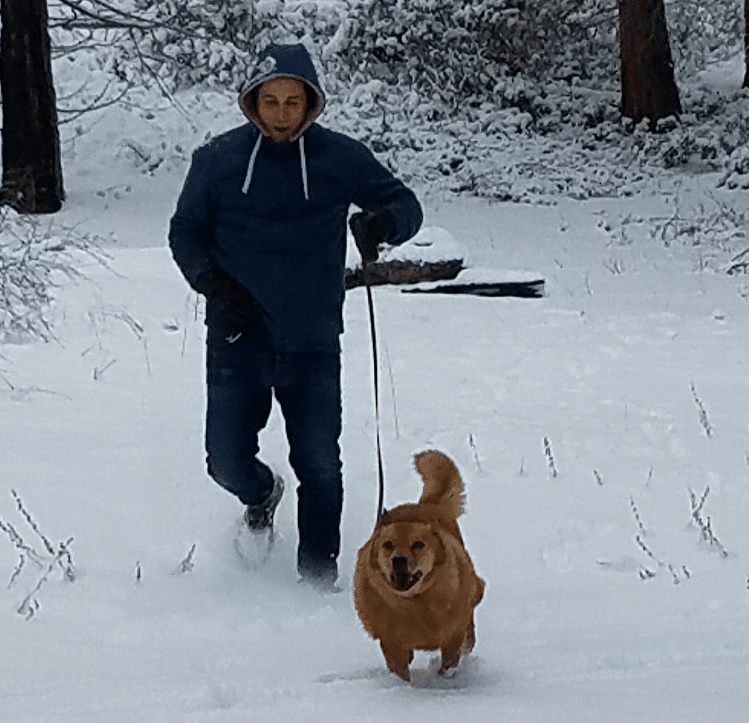
My dog (Noodle – image below) had what we thought was a ‘stroke‘ of sorts.

noodle small

The morning of her ‘stroke’, she was running around as usual, happy as can be. But in the middle of the day, I was suddenly called by my girlfriend to look at Noodle. She was having trouble walking, balance was off, and looked like she had a seizure of sorts.

Being that I studied neuroscience, I immediately started looking for signs of neurological damage. What I noticed was her eyes were twitching horizontal to the right (about .5) inches virtually every second with metronome like timing.

The twitching eye condition is called Nystaxis, and it’s symptoms communicate ‘neurological‘ problems.  Needless to say, we took her into the local vet emergency room.

The vet gave us some bad news. Noodle had what is called ‘Old Vestibular Disease‘. The thing is, there’s no way to determine if a dog will ever recover from these conditions. Here we were, at the hard right edge, not of a chart, but life itself and the life of our little furry friend.

We got instructions, but were told to just sit tight for 1-2 weeks and see what would happen. The next day came, and we were hoping for her to be better. But instead of getting better, she got worse.

She couldn’t walk more than 1 meter without falling, couldn’t make right turns (vestibular disease often causes a head tilt like the image below), wasn’t hungry, was dizzy and nautious.

dog vestibular

After a few seconds, she just fell in our arms, shaking, looking really scared. We felt like we had hit the end of the line for Noodle-bear.

Then, after a few days, she showed her first sign of improvement. Before, when she’d shake her body like dogs do, she’d fall over and crash. However, this time, she was almost able to hold her balance.

Then she could walk less without me holding her up by the leash.

Then she could almost walk DOWN the stairs by herself, without eating shit.

Then the nystaxis finally went away.

After about a month, Noodle is 90% back to normal. She still has the head tilt thing, and we think her hearing in her right ear is either gone, or almost gone.

But by and large, she’s living her life now as if nothing has really happened.

WHY AM I TALKING ABOUT THIS TO YOU TRADERS???

Minus the first two to three days after her ‘event‘, Noodle kept on truckin’ like nothing happened. It was fascinating to observe her ‘mind‘ through this process.

You could tell she was struggling just to walk up 5 stairs. However, there was no self-referencing about it. In other words, Noodle wasn’t making any meaning about her ‘condition‘ and challenging ‘experience‘.

Self-referencing is something we humans do, where we ‘self-reference‘ what the majority of our experiences ‘mean’ about us (our strengths, weaknesses, inabilities, capacities, are we a good person, a good trader, or a bad person, a bad trader, etc). It’s such an ingrained habit in us, that we ‘self-reference‘ the most meaningless things.

self referencing psychology

Case in point…what kind of self-talk/thinking did you engage in the last time had a big loss, or made a major mistake while trading?

My guess is 90+% of you ‘self-referenced‘ after you made such an error/blunder/loss. And my guess is the majority of that was negative.

Self-referencing can cause a lot of problems, but watching Noodle go through her process of recovery really showed me a lot about overcoming obstacles, building mental toughness, and how self-referencing really gets in the way of us building a successful mindset.

We’re supposedly the ‘superior beings‘, but dogs got us completely beat on this one.

dogs and humans

Noodle is just fully present in the moment, not self-referencing, and not meaning making about any ‘loss‘ she’s experienced. She just relates to things, as they are, without thinking she’s a ‘good’ dog when she wins, or a ‘bad’ dog when she loses.

She has no real mechanism to self-reference, and ironically, by not having this faculty, she doesn’t get in her way, or get down on herself for having her condition.

Noodle has tackled every obstacle from this health scare with 100% effort in the moment. If she falls, she gets back up. If she can’t do something (hearing in her right ear), she adapts (turns her head to the left to hear).

And nowhere in those struggles, process, or overcoming obstacles is Noodle every making this meaning anything (good/bad) about ‘Noodle’. She just does what she can in that moment, and accepts it as is. If she fails one time, she makes another effort.

bruce lee quote

After watching Noodle over the last month, this little 4-legged dog has given me a powerful life lesson on overcoming obstacles. I’m not sure I’d be as gracious as her had the same happened to me. Shoot, you should see how impatient I get when traffic is going too slow!

I wrote this article because I felt like many of you get too hung up on what you’re current losing streak, drawdown, or struggles in trading mean about you. I think y’all self-reference too much, and it only makes your trading obstacles more problematic, not better.

Noodle taught me that dogs can teach traders a lot about overcoming obstacles. Hopefully you can find some nuggets of wisdom in this pithy post of mine.

I’m back now after this incident and my recent meditation retreat, so expect more regular articles out of me.

In the meantime, I wish you good health, confidence in your mindset and that you become a profitable trader.

If you want to learn real practices and methods for overcoming your trading obstacles, then check out my Advanced Traders Mindset Course where you can learn the mindset needed to succeed in trading (and life as well).

Now that we have discussed the Two Necessities To Trade Successfully of what you need to trade successfully in part 1 of this series, it is time to get into part 2 of the series which is Developing the Two Traits.  These are traits which you may not have at the moment, but you can totally develop with relative ease, a passion to be a successful trader, and with a little work.

A Question and Common Characteristic

Before I describe what the two traits are, why you need them and how having them will help your trading, I am going to ask a critical question:

Do you really think you can become a successful trader without developing certain skills which you may not be good at already?  Do you really think all successful traders were just good at everything needed to be a highly profitable trader?  Do you really think you can just learn a system and become a professional trader without having to work at something challenging?

chris capre 2ndskiesforex https://2ndskiestrading.com

All professional traders had to go through training, break through various obstacles, and jump over whatever hurdles they had to become a successful trader.  The same goes for you.

One thing you will find as a common characteristic of successful people (in all fields, especially in trading), is when they are faced with something they are not good at, they become good at it.  They do not stop and say, ‘oh, I don’t have that so i’m just not going to do that,‘ or ‘oh, i’m not good at that and will never be so I cannot be good at trading, or martial arts, or business,‘ or whatever field they are working to become skillful at.

When faced with something they are challenged with, they start the learning process to become good with that skill set.

Michael Jordan, considered to be one of the best basketball players of all time, was not great (not even good at defense) when he entered the NBA.  In fact, he was below average. When his coaches told him this, what did he do?  He trained for years to become a better defensive player.

What happened?  

-He became the 1988 Defensive Player of the Year, 4 years after turning pro (meaning he already was considered a professional in his field while still below average in a key skill set)
-He was elected to the All-Defensive Team 9x
-Awarded the ‘Steals Champion’ 3x (player with most steals in the entire league)

So even Michael Jordan had to work at things, well after becoming a pro.  And what made him great was not just his ability to score and to win, but to become good (if not great) at things he was once weak in. That is the mark of a professional.

michael jordan practicing 2nd skies forex chris capre

My guess is you do not enjoy the areas you are most weak in when it comes to trading for two reasons;

1) they are a reflection upon where you are at (thus exposing you to self-judgment and criticism)

2) you simply are not good at them…yet.

Think about the first time you played pool/billiards or some other sport.  Then think about how much more fun it was when you got good at it.  Remember, you had to go through training to get good at something, and the same goes for trading, especially your weak aspects so keep this in mind.  Perhaps your weak aspects are not memory or pattern recognition, but at being disciplined in trading.  Or perhaps you are disciplined, but are bumping up against your Equity Threshold.  Whatever it is, develop it so it becomes your strength.  Remember, the height of your trading success is determined by your weakest skill set, so think about this deeply.

Another important thing is to ask yourself if you are critical towards yourself and your weaknesses.  Do you really think you’ll develop those skills if you are constantly being highly critical of them?  Being self-critical and judgmental might inspire you to become better, but if used improperly, will be a hindrance to your growth as a trader.

It will likely manifest in you beating yourself up for mistakes you’ve made over and over again, instead of taking real concrete steps to develop those skills.  It will manifest in you being less open to your ability to change and grow, instead of being humble about the process.  Food for thought when thinking about what we will discuss next.

What Are the Two Traits?

All highly successful and profitable traders who make their living from trading have these two traits.  They are;

1) Great Pattern Recognition

2) Developed Memory

Pattern Recognition
Think about this – what are all trading systems built of?  Patterns.  All profitable systems are based on patterns that people have noticed in the market.  They can be;

Price Action Patterns
Ichimoku Kinko Hyo Patterns
-Patterns of volatility
Understanding Price Action
or anything regarding the market.

But one thing is for sure, they are the result of some pattern which became the basis for a rule-based system to trade the forex market.  Whether it is a discretionary or algorithmic system, it is based on a pattern.  Thus, your ability to discover and discern patterns is a critical trait you need to develop.

Developed Memory

Another trait of successful and profitable traders is a developed memory, meaning they remember what they see in the markets, they remember the price action, what the market looked like when it reversed, what characteristics were present and were not when it did, when it trended.  They remembered these key things which either;

a) helped them build a system around it
or
b) helped them to identify key opportunities

Not all trading opportunities will be purely from your system, and some will be something you spot, or have an intuition about, and are sub-consciously picking up on it.

Ask yourself, have you ever seen something in the market, something that was not a signal from your trading system, but something peculiar you recognized, and either got out of a trade which saved you a lot of money, or got in the market which did what you thought it was going to do?

That is from something you remembered but could not fully intellectualize, yet had enough awareness to make your move.  It was something you picked out in your memory which you had seen before, and alerted you to the opportunity.  This is why it is critical to develop your memory so you can;

a) build your own trading systems (or improve on what you are already trading)
or
b) find the best trading opportunities in the market

There was a video on FXStreet where Chris Capre predicted where EURUSD will end the year.  This was during an ad hoc interview with FXStreet.  Keep in mind, this was October that year, and I had not only called the top within 70pips, but also called a 900+pip drop while predicting the small range it would end the year at.  How did I do this?  Through pattern recognition of the price action and a developed memory to spot the pattern.

The Good Thing

Now many of you might be saying, ‘well, I have a bad memory, or I’m not that good at recognizing patterns‘.  And guess what?  That’s ok, you don’t have to have them now to be great at trading. The good thing is you can develop them with relative ease and a little training.

Remember, the brain has a neuro-plasticity to it, meaning it is elastic in what you can learn, develop and become good at, especially memory and pattern recognition.  So with the right training, you can improve these in no time while also increasing your IQ (useful for trading and life).

brain training chris capre 2nd skies forex
Lumosity

When you need to become a fast runner, you go to the track and start training.  When you need to lift heavy objects, you go to the gym and train the right muscles.  And when you need to improve your memory and pattern recognition skills, you go to a brain gym.

What is a brain gym?  It is a program (could be in a school, class or on the internet), whereby you do various activities and exercises to improve key aspects and regions within your brain.  Some of the areas are;

-Speed of Processing
-Problem Solving
-Attention
-Flexibility of Thinking
-Pattern Recognition
-Memory

What we have learned about human learning and the central nervous system, is to develop something like memory, it is far less effective to just do memory exercises.  Why?  Because the brain is so interconnected, that having weak connections in many areas, but having just a strong memory, decreases the overall brains performance.  But by developing many key areas, all the increased connections help influence all the other areas and increase their performance.  So to develop your memory and pattern recognition skills, you have to stimulate all the areas in the brain.  How can you do this?

Lumosity (http://www.lumosity.com).  They have on their site activities you can do each day (few mins per day) to strengthen and develop all these areas, especially memory and pattern recognition.  They have won numerous awards, are being used in test schools, along with hospitals to work with the brain in improving performance.

They track your performance so you can see the development over time, while keeping the activities and games fun and challenging appropriate to your skill level.  By doing these simple but fun exercises everyday through the internet, you can not only increase your IQ, but develop your memory and pattern recognition skills to improve your trading.

In Closing

We can now see how critical it is to have the Two Traits (pattern recognition and a developed memory). The good thing is if you are not strong in these areas, you can easily develop them with little effort through the brain gym I suggested (and am a member of).

Developing these two skill sets not only empowers your trading, but also helps you to build your own price action systems, ichimoku trading models, or spot the best opportunities out there.

It could lead you to improve your current system, or build a completely new one.  It could mean shorting when your system is already long, or help you to protect your profits.  It could also lead to you finding one of your weak points in trading by remembering/noticing the pattern, and then taking key steps to correct it. When you become your own teacher in trading, there is nothing limiting you to becoming a highly successful and profitable trader, but it all starts with developing the Two Traits.

For those of you who did not read What Do You Need to Trade Successfully, visit the link to download the article.

Meanwhile stay tuned as part three in this series is coming in the next few days where we talk about Building the Three Habits.

Chris Capre - 2ndSkiesForex - What You Need to Do to Trade Successfully


We just wrote part 1 of ‘What Do You Need to Trade Successfully‘.  If you are a developing trader, or still struggling to trade consistently profitably, then you will want to read this article which goes into the two necessities of trading.


Kind Regards

Chris Capre
2ndSkiesForex

A Brief Story
We had this one trader (we’ll call him James) at the broker who had been trading a small mini account (about $3,000) for several years.  James could consistently bring it to about $10,000 in a matter of months. As he got to $10,000, James would then take $7,000 out and start all over again, only to do it again and again.
Eventually we all noticed James’s ability to do this.  Some of the people on the prop trading desk checked out the trading record, and it all held up; a good equity curve, good R:R (Risk to Reward Ratios), consistently accurate, low drawdowns…all the major ingredients of a good trader.
Armed with this knowledge, the company gave him a proprietary account to trade and started with $100,000.

What Happened?
James began to lose and lose badly. He lost 2 out of every 3 trades, could not repeat any of his previous success and was making mistake after mistake after mistake, not being disciplined, not following his trading plan, or risk management rules, or anything.
Risk Profit Loss

Everyone began to wonder, ‘is it the market…is it James’s system that’s not for this environment…was it because it was someone else’s account?‘ All kinds of questions came about but they all missed one crucial thing…he had gone beyond his equity threshold.

What is an Equity Threshold?
James had been used to making X amount of dollars for a long time in his job and in the market. It was where his psychology was comfortable with in terms of the amounts he was dealing with. When James was trading a $3,000 account, his largest risk was around $500. When he was trading an account this large and dealing with a risk of $500, losing $500 was not that big a deal to him and something he could tolerate. Because he made X amount of dollars every month, losing $500 did not really push his psychological buttons around money, so they never affected his judgment in trading.
But, when he was trading a $100,000 account, the average size of his risk was about $3,000.  This was 6x larger than what he was used to and his mind could not handle it.  He wasn’t used to losing $3,000 in a trade before as that was the entire size of his account.  Thus, when the trade started to go against him $1,000 or more, it hit all his hot buttons around money, and in came like the Niagara falls, a flood of emotions which totally affected his judgment.  As the emotions took over, reason and rationality left, along with good decision making and good trading.
It simply was more money than he was used to dealing with and his mind had gone past James’ equity threshold.
Whether you realize it or not, everyone has an equity threshold.  For some people it’s more, others less.  It is most likely linked to a) your current financial situation and more importantly b) your psychological beliefs about money.
I always find it amazing how much time people spend on systems, finding the holy grail, looking for some DaVinci Code system – basically spend all their time with a one-dimensional approach to the trading process.  What they often fail to find is the real enemy in trading (no, it is not the markets, or the market makers, or anything outside of you), but YOU!  Trading is a human endeavor against your emotions, psychology of money, and the reptilian part of your brain which undermines the path to successful trading.
Do you really think your mind is so well trained, that when trading, you can not think about how much money you could make, how many bills you have to pay, what kinds of things you’d like to buy, vacations you want to go on, cars you’d purchase, how little you have, or any of your current issues around money, that they would not be having an effect on your trading and decision making?
money photo
What most who embark on the path to become a successful trader have never realized, is the greatest obstacle in trading is you and your own mind.  Ask yourself if any of these scenarios sound familiar;
1) Have you ever overtraded and not followed your trading plan?
2) Had a long series of wins only to be undermined by one large loss (or a few large ones) and lose all your gains?
3) Ever felt over confident in your abilities to trade only to find the next series of trades were big losers?
4) Have you ever said to yourself, ‘I just can’t seem to make a winning trade’? and ‘Everything I do goes the wrong way’?
5) ‘I could make money on the demo account but all of a sudden cannot make money on a live account?’
6) Or said to yourself ‘All I need is a good high-accuracy system and i’ll be successful’?

Any of these sound familiar?
If so, don’t worry, your not alone and likely 9 out of every 10 traders has gone through this.  The thing is, what is the one common denominator in all these situations?  YOU AND YOUR MIND!
Yep, that is right…in all of them, both you and your mind were the common denominators, nothing else.
It is more likely your mind and psychological beliefs around money have more to do with failure (or success) than any other ingredient.  Not your system, not the market, but your mind.
Yes, your system does matter, no doubt about it, but your mind, emotions, psychology and beliefs around money can hinder you more than anything else.  It was nothing else but this which tripped James up.  He had for over three years repeated his success with a $3,000 account, yet could not execute his system with the same discipline when the stakes were raised.  What happened when James went back to a $3,000 account after destroying the $100,000 account?  He was successful again and pretty much went on as is.
iStock 000012210065Small
I recently heard a fellow trader tell me he has been ‘psyched out’ by the market many times.  What they did not realize is the market just held up a mirror and showed him what his mind was like under certain conditions.  The market didn’t force him to make a trade or decision, he did.  It was their inability to realize something in them psychologically was being activated and steering them off course.
To be a trader means to hold yourself up to a mirror everyday.   It means to embark on a process of self-discovery, particularly about two things which tend to bring out the Bugaboos and press all the buttons…that of your ideas and sub-conscious beliefs around 1) Success and 2 ) Money.
One of the most important things a trader can do (besides learning the market, learning a system, and proper risk management), is to learn more about oneself and uncover what unconscious or sub-conscious beliefs you have around money and success which are likely tripping you up.  It is one of the most important things a trader can do besides learning the markets, is learning about themselves.
Trading is not you against the markets, or the market-makers, but you against you.  It is a salmon like swim upstream against your emotions and psychological make-up that only you can uncover.  Luckily, there are many things you can do to help build healthy ideas around money, abundance and success.  By learning these methods, you will learn to make more intelligent decisions while trading, instead of emotional, or irrational ones which often cause the greatest losses.
For those of you wanting to learn more about what you can do to help build the mentality of success and abundance, make sure to come to the free webinar I am teaching this Tuesday with FXStreet on ‘The Laws and Mindset of Abundance
If you liked this article, then please make sure to ‘tweet’ and ‘like’ them via the buttons below.  Your comments are also welcome so please make sure to share.
Also make sure to check out this previous webinar with FXStreet I did whereby I talk about one of the Key Laws of Abundance.

Earlier this week I was talking to a student who is starting his private forex mentoring with me.  He was actually referred to me by a previous student I spent time mentoring two years ago.  This former students name is Tony and had no prior experience in trading, nor a degree in business or finance. But he had a serious desire to learn how to trade successfully while putting in the work and study.

Occasionally he writes me an email to tell me he is still trading and doing well.  He often asks me some advanced questions about the market, trading, but that is all.

What is interesting is when I talked to this newer student Ben I am starting to work with, I asked him how Tony was doing for 2011.  He told me the following;

‘Tony is doing great.  He is up 76% for the year and I’ve actually seen his trading report. He’s only had two losing months this year and has been getting asked to manage funds for clients.’

First off, I was nothing but proud and happy to hear this about Tony.  I was not surprised he was managing money as he emailed me 6 months ago asking about the issues around such ventures which can be complex.

I asked my new student after talking with Tony, what he thought Tony’s greatest asset is.  He responded with one word;

Discipline

Tony was taught a few of the exact same systems I teach all my students so he had no edge in regards to the system.  Tony’s edge was his discipline.  He simply had the mental fortitude to follow the system exactly as is.  On top of it, he had the forex trading discipline to always stick to his risk management levels and never violated them.

So here was a student given the exact same tools as the hundreds of other students, and he was performing exceptionally well for the year – even outpacing most hedge funds (along with most traders on the planet).

He didn’t have some crazy algorithm or DaVinci Code system which sent Tom Hanks on a wild chase across the world to find it. He had a system which was obviously profitable, but even more so, the Discipline to execute it consistently and never violate his risk management profiles.

A trader without discipline will never experience consistency in their trading because they fail to use proper risk management and stick to their trading plan. This will likely result in them making a lot of really good trades, building up their equity, only to have a few losing trades (or one) knock them down the ladder.  It is someone who kills long term success in the race by forgetting to tie their shoes and eventually tripping over them.  Trading is not a sprint, it’s a marathon and requires conditioning over time.

Perhaps this sounds familiar about building up your account, only to have one or a handful of trades take out all your gains. If it does, then it’s a clear communication on what you have to work on (staying disciplined).

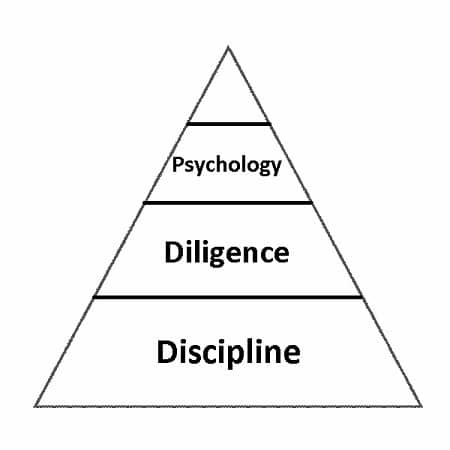
Developing traders often don’t understand, when you are asking to be a successful (or professional) trader, you are asking not just to build a pyramid, but to sit on top of it.  What most forget is the base is the biggest part of the pyramid and the foundation for building higher levels.

As the pyramid continues to grow higher, it gets a little more complicated, but you have a base (foundation) and structures in place to carry the stones up to the higher levels.

Pyramid Of Trading

But just like a pyramid, there are more stones at the base and this takes more time to build. Also like a pyramid, there are more traders at the base (not making money or breaking even) then there are at the top.

However, with structures and rhythm in place, the fruits of your labor will result in a steady conditioning of your muscles (discipline, diligence and psychology).  This will allow you to take on greater and greater heights, challenges and climb the pyramid of trading.  Having forex trading discipline, diligence and psychology will give you a sense of confidence and a feeling of mastery over the process.

This is the pyramid of trading and the attributes needed to climb to higher levels.

While most traders spend time trying to find profitable trades, or the next great system, make sure you take time out to build the attributes which develop your trading muscles (discipline, diligence and psychology). By yourself this can be a very difficult task so it helps to create mechanisms in your life to build these habits. Finding a mentor who can guide you along your path can be instrumental in developing yourself into a successful trader.  But cultivating the habits needed to take your trading to the next level simply requires some work and time.

Kind Regards,
Chris Capre
2ndskiestrading.com
Twitter; 2ndSkiesForex

For those of you looking for a mentor, make sure to check out our highly successful Online Courses to help take your trading to the next level while getting direct access and mentoring from Chris Capre.

A Brief History
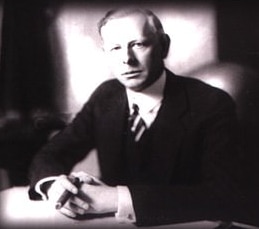
At the age of 14, Jesse Livermore began his trading career, although not as a trader.  He was one of the young boys who would stand on a wooden plank in front of a chalkboard posting the quotes of prices for speculators.  This was at the Paine Webber brokerage in Boston.
After about a year of this watching stock prices, noticing patterns, having hunches and checking to see how they did, he decided to make a move.  Keep in mind he had no education in economics, business or finance.  He came from a farming family and left at 14 to make a new life for himself.
He took his $5 in savings and made his first trade which he won.  After trading for several months, at the age of 15 he had made $1,000 in winnings (about 20k today).  By the age of 21, he went to New York with everything he had – $2,500.  Keep in mind, just before this he was actually up about $10,000 so lost 75% of his stake just before heading to the Big Apple.  How did he do in his first few hours of trading?  Lost almost half his $2,500, in about 2hrs.  He proceeded to lose the rest in a matter of days.  He actually had to borrow money at that point to continue.
jesse livermore
And continue he did, actually leaving Wall-Street to go make money where he knew he could, the bucketshops – places built specifically to help speculators lose money.  He gained enough money to come back to Wall-Street, only to lose it again.  He did this three times.
During the 1907 crash, he built up his wealth to $3million.  He had done so shorting the market until a plea from a man named J.P. Morgan asked him to stop shorting the market as it may threaten the financial stability of the country.
He lost virtually all of this (90%) on a blown cotton trade and had to start over.  He continued to lose money after this during the flat markets of 1908-1912, hitting a low of $1million in debt forcing him to declare bankruptcy. Remember this cotton trade as we will write about it in a later post.
Moving on to 1929, after slowly building up his stake again (after several losing periods as well), he made another big win shorting the market going into the crash.  How big?  To the tune of $100million dollars which would be worth billions in today’s value.
JesseLivermore
5 years later, FDR had created the SEC  which caused the markets to take on a completely different character, something never before seen in the markets. How did this effect Jesse’s trading?  He subsequently lost all of his $100million dollars.  When he died a few years later in 1940, including all his trusts and assets, he had a net worth of about $5million ($95million less from his all time highs).
The Lessons
Now that you’ve had a brief history of one of the most amazing traders and stories of speculators across time, what were some of his crucial lessons he learned from trading?
1) Learning how to read price was a critical aspect of his trading, learning how to spot opportunities, notice price behavior for an underlying instrument, find opportune times to get in, etc.  He spent the early days of his first year not trading, but watching, learning, observing and remembering price moves.   No indicators, no computers, no charts.  Nothing but pure price data and price action.  He could spot key levels where the market was going to bounce, or break out, or start a trend or crash through a key level.  But again, he learned this from hours and hours of observation of price behavior and price action.
He did not expect to get rich quick or cut corners.  He worked and studied hard to develop his skills.  One of his more famous quotes on the subject, “The game of speculation is the most fascinating game in the world. But it is not a game for the the mentally lazy, the person of inferior emotional balance, or the get-rich-quick adventurer. They will die poor.”  from his book, ‘How to Trade Stocks
You would not believe how many people I run into asking me how they can make money fast, or 10% per month for the next year (when they cannot even be profitable now), or say they want to be a ‘professional trader’.  Yet, they don’t fill out their trade journal, or do performance analysis on their systems or trading, or follow their trade plan, or work on their mental game, or spend time just studying the markets.
Jesse Livermore constantly filled in his trading journals and studied them endlessly, along with price movements and price action.  When he went to Wall Street and failed the first time, he spent the next several years analyzing his system.  It took him three times before he could return and be successful there.  He also worked exceptionally hard at his risk management and did not expect to do 10% per month every month for the next year.  He had no dreams or illusions about making fortunes.  He simply looked for the best opportunities and traded them.  And when he did, the money came.
2) Resiliency.  If you were to put 100,000 traders through the wins and losses and all the experiences Jesse went through, probably less than a few % would see it through the end.  He went through several divorces, actually asked his first wife to borrow money to keep trading which divided them forever.  He traded in ‘bucketshops’ designed to take people’s money with no regulatory bodies in place to protect anyone.  He had the poorest execution for the longest time and lost his entire stake over a dozen times.
Yet he always came back.  He studied harder, refined his system further, made less mistakes & learned from his big losses.  By eliminating most of his mistakes, getting more disciplined after each setback, sticking to his trading plan and constantly studying the markets, he came back with more vigor each time and greater successes, even after losing all his prior gains.  It takes resiliency to trade the markets, mental, physical, spiritual (if you will), that in the face of losses, humiliation, being undisciplined and being flat out wrong, to pick up and try again.  The best of all careers (and not just in trading) are marinated with characters of resiliency.
3) GettingThe Big Moves‘ or ‘Best Opportunities‘  Jesse Livermore was one of the few people to make money in both the 1907 and 1929 crashes.  While tens of thousands were losing fortunes, he was making money and becoming exceptionally wealthy in the process.  He was not married to any bias or view of the market (bullish or bearish).  He read the price action and found the best opportunities when they came.  He did not over-trade or expect to find exceptional trades every day.  He was patient, sometimes not trading for an entire year until conditions were ripe.  He noticed how people would get lured into markets that were not prime for making money and how often people lost during those times.  His discipline and patience allowed him further to get him into the ‘Big Moves’ being short the markets going into the 1907 and 1929 crashes.
Imagine you are short the strongest stocks to date before the market makes a big move, and then starts to fall and your profits are increasing by multiples of 2, 3, 5, 10, 20 or 50x.  Are you watching your profits in the ‘account balance’ window of your platform wondering when its going to reversethinking ‘I should just take my profits now‘?  Or are  you watching the two things you should be, the markets and your system, waiting for your exit signal.
By always keeping his eye on the markets and waiting for his signal telling him to exit, he was able to stay in the biggest moves of the decade and hold them until he got his signal (or was asked to stop selling the market so the financial system would collapse).  Nothing was more important to him than keeping his eye on the target and the markets.
Dozens More…
These are just some of the most important lessons from his career and I could write about dozens more which I will share in later articles about one of the greatest traders of all time. Jesse Livermore and his trading career is someone I can read about time and time again and continually learn from (whether trading is good or challenging).
Perhaps you are profiting from these volatile times, or perhaps you are finding challenges in trading this unique environment.  Hopefully you will benefit from these timeless lessons of Jesse Livermore’s career.
-May all good things for you increase.
Chris Capre
2ndskiestrading.com
Twitter; 2ndskiesforex
*For another great article on Trading Psychology, make sure to check out ‘The Pyramid of Trading