
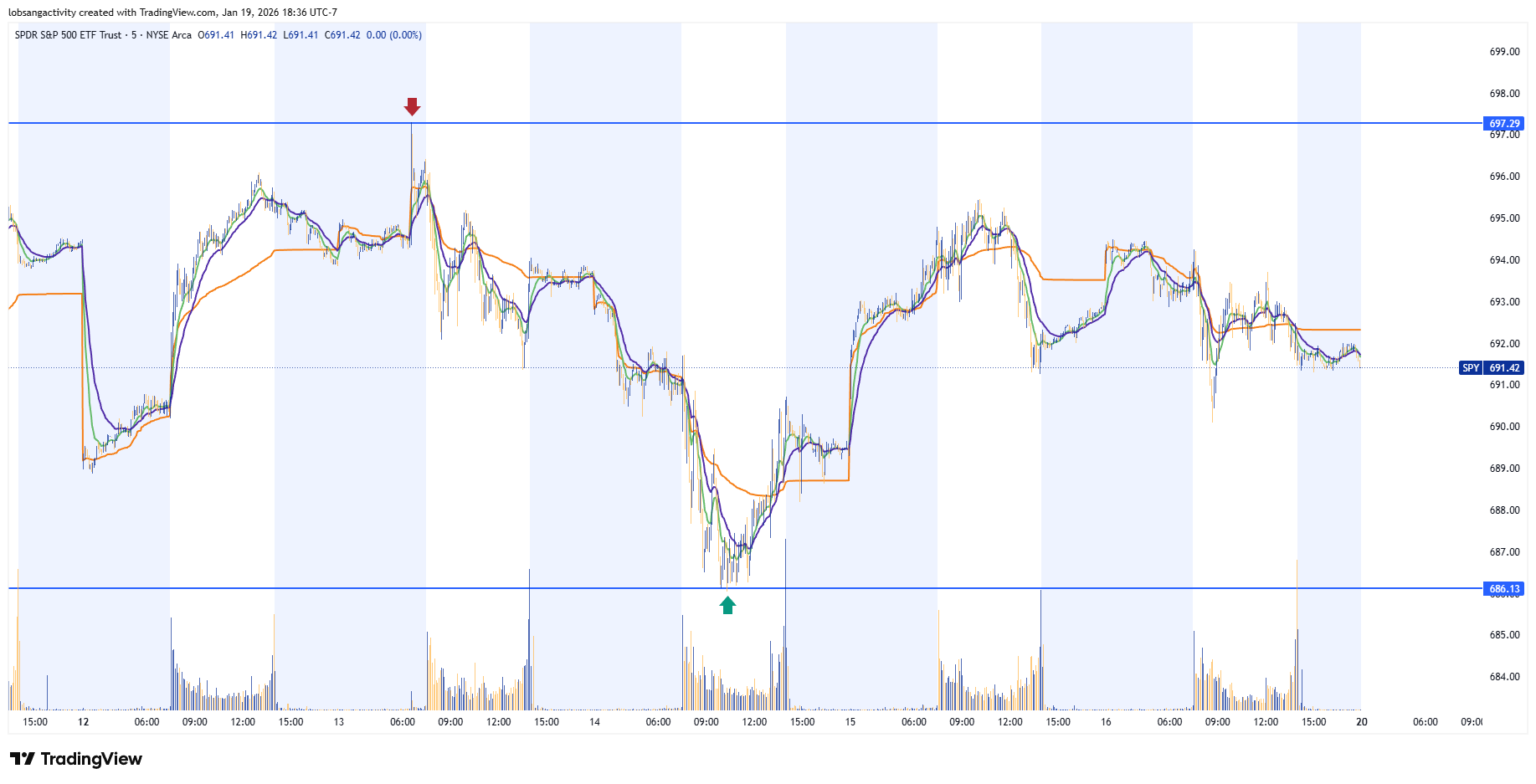
Last week SPY chopped in place finding resistance just ahead of the key 700 level we’ve been flagging for weeks while bouncing off 686 lows last week before recovering to close UNCH (unchanged).

5 min chart $SPY
SPY 2026 01 19 18 36 51

What seemed most interesting to us is a buildup of protective positions heading into earnings season and the FOMC next week. This was mostly done so via traders selling calls into rallies along with buying long OTM puts. This communicates to us traders are holding a mild bid to worry/defense vs adding long calls (bullish bets) as we barely hold around 690.

As long as we can hold the 690 support zone, we’ll hold a mild bullish bias up to 700. But if we lose the 690-686 support zone, then we’ll shift to a ‘risk off’ stance in SPY.

The Best Offense is Defense?

What we’ve been recommending since the beginning of the year and in the 2026 predictions was that the current Trump admin’s policies are increasing global tension. From taking Maduro in Venezuela to threatening Norway and the EU with tariffs for not giving the US Greenland, to potential conflict in Iran, we think traders will continue to pile into the defense sector.

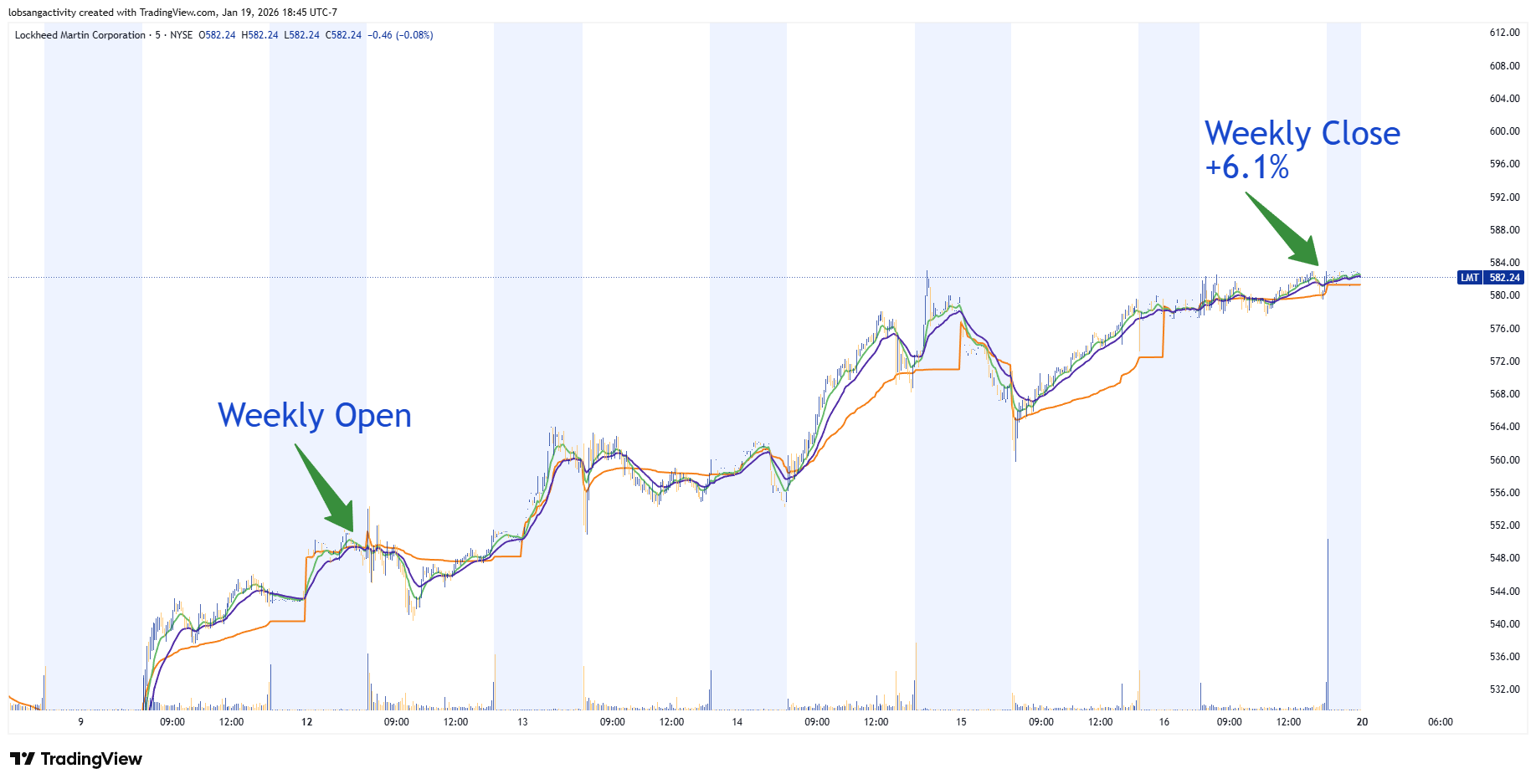
We mentioned $LMT in our trade setups we’re watching for last week as a potential play. We’d like to note $LMT climbed over +$33.43 last week, or +6.1%.

5 min chart $LMT
LMT 2026 01 19 18 45 13

Had you followed this recommendation, you’d have profited handsomely.

From a positioning perspective, we’ve seen more bullish bets pile into $LMT last week with traders buying long calls targeting $600. We’d like to note the $600 strike has now become the TGS (top gamma strike) + TCS (top call strike) combo level. We feel bullish traders are telling us they’re gunning for $600, so we’ll look for more bullish plays to target this, while looking to take profits just shy of this combo level. Lastly, we’d like to note that Trump’s threats to take over Greenland continue to escalate with tariffs on many EU countries, particularly Norway for snubbing him of a Nobel peace prize. Never mind the fact the Norwegian government doesn’t control who gets the Nobel peace prize, EU markets tanked on the news with every major EU index down, and China is opening up soft with 4/5 tickers in the red. Thus, we could be heading for a market gap lower and more ‘risk off’ sentiment going into the next two weeks.

Make sure to check in with our option flow report for TTM members tomorrow morning before the market opens, along with our live trading webinar next week to see what other tickers we’re looking to trade in the coming volatile weeks ahead.

Last week in our option flow report we predicted SPY would grind higher as long as it holds the key 690 TGS (top gamma strike). This played out as expected with SPY gaining a whopping 1.09% on the week from the cash open to close.

5 min chart $SPY

SPY 2026 01 11 17 01 11

We also mentioned in our 2026 market predictions that we think the Trump admin will move away from a rules based international order (think UN) vs applying executive action/orders in ways that will move supply chains away from the US. This manifested in Trump invading Venezuela and taking Maduro. We think this will lead to a) Latin America trusting us less while looking for supply chains outside the US, b) lead to a weakening of the USD, and c) be good for defense/military contractors.

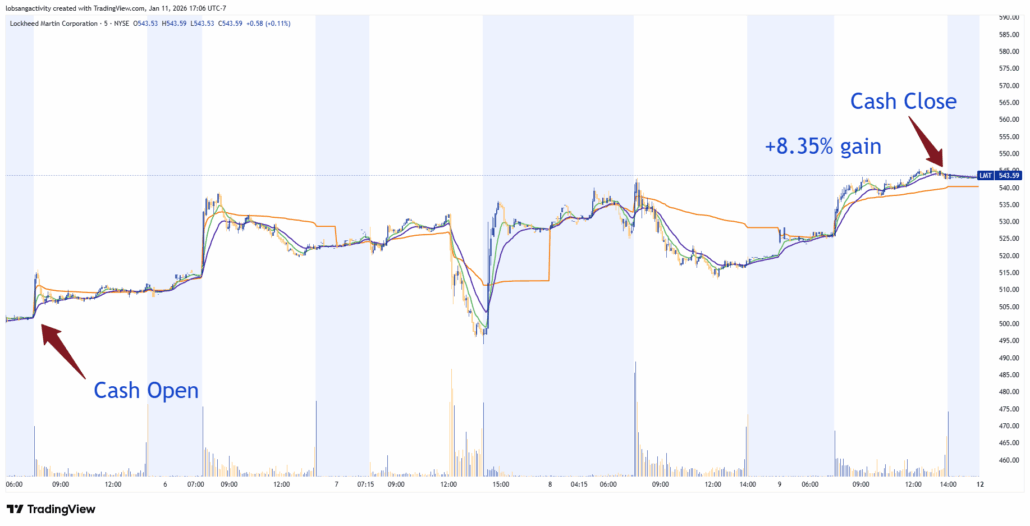
As you can see via the chart below, defense contractors did quite fine with $LMT (Lockheed Martin) gaining +8.35% on the week.

LMT 2026 01 11 17 06 12

5 min chart $LMT

We think defense contractors will continue to shine in this environment, especially with the Trump admin wanting to increase the military budget by 50%.

Along these lines, we also are watching trade setups in metals and materials, not just for mining, but also rare earths as we think this will continue to see upside pressure in an environment increasing with geopolitical tensions.

Tickers we like watching are $REMX and $XME. We currently have long calls in $XME and are long shares in $REMX, but we’ll be looking to add if they continue to find more upside.

Lastly, circling back to $SPY and the week ahead, we have the Jan op-ex on Friday, earnings starting to heat up and CPI/PPI on the 13th and 14th. With open interest building at 700 for SPY, we can see this being a clear upside target, but we also lean towards this acting as strong resistance that likely won’t be broken without a heavy bullish catalyst. After this op-ex, due to the call heavy positioning, we think the market could be vulnerable to a pullback after the Jan op-ex.

Make sure to check in with our option flow report for TTM members on Monday before the market opens, along with our live trading webinar next week.

We head into the first full trading week of the year with a dense macro calendar, elevated event risk, and market structure that remains highly sensitive to short-term flows. Together, these conditions create the potential for sharp intraday moves and volatility expansion, particularly as traders begin positioning for the first quarter. Below are the three primary drivers we’re watching in the week ahead.

Market Commentary Jan 5 9 2026 01

1. A Front-Loaded Macro Calendar with Asymmetric Risk

The week begins with ISM and PMI data, but the focal point is Friday’s Non-Farm Payrolls report, which will capture December labor conditions. A meaningfully weak print would mark the second negative employment signal out of the last three reports, reinforcing concerns around labor market softening and increasing the probability of policy repricing.

These releases matter less in isolation and more in how they interact with positioning and options flow—particularly given the market’s current sensitivity to growth and rate expectations early in the year.

Market Commentary Jan 5 9 2026 02

2. Short-Dated Options Flows as a Primary Intraday Driver

Short-dated (0DTE) options remain one of the most important intraday drivers of S&P 500 price action, and we expect this dynamic to be especially pronounced in the week ahead.

Throughout 2025, 0DTE options grew into a dominant component of daily options flow, with many sessions seeing over 60% of S&P 500 contracts concentrated in same-day expiries. This flow has materially altered intraday market behavior, particularly around dips and short-term support levels.

When traders sell 0DTE puts or buy short-dated calls, dealers are often forced to hedge dynamically. In rising or stable markets, this hedging process typically results in incremental long exposure, which can create a short-term tailwind for prices and reinforce the familiar “buy-the-dip” behavior seen during much of the past year.

However, this support is conditional.

During periods of elevated event risk—such as major macro data releases—0DTE participation can drop sharply. When short-dated flows fail to materialize, intraday support becomes thinner and more fragile, increasing the likelihood that key levels break rather than hold.

Trading implication:
With a heavy macro calendar this week, we expect strong 0DTE activity early in the week, which can fuel sharp intraday moves, including 1%+ swings. At the same time, traders should remain alert to moments when these flows step aside, as downside moves can accelerate quickly in their absence.

Market Commentary Jan 5 9 2026 03

3. Volatility Setup Favors Episodic Expansion, Not a Straight Trend

Volatility conditions entering 2026 suggest a shift from the unusually calm environment seen late last year toward episodic volatility expansion, particularly in the first quarter.

We ended the year with one-month realized volatility near historically low levels, while forward implied volatility continues to trade at a premium to spot. This structure indicates that market participants are pricing in a higher probability of volatility ahead, even if near-term conditions remain quiet.

Several factors support this view:

  • A dense macro calendar early in the year
  • Sensitivity to labor market and inflation data
  • Political and policy uncertainty as the new year begins

Rather than expecting a sustained volatility trend, the more likely outcome is short, sharp volatility spikes—often lasting one to three weeks—followed by periods of relative calm.

Trading implication:
This environment favors selective, time-bound long volatility exposure rather than constant positioning. Instruments such as VIX or volatility-linked products can offer asymmetric opportunities if entered during periods of compressed volatility and rising event risk. Conversely, traders should be cautious about assuming that low volatility will persist simply because recent conditions have been quiet.

In Closing

The first quarter is likely to play an outsized role in setting the tone for 2026. With policy uncertainty, macro data sensitivity, and options-driven flows all elevated, traders should expect a more reactive market environment—particularly in the weeks ahead. Staying focused on key events, positioning dynamics, and volatility conditions will be critical as the year gets underway.

For a broader framework on the regime shifts we’re watching this year, we encourage readers to review our full 2026 outlook.