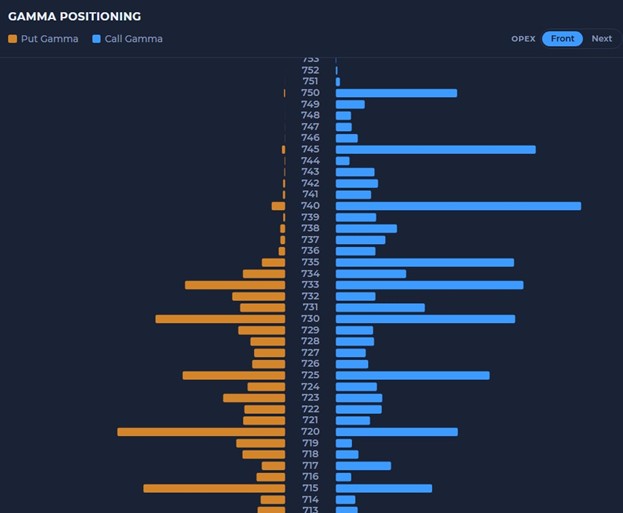
If you’ve ever seen price stall at a level that wasn’t on any chart you were looking at, or reverse exactly where you didn’t expect it to, there’s a good chance gamma positioning was the reason.
Most traders spend years studying candlesticks, moving averages, along with support and resistance levels they see on the chart. What they’re rarely taught is the most important levels in the market aren’t drawn on charts at all. They exist in the options market — in the gamma exposure of the institutional players who make markets and hedge risk for a living.
This article explains what gamma positioning is, why it matters for every trader regardless of whether they trade options, and how to read the four key levels — TCS, TPS, BBP, and TGS — that reveal where the big money is sitting and where price is likely to go next.
THE FOUNDATION
What Is Gamma in Options Trading?
Before explaining gamma positioning, it’s worth understanding what gamma itself is — and why it creates the market dynamics we’re going to discuss.
In options, delta measures how much an option’s price changes for every $1 move in the underlying asset. Gamma measures how fast delta itself changes as price moves. A high-gamma option is one where a small move in the underlying creates a large and rapid change in the option’s directional exposure.
For most retail options traders, gamma is an abstract risk metric. For market makers — the institutional players who are on the other side of most options trades — gamma is an active hedging obligation that forces them to trade the underlying asset continuously as price moves.
Key insight: When you buy an option, someone sells it to you. That seller, either a broker or a market maker, immediately takes on gamma exposure they must hedge. How they hedge that exposure creates predictable, recurring price behavior at specific strike prices.
This hedging activity is what gamma positioning reveals. It’s not about the options themselves. It’s about the mechanical behavior of the players who must manage their exposure as price moves.
THE MECHANISM
How Market Maker Hedging Creates Predictable Price Behavior
To understand why gamma positioning & hedging matters for price, you need to understand what market makers are doing after they sell an option.
When a market maker sells a call option (which makes them short a call), they collect the premium and take on the obligation to deliver shares if the option is exercised. To delta hedge that risk, they buy shares of the underlying asset. The amount they buy is proportional to the option’s delta. As prices rise and delta increases (because they are short a call), they must buy more shares. As prices fall and delta decreases, they sell shares. This can amplify movements in the stock price. This is a big part of what happened to $GME in 2021, creating a gamma squeeze.
On the other side, when a market maker sells a put (which makes them short a put), they hedge by selling shares as price falls (to match the increasing delta of their short put). This means they’re selling into weakness, which amplifies price movement.
The critical insight is this: the direction and intensity of this hedging activity is entirely predictable if you know where the largest options positions are concentrated. That’s what gamma positioning shows you.
THE TWO REGIMES
Positive vs. Negative Gamma: Two Completely Different Market Environments
Gamma exposure across the market isn’t uniform. At different strike prices, dealers may be long or short gamma, and the balance between those two states creates two very different market environments (which you can see via the graphic below).
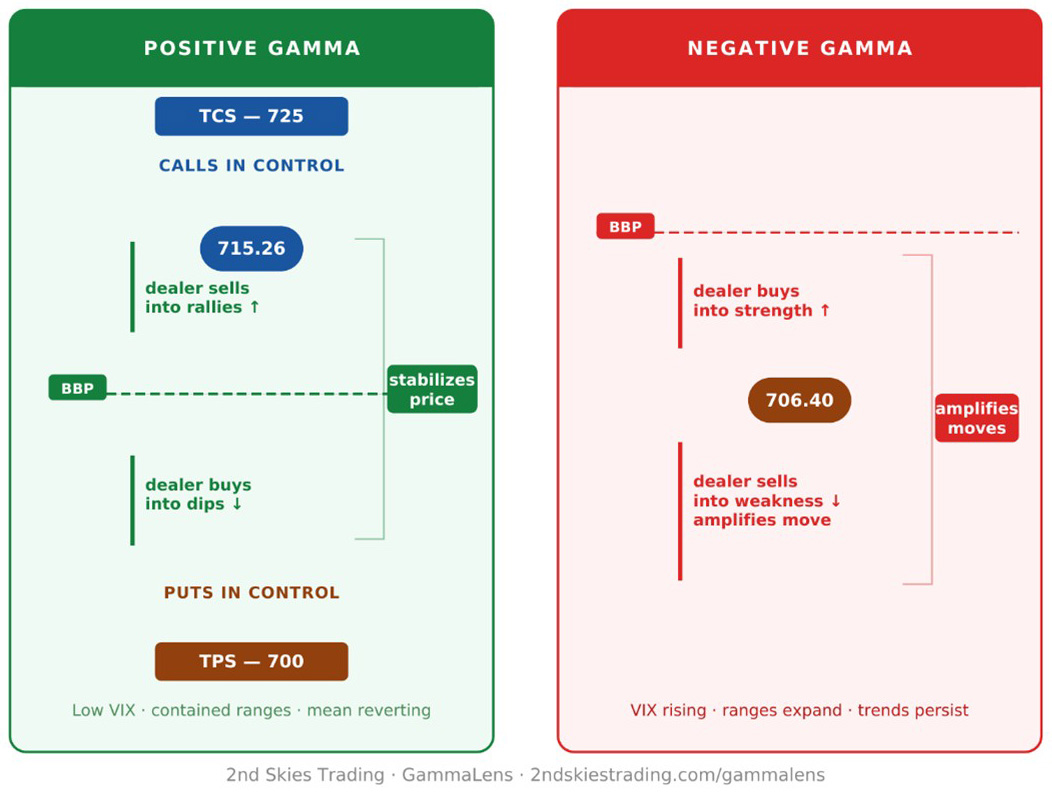
Positive Gamma Environment
When the market is in a positive gamma environment, meaning dealers are net long gamma, their hedging activity is stabilizing. They sell into strength and buy into weakness, keeping price in a tighter range. Realized volatility tends to be low. Intraday ranges are contained. Price moves feel controlled and orderly.
This is the environment where mean reversion strategies work well, where implied move expectations tend to be accurate, and where key strike prices act as reliable magnets for price action.
Negative Gamma Environment
When the market crosses into negative gamma territory, meaning dealers are net short gamma, their hedging activity flips. They buy into strength and sell into weakness, moving in the same direction as price rather than against it. This amplifies moves, increases realized volatility, and creates the kind of trending, high-momentum price action where ranges expand significantly.
Understanding which gamma regime the market is currently in, and where the transition point is, is fundamental to setting realistic expectations for how far and how fast price can move on any given day.
The transition point between positive and negative gamma is one of the most important levels on the board. In the PFP framework, we call this the Bull/Bear Pivot (BBP), and it’s covered in detail below.
THE FOUR LEVELS
The Four Key Gamma Positioning Levels: TCS, TPS, BBP, and TGS
Gamma positioning across the options chains create a landscape of key levels. In the PFP framework, we track four that matter most for understanding where price is likely to go and how it will behave when it gets there.
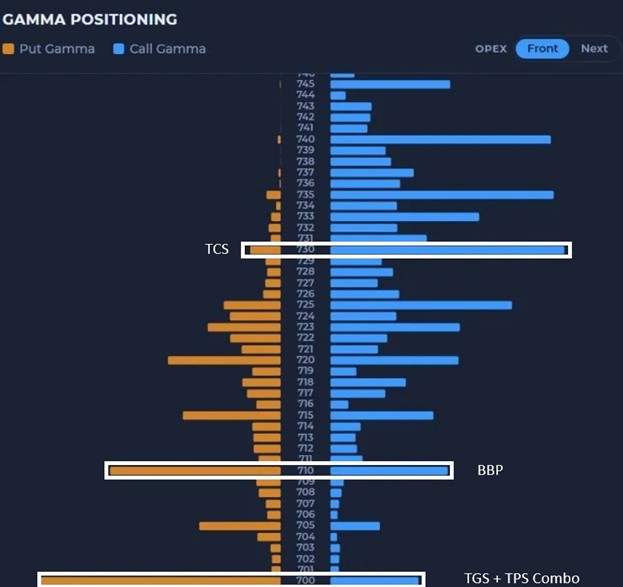
| Level | What It Is |
|---|---|
| TCS — Top Call Strike | The strike with the largest concentration of call gamma. Price tends to gravitate toward it in bull trends and can stall or act as a resistance level when price reaches it. |
| TPS — Top Put Strike | The strike with the largest concentration of put gamma. Functions as a key downside target + support level when price reaches it. |
| BBP — Bull/Bear Pivot | The transition point between positive and negative gamma. Above it, dealers stabilize price. Below it, they amplify moves. One of the most important levels on the board. |
| TGS — Top Gamma Strike | The single strike with the highest total gamma across both calls and puts combined. Often acts as a gravitational center for intraday price, thus a level price can consolidate around. |
TCS — Top Call Strike
The Top Call Strike is the strike price where call gamma is most concentrated for a given expiry. When large institutional players or retail traders accumulate call options at a specific strike, the market maker on the other side has taken on significant gamma exposure at that level.
As price approaches the TCS from below, dealer hedging activity (buying the underlying to maintain delta neutrality) creates an upward pull that can act like a magnet for price. However, once price reaches the TCS, dealers who are now significantly long the underlying begin selling into further strength to stay hedged, which creates friction, resistance, and often a stall or reversal.
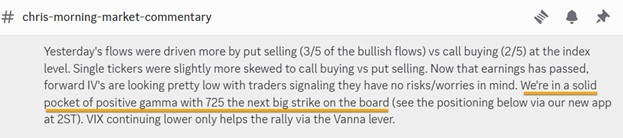
On Friday May 1, 2026, GammaLens showed 725 as the dominant TCS on the SPY board for the front expiry. The morning commentary at 6:49am MST noted: “We’re in a solid pocket of positive gamma with 725 the next big strike on the board.” SPY hit 725 by Friday’s close, which we called before the move, using positioning data alone.
Practical application: When price is trading below the TCS in a positive gamma environment, the TCS is your upside target. When price tags the TCS, watch for stalling, mean reversion, or a range-bound consolidation as dealer selling absorbs momentum.
TPS — Top Put Strike
The Top Put Strike is the mirror image of the TCS on the downside. It represents the strike with the heaviest concentration of put gamma, thus the level where market makers have taken on the most put-related hedging obligations.
When price approaches the TPS from above in positive gamma, dealers must buy the underlying to hedge their delta exposur. This buying activity creates a floor, thus a level where natural institutional demand supports price. The larger the put gamma at a given strike, the more more likely it will be tagged as price moves lower.
The TPS is not just a support level in the traditional technical analysis sense. It’s a level with a mechanical hedging force behind it, one that operates regardless of what the candlestick patterns, price action or moving averages are saying.
Practical application: The TPS is your key downside target in a bearish environment. A sustained close below the TPS, especially in high volume, signals that institutional put positioning has shifted lower and the support floor is more likely to give way.
See what most traders never do — before the move.
Join Second Sight for weekly institutional positioning and options flow, broken down in plain English. Free.
No spam. Unsubscribe anytime.
BBP — Bull/Bear Pivot
The Bull/Bear Pivot is arguably the most important single level in gamma positioning analysis. It’s the strike price at which total dealer gamma exposure flips from positive to negative. Thus it’s a transition point between two market regimes (positive and negative gamma).
Above the BBP, dealers are net long gamma. Their hedging stabilizes price, meaning they sell into rallies, buy into dips. This leads to a more stable market with an overall bullish contour with some mean-reverting action. This is a favorable environment for range trading, spread strategies, and buying dips with defined targets.
Below the BBP, dealers flip to net short gamma. Their hedging now amplifies moves, meaning they sell into weakness, buy into strength, and the market becomes more trending + volatile. Ranges thus expand. Moves that look overextended on a chart can continue much further than expected because the mechanical hedging flow is pushing in the same direction as price.
Understanding which side of the BBP price is trading on fundamentally changes how you should approach the market on any given day. It impacts your strategy selection, your risk parameters, and your expectations for how far price can move.
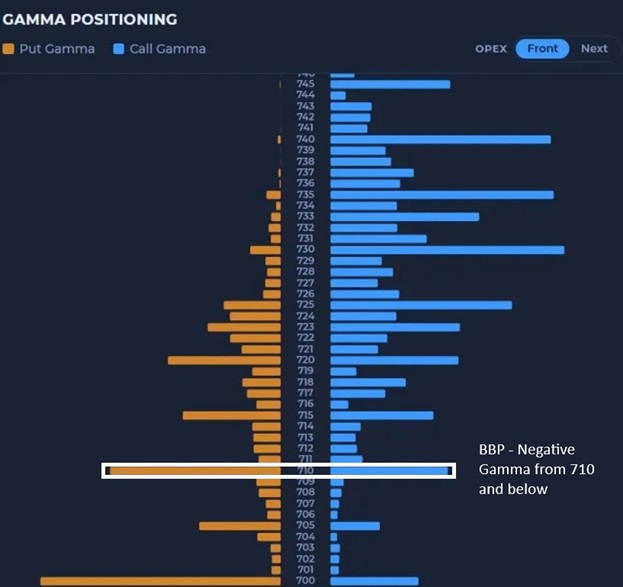
Practical application: Use the BBP as your daily directional filter. Trading above the BBP with a bullish bias in a stable, range-bound framework. A break below the BBP, particularly on heavy volume, is a signal that the market regime has shifted and volatility is likely to expand.
TGS — Top Gamma Strike
The Top Gamma Strike is the single strike price with the highest combined gamma across both calls and puts. Unlike the TCS and TPS, which look at gamma by type, the TGS looks at the total gamma weight regardless of direction.
The TGS often acts as a gravitational center for intraday price action. Because dealers on both sides have large hedging obligations at this level, price tends to orbit around it, or pin near it heading into expiration as dealer activity keeps pulling price back.
The TGS is particularly useful for understanding where price is likely to consolidate or settle on high-gamma, low-volatility days. On days when implied volatility is compressed and the market is in a deeply positive gamma regime, the TGS can act as an high gravity level for price throughout the session.
WHY IT MATTERS
Why Gamma Positioning Matters Even If You Don’t Trade Options
A common misconception is that gamma positioning is only relevant for options traders. It’s not. If you trade stocks/equities, ETFs, or any instrument that’s influenced by options market dynamics, which includes virtually every major stock and index, gamma positioning is impacting your trades whether you’re aware of it or not.
Options market structure doesn’t just influence options prices. Through the continuous hedging activity of market makers, it directly influences the price of the underlying asset. The TCS, TPS, and BBP that show up in the gamma positioning data are the same levels where equity traders see unexplained corrective moves, reversals, and breakdowns, levels that don’t come from any traditional chart pattern.
Understanding gamma positioning gives you the answer to the question that frustrates most traders: why did the price action stop right there? The answer lies not because of a trendline or a moving average. The answer is due to massive hedging that was sitting at that strike, and the market makers on the other side had no choice but to trade against the move to stay hedged.
HOW TO READ IT
Where Can You Get the Gamma Positioning?
Gamma positioning data comes from options chains, specifically from calculating the gamma exposure across all open contracts at every strike price. The raw data is available through options chains on most brokers, but calculating meaningful gamma exposure levels from raw options data requires significant processing.
GammaLens, built by 2ndSkies Trading, was designed specifically to solve this problem. It displays real-time gamma positioning across 100+ of the most actively traded tickers, showing the TCS, TPS, BBP, and TGS clearly alongside a live price feed, with multiple expiry views available at a glance. GammaLens is included with the PFP course, the complete framework for reading institutional positioning, options flow, and price action together.
LIVE EXAMPLE
A Real Example: Calling 725 on SPY Before the Open
Theory is useful. But the clearest way to understand gamma positioning is to see it applied to a real timestamped market call.
On May 1, 2026, GammaLens showed the following structure on SPY for the front expiry:
- TCS at 725 — the dominant upside target, carrying the largest call gamma concentration on the board
- Current price trading around 719, sitting near a significant call gamma level for the front expiry
- Positive gamma environment overall = VIX suppressed, dealer flow stabilizing
The morning market commentary at 6:49am MT that day read: “We’re in a solid pocket of positive gamma with 725 the next big strike on the board… until we get a close below 715 in SPY, we like staying bullish.”
SPY hit 725 by Friday’s close. The call was made before the market opened, using the gamma positioning data visible in GammaLens. No pattern recognition. No indicator confluence. Just a clear read of where the institutional hedging walls were sitting and which direction the flow would push price.
This is what gamma positioning makes possible: not certainty, as the markets are never certain, but a structural edge. Knowing where the large players are concentrated, what the hedging mechanics will do near key levels, and which direction the flow will push the price action gives you a framework that most traders simply don’t have.
KEY TAKEAWAYS
Key Takeaways
- Gamma positioning reveals where market makers have their largest hedging obligations, and those obligations create predictable, mechanical price behavior at specific strikes
- The four key levels to track are TCS (upside target/resistance), TPS (downside support), BBP (the positive/negative gamma transition), and TGS (intraday gravitational center)
- Above the BBP, dealers stabilize price. Below it, they amplify moves. Knowing which gamma regime you’re in fundamentally changes your strategy selection and risk parameters
- Gamma positioning matters for equity traders, not just options traders, dealer hedging affects the underlying price of every major stock and ETF
- Gamma positioning is most powerful when combined with price action analysis and options order flow, not used in isolation
Learn to Read the Institutional Data Layer in Real Time
Our GammaLens shows you the TCS, TPS, BBP, and TGS across 100+ tickers, updated live, alongside a real-time price feed. It’s included with the PFP course: the complete framework for trading institutional positioning, options flow, and price action together.
Related Articles
How Options Dealer Hedging Moves Stock Prices — Article 2 in the gamma positioning series
Risk of Ruin Calculator for Traders — Know your real probability of blowing up before your next trade