Tag Archive for: gbpjpy

We are back with another Top Trade Review, this time a pullback setup for +380 pips of profit, or 10.1R return on the GBPJPY pair.

In this video we look at the exact price action strategy, stop loss and take profit our student used to bank this winning trade, along with suggestions to improve trade performance.

Read more

Chris Capre’s current live open price action & ichimoku trades: USDMXN, EURRUB, EURMXN, BIG, DIS, AC, ISD

New to Forex? Then check out my FREE Learn Forex Trading Course with videos, quizzes and downloadable resources

Top Trade Review: Check out our latest Top Forex Trade Review with my student banking +158 Pips on the EURCHF nailing a PERFECT ENTRY!

Forex Trade Idea: GBPJPY – Buy & Sell Setups Available (daily chart)

Price Action Context

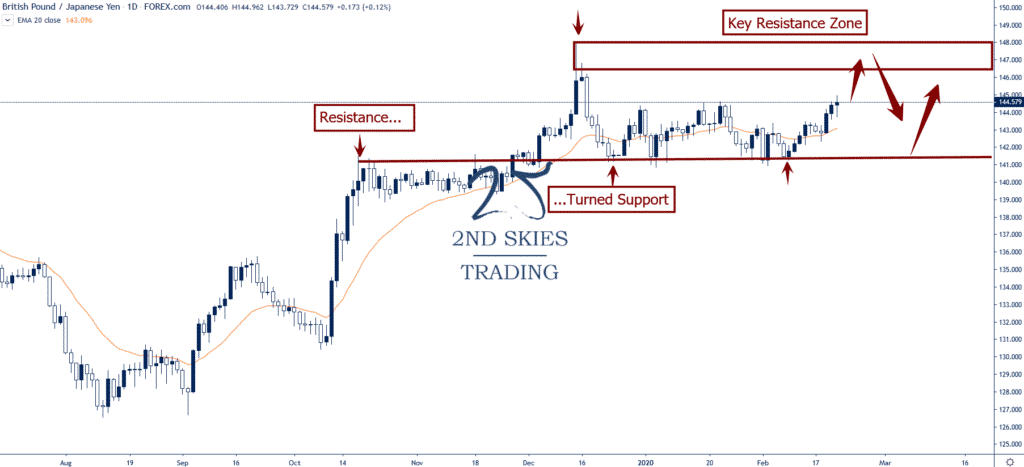
For all of 2020, the GBPJPY forex pair has been stuck in a 325 pip range between 141.25 and 144.50.

The pair however has gained 7 of the last 10 days, and is making an earnest attempt to break the yearly highs.

Doing so would put key resistance zone between 146.60 and 148 into play where likely profit taking will emerge, along with some sellers.

Meanwhile a failure to break the yearly highs would likely put 143 and 141.25 into focus.

gbpjpy forex pair 2ndskies

Trending Analysis

ST & MT neutral while inside the 325 pip range. Watch break for next technical direction.

Key Support & Resistance Levels

R: 146.60, 148

S: 141.25, 139.45

Stay tuned with our members market commentary for updates.

******

Commodity Trade Idea: XPDUSD (Palladium) – Makes New Yearly Highs, Lifts Support Zone (4hr chart)

Price Action Context

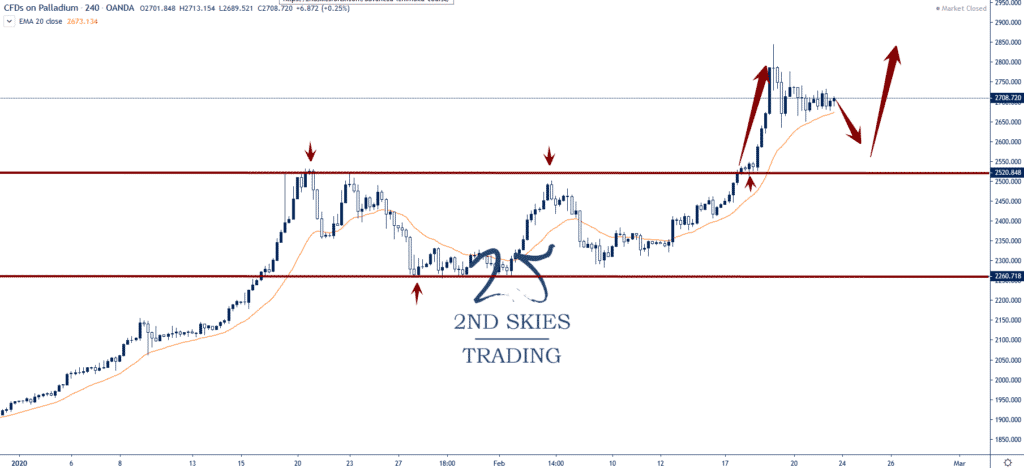
After going gang-busters to start the year, climbing from sub 2K to 2520 last month, Palladium formed a large corrective structure for about a month.

That structure just got annihilated as the precious metal broke through the 2520 resistance ramping up to 2545 in a couple days.

Since then the PM has consolidated its gains while tidily holding above the 4hr 20 EMA (chart below).

palladium bullish setup 2ndskiesforex

Trending Analysis

I’m bullish on Palladium till we get a weekly close below 2500. I’m watching for corrective pullbacks towards support to get long.

Key Support & Resistance Levels

R: 2845, 3000

S: 2520, 2260

******

Crypto Trade Idea: Bitcoin (BTCUSD) – Looking to Buy On A Pullback (daily chart)

Price Action Context

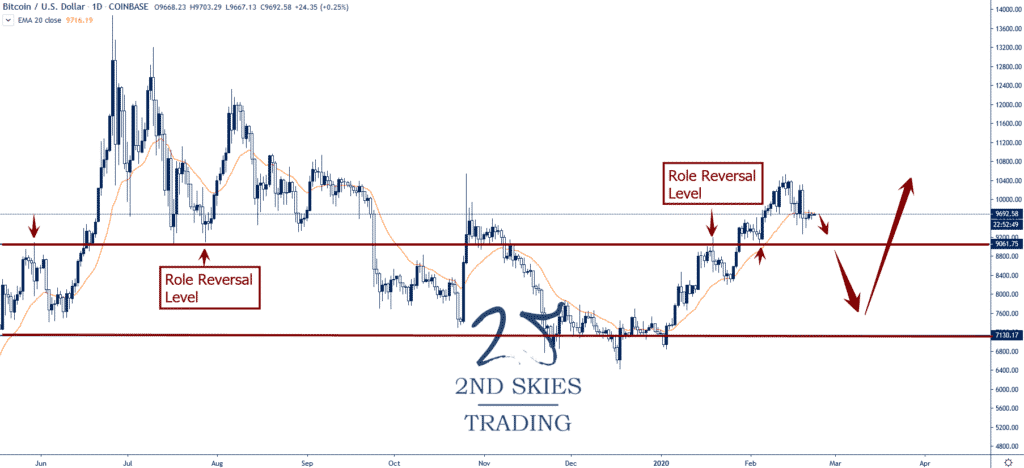
Bitcoin has had a pretty solid start to the year, up +30% on the year.

You’ll notice the strong momentum on the daily chart below in how the price action maintained its bullish position above the 20 ema.

Recently however, the cryptocurrency has played on both sides of the 20 EMA, suggesting the momentum short term is weakening.

To me, the overall bull trend to start the year is in place, but may be taking a pause.

I’m looking to buy a pullback into support with the first potential level being the role reversal level around 9060.

bitcoin trade idea 2ndskiesforex

Trending Analysis

ST neutral but MT bullish while above 7250 on a weekly closing basis.

Key Support & Resistance Levels

R: 10450, 12000

S: 9060, 7130/7250

******

Chris Capre’s live open price action and ichimoku trades: GBPUSD, NZDJPY, USDJPY, USDNOK, CAC40, VIX

New to Forex? Then check out my FREE Learn Forex Trading Course with videos, quizzes and downloadable resources

How Much Should You Risk Per Trade? Watch our latest video How Much Should You Risk Per Trade {3 Rules}

GBPJPY – Testing Multi-Year Support (Weekly chart)

Price Action Context

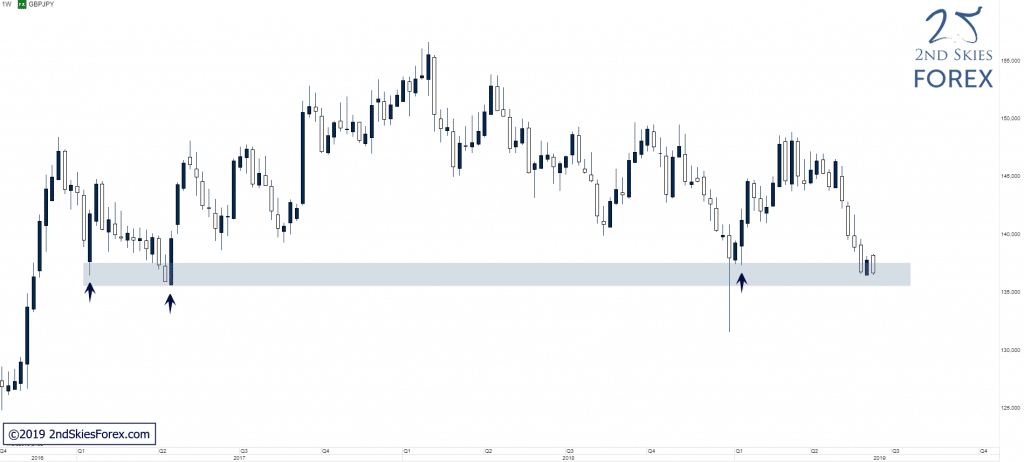
After breaking below 140.00, the strong selling continued and the pair is now testing a multi-year support zone at which I think at least a solid ST bounce is likely considering the significance of this support zone.

forex-gbpjpy-key-support-2ndskies

Trending Analysis

If bulls are able to successfully defend this key support, a move back up towards 140 is likely IMO and should 140 fail to stop price, 148 would be the next key resistance to look out for. A failure of this support on the other hand would open up a solid amount of downside with 130 being the first support in line to look out for.

Key Support & Resistance Zones

R: 138.60 – 140.00
S: 135.50 – 137.50


******

XAUEUR – Broken Above Key Resistance, Potential False Break (Daily chart)

Price Action Context

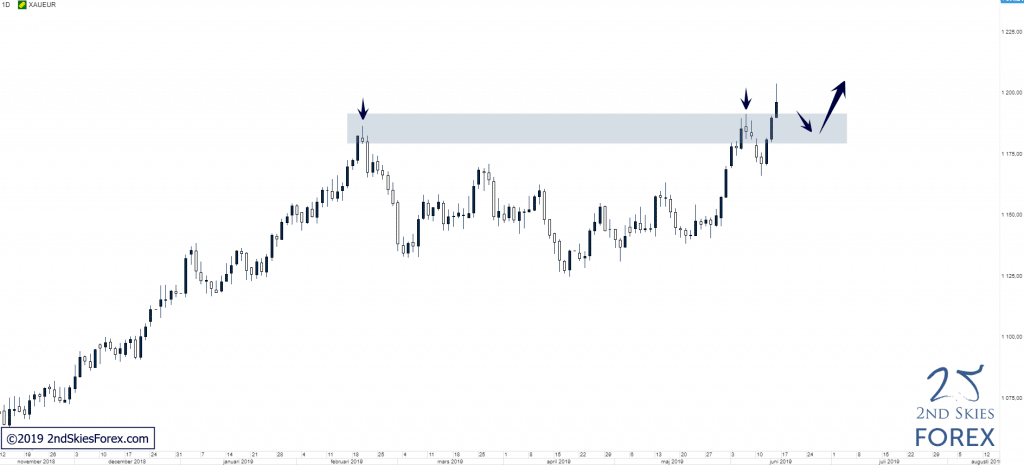
After a brief rejection at the KSP from February, the precious metal found support at 1 170 and impulsively broke above 1 190, producing a solid bullish close above the resistance.

gold-vs-euro-bullish-trend-2ndskiesforex

Trending Analysis

LT bias is bullish and weak pullbacks towards the broken resistance can present potential buying opportunities. A break and close back below 1 180 would render this a CT FB and initially open up for a move back down to 1 135.

Key Support & Resistance Zones

R: 1 215 – 1 225
S: 1 180 – 1 190

******

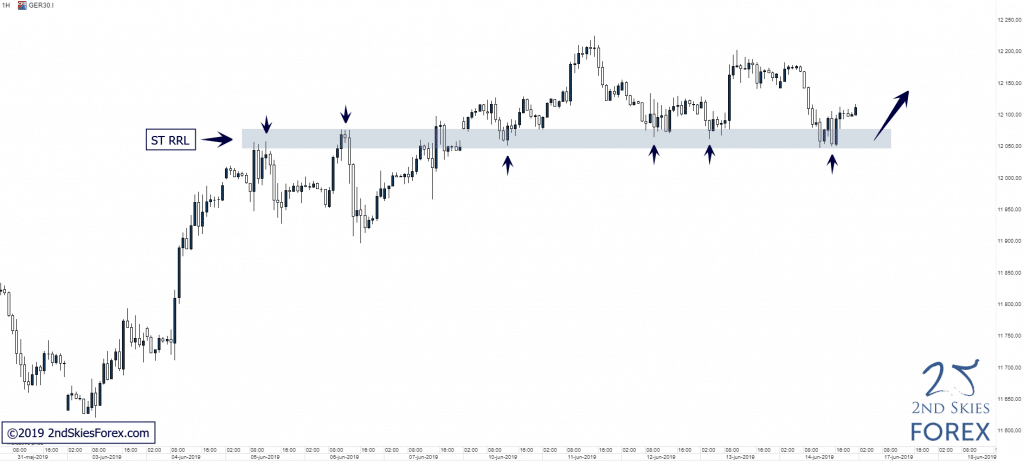
DAX – Holding Above ST RRL (1h chart)

Price Action Context

After putting in a WT false break at 11 850, which we talked about in our commentary on the 8th of June, price continued trading higher and is currently holding above a ST RRL.

dax-trade-signal-2ndskiesforex

Trending Analysis

LT bullish bias and bulls can look for possible buying opportunities around the ST support level. A break below this ST support would open up for a move lower back into 11 850 which in turn also could present potential buying opportunities IMO.

Key Support & Resistance Zones

R: 12 173 – 12 225
S: 12 045 – 12 080

Today’s price action tip article is designed to give any beginning, or non-profitable trader, 2 critical tips to help accelerate your learning curve and avoid the pitfalls almost everyone falls into.  If you can learn to follow these two beginner forex trading tips, then you will find yourself making more winning trades, along with less mistakes that tend to get you in trouble.

Trading is already hard enough, regardless of your level, so integrating these two tips will help you to make more winning trades.

Tip #1:  Trade Only When The Price Action & Direction Is Clear
Although this may seem confusing for the beginner, as price action rarely seems clear, there is actually a simple model to determine whether the price action and direction is clear.

The model I use daily to determine the direction/clarity of the market is looking for impulsive price action moves.  To briefly sum it up, impulsive price action is when the institutional players (those that move the market) are either heavily buying or heavily selling the market.  You can spot these moves by three simple characteristics;

1) The bars are quite large

2) They are mostly one color

3) They have closes towards the highs or lows (in the direction of the move)

When you see these three things, you almost always have an impulsive move.  And when you have an impulsive move, those that move the market are predominantly pushing it in one direction, which is the direction you want to trade with.  When you can find the correct direction, and trade it, you give yourself the greatest probability of making money.

An example of some impulsive moves are below, and you will see when looking at the chart, you will definitely want to be trading in that direction.

Silver 4hr Chart
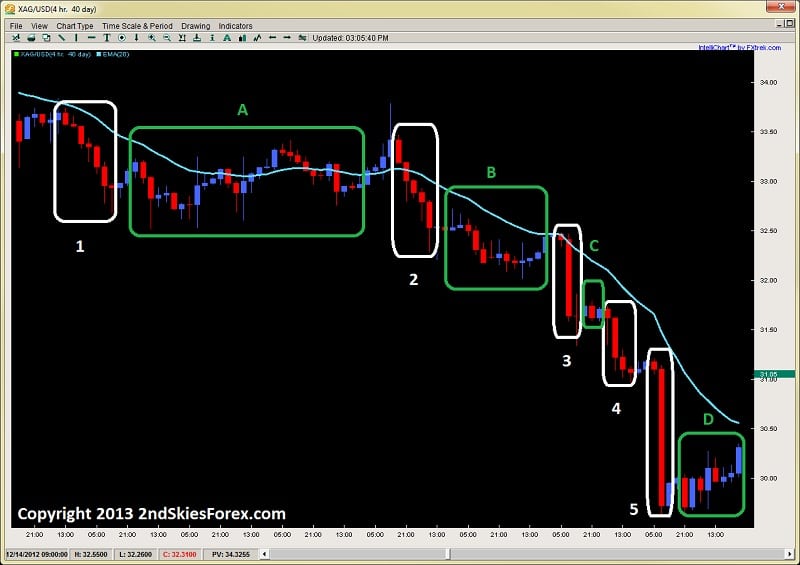
impulsive price action 3 tips for beginning traders 2ndskiestrading.com

Looking at the chart above, you will see two colors of boxes; White and Green.  If you look at all the white boxes above, you will all notice they have the three characteristics of impulsive moves described above.

Compare them to the green boxes – these have the opposite of the 3 characteristics of impulsive moves. These are called corrective moves, and for beginning traders, they should be avoided as a whole.  When in doubt, if you do not have a clear market or impulsive moves, avoid trading.

Often times for beginning traders, finding the right direction is difficult, and it seems like you tend to find the opposite side of the move.  By learning to only trade with impulsive moves and the price action is clear, you are saying to yourself, ‘I’m only going to fish when the easy fish are around’.

Tip #2:  When Trend Trading – Best to Buy or Sell When the Prior Bar Closes in Your Direction
This is a general rule I suggest to use until you get really good at trading trends.  The reason for this is simple;

a) If you are looking to buy in an uptrend, you have a greater chance of being correct when the last bar to close, closed bullish.
b) If you are looking to sell in a downtrend, you have the greater chance of being correct when the last bar to close, closed bearish

If you think about it – when looking to buy in an uptrend and the last bar closed bullish, it is a confirmation for the last candle (and time), the bulls were in control.  This bullish close is more likely to inspire bulls the trend is still alive.

Contrast this to buying when the bears demonstrated control on the last bar.  This means they dominated the order flow for that bar, and may be pushing against your orders.  This increases the chance the bulls will take profit after seeing a bear bar as opposed to a bull bar (continuation).

However, if the bulls demonstrated control on the last bar, then they are likely still present pushing the market in your favor, so this gives you a greater probability to have follow through on your trade when you enter the market.

Two examples are below.

GBPJPY 4hr Chart
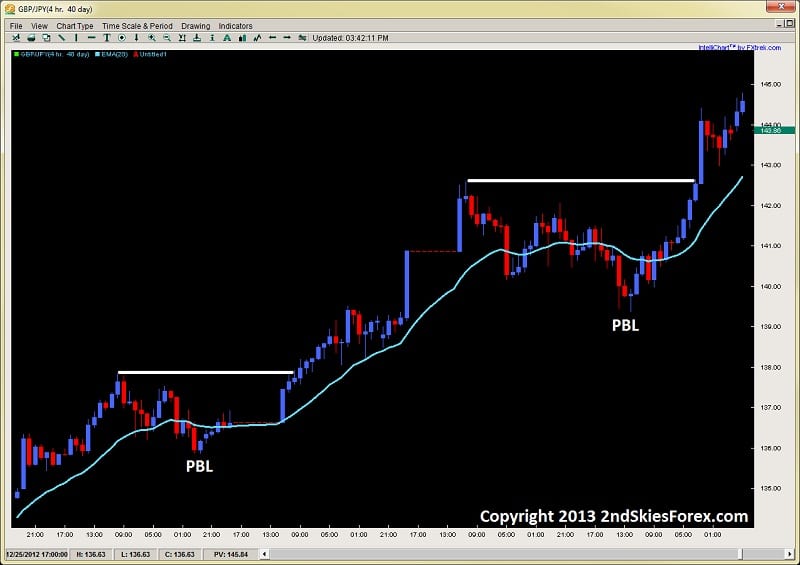
pullback low pbl price action chris capre 2ndskiestrading.com

In this chart, we clearly have an uptrend, which offers a couple of with trend pullbacks.  In these pullbacks, you will see two PBL’s (Pullback Lows), which led to a breakout of the prior SH (Swing High) for the trend. You will notice in both of them, the low for the pullback was a bull candle, and the follow up price action was a strong series of bull candles to follow.

Another example is in the chart below on the EURJPY 4hr Chart
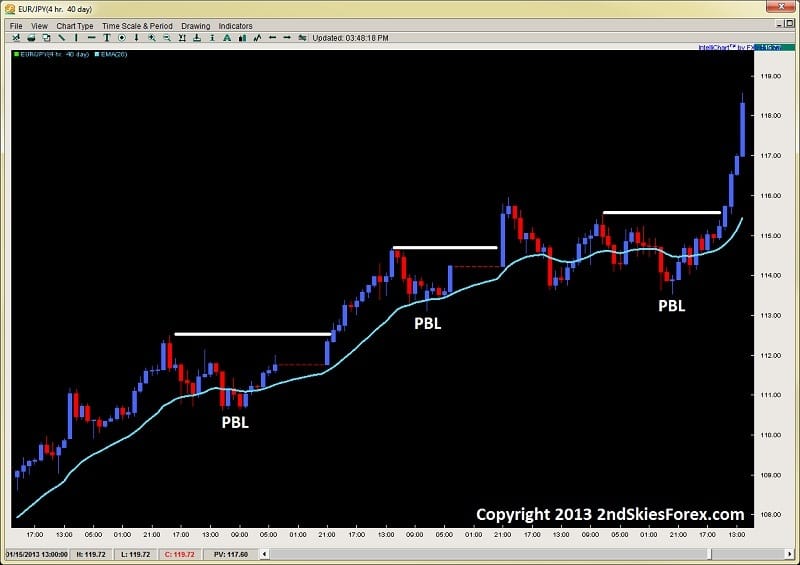
price action pullback low pbl chris capre 2ndskiestrading.com

In this chart, we have 3 major with trend pullbacks, and in two out of three of them, the PBL’s had a bull bar at the bottom, also demonstrating this principle.  As a general rule, bulls will feel more confident buying a pullback (or breakout) in a trend, when the last bar closed bullish. This is a stronger communication the bulls have been able to take control of the price action and order flow for the last bar.

In Summary
Trading is already challenging enough, and finding the right direction is one of the most crucial aspects to making good trades. In the beginning, you already have enough to think about, so try to keep it simple, and trade when the direction is clear.  Look for impulsive price action moves as much as possible, and when you find them, trade in that direction.

However, when the price action is not clear, try to stay out until a clear signal and market emerges.

When trend trading, you have a much better chance in the beginning, if you buy/sell when the last bar closes in your direction.  This closing in your direction is a clearer communication from the market, the bulls/bears are more likely in control, and in your favor.

I hope these two beginner forex trading tips help you.

To learn more price action techniques and systems, make sure to check out my price action course where I have a large community of traders, posting live trade setups daily, and I teach them how to read and trade price action.

The learning process never ends for a trader.   The market is always evolving and you have to adapt. Algorithmic trading was about 3% of the FX market in 04′.  Now 28% of it is just HFT’s alone! Think that has changed the intraday price action?  Absolutely!
Thus, you must always be learning, evolving and challenging yourself.  There are always refinements and greater depths to what you are doing, whether you are trading price action, ichimoku or other rule based systems.
Regardless of your skill level in trading, you are going to make mistakes.  I make mistakes, but I learn from them with alacrity.  I quickly analyze what I did wrong, visualize what I would do differently, clear my mindset and get back to business.   The difference between a professional & beginning trader is usually two-fold;
1) they make less of the typical mistakes beginners do
and
2) they rebound much faster, control the damage quicker and get back to business
Analyze your last year of trading in your journal.  I’m willing to bet if you eliminated just one or two mistakes you continually repeat, your current losing year would have been a profitable one.  If you ended the year break-even, then it likely would have been highly profitable.
Eliminating mistakes is one of the fastest ways to profitability. The sooner you discover, eliminate and transform them, the faster your equity curve will climb.
Thus, in the spirit of this, I will share my top trading mistakes for 2012 in the hopes you can learn from them.
1) Trading and Investing are Two Different Things
I am a trader first and foremost, but I also am invested long term in physical gold.
To ‘invest’ in physical gold, you constantly have to understand what is happening in the physical AND paper market.  It helps to study central bank buying of gold, physical supply, how it is used as a safe haven against bad governments, etc.
However, I also trade gold using intraday price action strategies, and sometimes my methods/opinions on one get mixed with another.  Long term I am a bull on gold, and have been since 2004/05 back at the $400 levels.
Many times in the last 3 months, I was long paper gold.  Yet intraday price action would be screaming for me to get short.  My broker allows hedging – so why wasn’t I shorting physical?  Because my long term investing bias was interfering with my short term trading methods.
One of my top trading mistakes for 2012 was forgetting that I am a trader first and foremost, and to not let my bullish bias or investing strategies interfere with an obvious price action setup.
A good example is I bought paper gold at $1633, which I blogged about as a high probability breakout.  At one point I was up 51x my risk, meaning for the 300 pips I was risking, I was up about 15200 pips.
By the time I walked away from the trade, I was only up 6500 pips. I didn’t follow exit rules because of my long term investment bias.
Remember, a trader and investor are two different things, and you must understand the difference.
2) Trading Against Impulsive Price Action
One of the base models I use for trading is understanding impulsive and corrective price action.
To sum it up briefly, impulsive price action moves are when the institutional market is heavily buying or selling and driving the price action directionally.  With training and practice, you can learn to read the order flow behind price action, particularly by identifying these impulsive price action moves.
A few times this year I traded completely against these moves.  Case in point – meet exhibit A, ironically on……wait for it……Gold!
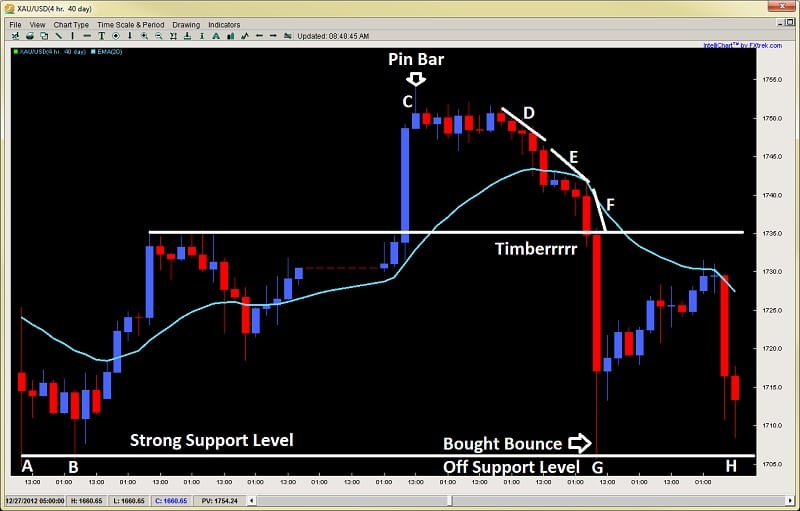
Gold 4hr Charts
impulsive and corrective price action gold trade 4hr chart 2ndskiestrading.com
Looking at the chart above, you will notice on the bottom left points A and B which showed strong price action rejections.  Buyers stepped in at this level, driving prices almost $50 higher in about 6 days.
At C you will notice the pin bar at C which was the second sign the bullish move was ending.  Any idea what the first was?
Regardless, after the pin bar, price action failed to make a HH (higher high) and started with selling off impulsively at D, then more sellers came in at E, and by F, once it broke the role reversal level, price got monkey-hammered dropping $30 in 4 hours.
I had a buy order at the support level at G, so made some profit on the bounce, but missed the fact the market was still showing impulsive price action selling.
So at H what did I do?  I bought some again, hoping for a similar move.  The result is below, but you get the idea.
Gold 4hr Chart Exhibit B
impulsive price action breakout pullback setup gold 2ndskiestrading.com
At the support level where my first long worked out, I went long again at H and the same level.  Shortly after I was stopped out.
Instead of realizing I was trading against the trend and impulsive price action, I was looking for a reversal. I consequently missed the obvious breakout pullback setup at the same level I was looking to get long, which then became a role reversal level.  This is what happens when you trade against the trend and your system.
Not only do you miss several good with trend setups, but after you get stopped out, you usually miss the follow up trade from your price action system to take advantage of the move.
3) Let Your Trade Run Until Your System Tells You To Exit
Barring any extreme or black swan event, I usually just let my trade run until my rule based system tells me to exit.
However on a recent buy on the GBPJPY, after getting a great entry and banking about +300 pips, I exited the trade, even though my system was still telling me to hold long and hadn’t given an exit signal.
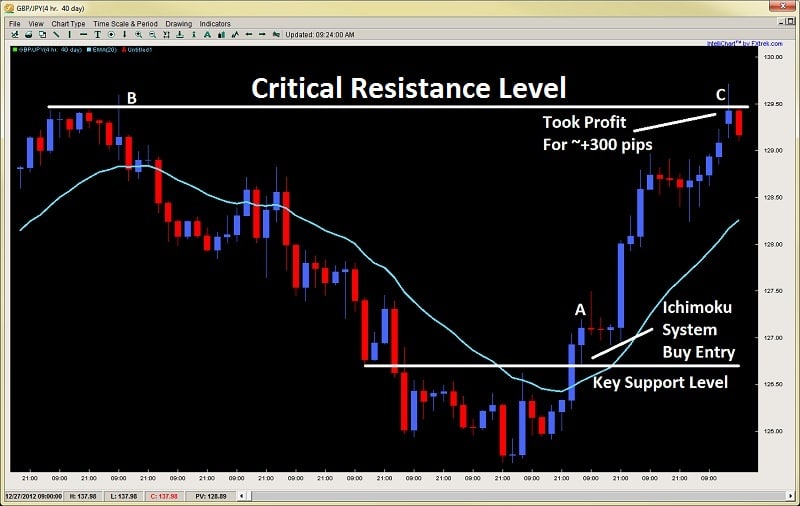
Looking at the chart below, you can see on the top left at B a critical resistance level which started the massive 300 pip sell off.
ichimoku strategy chris capre 2ndskiesforex gbpjpy + 300 pips
Price started to show signs of exhaustion, and started a reversal.  My ichimoku strategy picked up a buy order just above 126.60.  Shortly after, price climbed rapidly gunning it for the same resistance level at 129.50.  After the weekend gap rejected, I took profit banking about +300 pips.
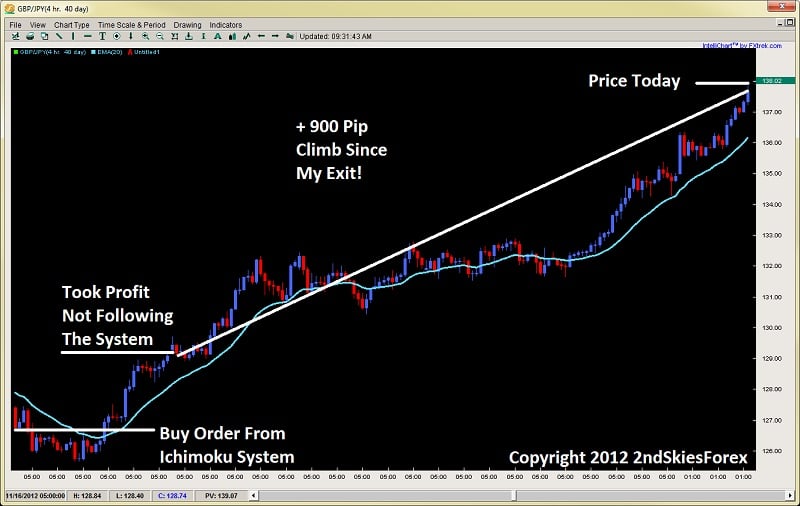
Not so bad you say…until you look at the chart below.
ichimoku trading strategies chris capre 2ndskiestrading.com gbpjpy
Not only did my system hold on for another + 300 pips, but it gave me a re-buy signal around 132 and is still currently long today.  I missed that one as well from being ‘upset’ about exiting early.  Needless to say this would have over tripled my profits. Even though my system never gave me an exit, I got out of the position.
Not letting runners run is one of the most costly mistakes a trader can make.  Yes, it is important to understand what is a high quality signal, but I’m guessing if you let just 10 of your trades run until the system gave you an exit, you would have made almost double your profits on those 10 trades.  For me, it was actually 2.4x more.  Food for thought.
In Closing
Part of trading is making mistakes, but a key component of your success is learning from your mistakes and making less of them over time.  Regardless of your skill level or how long you have been trading, you will make mistakes.  Anyone who only posts their successes and doesn’t admit to their failures is hiding behind a wall of fear and a false reality.
I make mistakes and I’ve been doing this for 12 years.  But I learn from them continually and make less of them as time goes on.  This translates into more profits, smaller drawdowns, less emotions, and a smoother equity curve.
Eliminating mistakes is the fastest path to making more profits.  But the first step is becoming aware of them.  This is where the trading journal comes in handy.  If you’ve made 300 trades last year, are you really going to remember every mistake you ever made?  Unlikely, this is why you have a journal, to help you become aware of your mistakes.
The second step is to actively work on eliminating and transforming them.  If you repeat a mistake over and over again, then the cause is likely psychologically, and something that can be re-wired through ERT training and developing a successful trader mindset.
But the bottom line is you can transform your mistakes into strengths, and most definitely into greater profits.  In almost all cases, making less mistakes can be the difference between a winning and losing day, month or year.  And in almost all cases – will lead to significantly greater profits.
Kind Regards,
Chris Capre