Tag Archive for: confirmation price action signal

Want to Increase Your Profitability? Try this powerful approach

If you want to find high probability trades, and skip those with a low probability of working out, you’ll need to develop a core skill. Does this sound interesting? Then keep on reading. What is this skill you ask?

I am talking about trading with price action context.

Good Trading Decisions Are Based Upon Context

First, let’s define the word ‘context’. Context = understanding and approaching a situation based upon the ‘context’ (or environmental variables) around it.

In price action, the ‘context’ is a way of describing the overall environment, and using that to help you trade with the underlying order flow. We have 3 filters to understand the price action context in our Trading Masterclass Course. For the purposes of this article, we’ll talk about impulsive and corrective moves.

Impulsive and Corrective Moves

Now I’ve already done many videos and articles on impulsive and corrective moves. For a more in-depth study, you can watch this video on impulsive and corrective price action, or this article on impulsive and corrective moves. But to sum them up briefly:

Impulsive moves = large bars + majority of bars 1 color + closes towards the highs/lows

Corrective moves = smaller bars + mix of colors + closes towards the middle

An example of an impulsive move is below:

Impulsive move 2ndskiesforex

And an example of a corrective move is below:

Corrective move 2ndskiesforex

As a whole, impulsive and corrective moves communicate a lot about the price action context, such as the underlying order flow behind it.

During impulsive moves, the order flow is relatively ‘imbalanced’, meaning it’s dominant towards one side (buying/selling) which causes strong directional moves.

During corrective moves, the order flow is relatively ‘balanced’, meaning there is no strong winner between the buyers/sellers, hence the market goes mostly sideways.

Using Impulsive and Corrective Moves to Discover the Price Action Context

Now that we understand the basics of impulsive and corrective moves, we can use them to discover the price action context of the market.

As a general rule, an impulsive move (the majority of the time) is followed by a corrective move. If the impulsive move is with trend, then the next move after the corrective move will more often be an impulsive move in the same direction.

Two good examples of this are below:

Example 1: Impulsive and Corrective Moves

Impulsive & Corrective moves 2ndskiesforex

Example 2: Impulsive and Corrective Moves

Impulsive & Corrective moves 2ndskiesforex

Now what do impulsive and corrective moves teach us about price action context?

They give us an underlying sense of what the dominant order flow is. If you see a potential trend in place, along with a good series of impulsive and corrective moves, then you can feel confident the overall price action context is bullish, and thus you should be looking to buy more often than sell.

Now instead of waiting for a pin bar, fakey or some other 1-2 bar confirmation price action signal, look at the impulsive and corrective moves for trade opportunities as they will often offer you many.

You don’t need a 1-2 bar candlestick pattern to know if the market is bullish – just determine the overall ‘context’, and trade with the impulsive and corrective structure as much as possible.

NOTE: If you want to learn how to find high probability trade setups using impulsive and corrective moves, check out our Trading Masterclass course.

The bottom line is – many of those 1-2 bar candlestick patterns (pin bars, fakey’s, inside bars, etc) don’t form that often. Yet if there is a strong trend in place, why are you waiting for a pattern that may never materialize, when the overall order flow is already bullish?

Get into that trend and make some money. Just make sure the price action context is in your favor. A great way to determine this is to make sure you can read the impulsive and corrective moves.

The most favorable situation is when you are trading in the direction of the impulsive moves (not against them) because you’re trading with the dominant order flow in the market. It also means you can make money faster because impulsive moves travel farther and faster than corrective moves.

Hopefully you can now see how price action context, particularly spotting the impulsive and corrective moves, can give help you find better trade setups.

Want To Learn More About Price Action Context?

While impulsive and corrective moves are a crucial part to determining price action context, they are not the whole. We have two other key factors to determining price action context and what the dominant order flow is in the market.

To learn more about these two, check out our Trading Masterclass Course where we teach you higher, lower and multiple time frame context with clear rules to understanding them. In fact, our entire 1st section of lessons is dedicated specifically towards understanding price action context.

To get access to these lessons within minutes, click here. Inside the course, you’ll also learn how to read other critical (or more advanced) price action structures and find more trade setups.

Keep in mind, trading with price action context is a skill that works on any instrument, time frame or environment. If you’re learning a price action strategy or approach that only works on specific time frames, then it’s a limited strategy that doesn’t really understand price action or PA context.

Until then – I look forward to your comments and feedback.

What’s Inside Today’s Trading Article?

  • Let’s talk about breakout strategies
  • What are some consistent breakout patterns?
  • When trading breakout patterns, how can I avoid false breaks?

Ever heard the statements “most breakouts fail” or “you should avoid trading breakouts“?

Let me just put the kibosh on that by sharing with you Exhibit A.

Behold…Exhibit A – winner of the 2017 World Cup Futures Championship, Stefano Serafini, who won with an impressive +217% return (see below).

stefano serafini breakout trader 2ndskiesforex

What was Stefano Serafini’s main trading strategy to generate such an impressive return? Trading intra-day breakouts!

So do me a favor, the next time you see some fake trading guru telling you “most breakouts fail” or “you should avoid trading breakouts“, please share the link to this post.

For today’s article, I’m going to share with you two breakout strategies to help increase your accuracy & profitability in trading breakouts. I’m also going to share how you can use this to avoid any false breaks and getting stopped out.

Let’s jump in.

Breakout Strategies

While there are many types of breakout strategies you can classify breakout trades into two broad categories:

  1. The momentum breakout setup
  2. The breakout pullback setup

For today’s breakout trade article, we’re going to focus on the second breakout strategy (breakout pullback setup) as it’s much easier for traders to learn and execute because it requires less skill.

NOTE: If you want to learn how to trade momentum breakout setups, then check out my Trading Masterclass course where I teach you how to trade this for maximum profit.

The Breakout Pullback Setup

Before you can even make a breakout pullback setup, you’ll need to identify some of the consistent breakout patterns that manifest in the price action.

By learning these, you’ll be able to identify A+ setups which will increase your accuracy and profitability in trading them.

There are many things you can do to identify an A+ breakout pullback setup, but there are 2 things I’ll give you to work with for now.

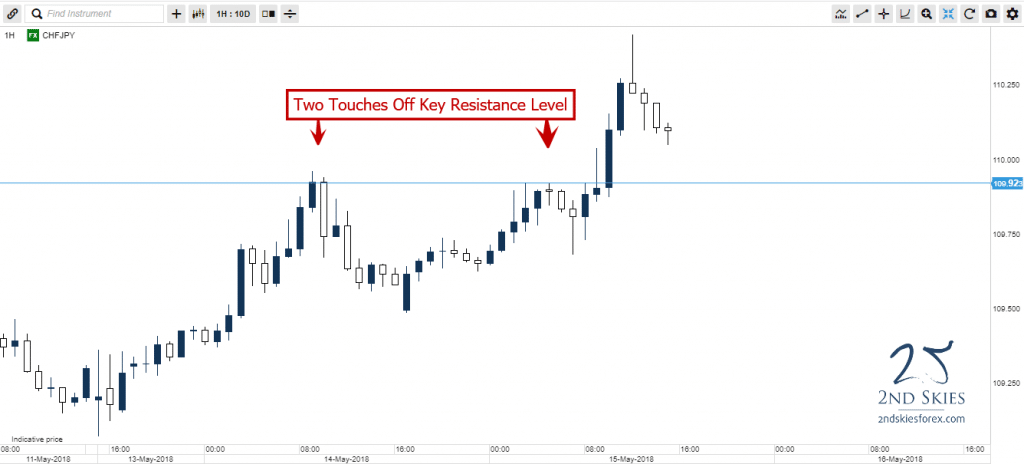
Breakout Pattern #1 – Finding a key support or resistance level with a minimum of two touches

Why two touches?

While the market may hit a key support or resistance level once, which indicates at least some potential order flow and institutional players wanting to hold that level, two touches indicates a greater probability and amount of order flow behind that level.

trading forex breakouts 2 touches 2ndskiesforex

The more buyers/sellers you have at that level, the greater the chance the breakout trade will succeed.

Why?

One reason is those same players who, when they get stopped out after their support or resistance level is broken, them getting stopped out clears out some of the order flow against that breakout, thus making it easier for the breakout to continue.

On top of this, smart money players after they’ve been taken out (and spot a good breakout) will often flip sides after they get stopped out, thus providing further momentum to your breakout trade.

Hence it’s important to identify a level that has a minimum of two touches (the more, then better) to increase your probability of a breakout setup forming.

Breakout Pattern #2 – A reduction in the reactions (or pullbacks from that support/resistance level)

Why does a reduction in the pullback from a key support or resistance level help your breakout trades?

Let’s say the market is in a bull trend and it’s encountering a resistance level where there are likely bears with offers up at that level. If the bulls hit the resistance level the first time, and the market pulls back say 50 pips, then when the 2nd time the price action hits that resistance level, the market only pulls back say 25 pips, this indicates a weaker reaction by the bears at the level.

A weaker pullback from the bears = less order flow and strength on their side. As their side continues to weaken, this a) gives the bulls more confidence a breakout is becoming more likely, and b) communicates their side is losing the battle.

Looking at our prior chart, notice how the reactions/pullbacks to the resistance level were weaker the 2nd time around?

trading forex breakouts two touches 2ndskiesforex

Those weaker reactions were communicating how the bears were less able to push back while the bulls kept their foot on the gas, producing an eventual breakout.

Below is another good example of the two touches + weaker reactions to the resistance level on the USDJPY, producing a +125 pip breakout.

forex breakout setups 2ndskiesforex

Hence, make sure to look for weaker reactions each time off a key support or resistance level to identify a high probability breakout.

Key Tip: One additional pattern you can apply in the price action is to look for breakout setups that are forming with trend vs counter trend.

Now that I’ve shown you two underlying components of a breakout strategy, let’s talk about how you can get in on a breakout pullback setup.

The Breakout Pullback Setup

Assuming you’ve found a situation whereby you have the minimum two touches off a key support or resistance level, along with weaker reactions to the level each time, let’s talk about how you can get into a breakout pullback setup and how I trade it.

Once the market and price action has closed above your key support or resistance level, I’ll place a limit order on that particular support or resistance level to trade in the direction of the breakout.

NOTE: I am not waiting for a confirmation price action signal to form on that level. If you’ve read the price action context correctly, and found a legitimate breakout, any confirmation price action signal will only give you a weaker entry, and thus reduce your profitability.

If you learn to read the price action correctly, you won’t need any confirmation price action signal to get in the market, because the underlying order flow from the big players will already be there.

When I’m trading a breakout pullback setup, once I’ve qualified the breakout, I’m placing my order to get long/short on a pullback to the level.

If the order flow at that level is legit, there will be larger players willing to get long/short at that level without the need for any pin bar, inside bar or ridiculous tailed bar.

Case in point, watch this video on me doing a live breakout pullback trade on the NZDUSD for +100 pips of profit with only a 29 pip stop loss.

Notice how there were two touches on the support level near 6625, along with each bounce getting weaker. Once the market broke through the level, I placed my order to get short.

After pulling back to my level, and barely going negative, the pair took off for over +100 pips of profit.

Had you waited for any confirmation price action pin bar signal, you would have a) gotten a worse entry, and b) had less profit potential.

You can see another example of a live trade using a pyramiding trading strategy where I get in on the breakout pullback setup to the level on both trades, stacking onto the same with trend move for extra profit.

After watching the two videos, hopefully these examples give you a good idea of how to trade the breakout pullback setup.

How to Avoid False Breaks?

There is a lot that can be said about avoiding false breaks when trading the breakout pullback setup, and there are many breakout patterns that often fail.

false breakout patterns

To keep it simple, the best thing you can do is:

a) learn to read price action context, and

b) trade with trend as much as possible

By learning to read price action context, you’ll have a better grasp at finding key support and resistance levels where there is a lot of order flow around that level. You’ll also be better able to spot with trend environments, which are much more favorable for breakout trade setups. This is because there is a greater amount of order flow in your favor to support your trade.

In Summary

To recap, trading forex breakout patterns can be a highly profitable trading strategy when you learn to identify A+ breakout setups. There are two classifications of breakouts, which are a) the momentum breakout setup, and b) the breakout pullback setup.

There are also key breakout patterns you can spot in the price action which will help you find higher probability breakout trades.

In the beginning, try to trade breakout pullback setups as they require less skills, and will help you build your confidence in trading breakouts over time.

Lastly, when trading the breakout pullback setup, make sure NOT to wait for confirmation price action signals as they’ll give you a worse entry (trade location) and reduce your profitability.

Now Your Turn

What did you learn from this article that helped you with trading breakouts in the forex market (or any market for that matter)?

Did you find this useful and give you some increased confidence to trade breakouts?

Are you currently trading breakouts and struggling?

Please make sure to leave your feedback and comments to help us create better trading articles and content for you.

Until then, may good trading setups and karma be with you.

Kind Regards,
Chris Capre

Why confirmation price action signals crush your trading profits and success.
Read more

key support and resistance levels chris capre 2ndskiesforex

Today I got a question from a student who’s only made a few posts in the course, so just getting started.

They asked a question which points to a critical aspect of trading.

Here is what they asked below:

questions about trading support and resistance


I think this is a fantastic question many developing traders struggle with.

How do you ‘know’ if the key level you’ve chosen is the right one?

What happens when the level you chose just got sliced through like Swiss cheese?

And do I look for ‘confirmation’ whether this key level will hold or not?

I’ll address these questions in this article to clarify your understanding of trading with support and resistance levels.

Isn’t Finding Key Support & Resistance Levels Subjective?

I think many beginning traders struggle with the more ‘discretionary’ elements of trading.

It’s easy to want things to be fixed, to be purely scientific or mathematical. That is nice because it means for every situation x comes up, you should do y.

Lamentably, trading isn’t that simple, especially when trading price action. Risk management would be one of those components of trading which is purely scientific. It all boils down to math and the risk of ruin.

risk-of-ruin-formula 2ndskiesforex

However, trading key support and resistance levels is part scientific and part artistic. This means there are rules to trading them, but part of working with them will entail a ‘discretionary’ call.

Hence the answer is yes, there will be a part of your trading with key levels that will be subjective which you cannot avoid.

It should be noted I do not look at support and resistance levels as pure lines in the sand. I look at them as zones of order flow.

Why do I say this?

Because when you look at the order flow and liquidity around key levels, you’ll notice a pattern. That orders and liquidity vary at several prices above & below the key level.

order flow liquidity price action 2ndskiesforex

This is because there are varying institutional players out there who will place their orders at varying prices above or below any key level.

A great example of this is when we consider time horizons for trading. If someone is trading intra-day, then they will likely have a smaller stop.

This will require them to have greater precision in terms of their entry price and trade location. Thus they will be as close to the level as possible.

However someone who is swing or trading long term will not be so concerned with this as a few pips difference on a +500 pip profit target and 150 pip stop loss.

Keep in mind, this is just ONE factor regarding how orders are placed around key levels (as there are many).

But when we look at the order flow around key support and resistance levels, we can see there are going to be orders at many prices above and below a key level.

This is part of the reason why I consider trading key levels to be more like zones of order flow. There are other reasons which I explain further in my price action course.

How Do I Know The Levels I Selected Are Key Levels?

This is another critical question that I often see amongst developing traders. The reason why I say ‘developing‘ traders is because this type of question & wording gives a unique insight into a traders mindset.

They make it seem  like placing a trade around a key level is like jumping off a cliff that is only 15 feet above water 😮

jumping into water

As a general rule, you will never ‘know‘ anything about trading, let alone price action. This isn’t like poker where you have a fixed number of cards in the deck and can ‘know’ the probability of a hand or card being hit.

There are an infinite amount of possibilities -1 that can happen in the charts. You will never ‘know‘ with 100% certainty and you cannot avoid this.

The desire and want to ‘know‘ comes from a beginning traders mindset…of wanting pure objectivity in trading.

“Beginning traders want certainty because they are uncertain of their abilities and skills.”

The want for certainty is an attempt to compensate for their lack of skills and confidence. The problem is, certainty is an illusion in trading, so you are wanting something that does not exist.

I do not ‘know‘ a key level I’ve chosen will work or not. I’m just going on probabilities & my read of the price action context.

I’m guessing an olympic biathlon shooter doesn’t ‘know’ when the wind will blow. But they can take measurements, read the wind speed and direction (constantly in flux), then make the best shot they can.

biathlon shooter 2ndskiesforex

Trading is very similar.

And professional traders will never ask this question about ‘knowing‘. Why?

Because professional traders trade and think in probabilities. They know that certainty is an illusion. They know what you are really working with is ‘probability‘.

Hence the best you can do is align the probabilities in your favor as much as possible.

Are There Ways to Improve Your Ability To Read Key Levels?

Yes, I have an entire lesson dedicated to this in my price action course. We cover how to work with key levels across multiple time frames and context.

Do I Look for Confirmation Whether The Key Level Will Hold?

I’ve talked about this how hedge funds do not trade confirmation price action signals. They give you a worse entry and actually lower your overall profitability and accuracy.

Hence I do not look for confirmation signals at key levels. You can read more about why I don’t trade confirmation signals at key levels here.

In Conclusion

Until the Hal 9000 is available for trading, I’m not sure we will have an ‘objective’ way to trade key support and resistance levels.

hal 9000

It’s important to understand where this mindset comes from and why you should trade and think in probabilities.

It also helps to think of support and resistance as a zone of order flow, not pure lines in the sand.

Most often, traders who struggle with the probabilistic nature of trading are wanting certainty. But this is an illusion in trading. We have to get comfortable with certain parts of trading that will simply be ‘unknown‘.

Your ability to read key levels will improve over time, and there are many things you can do to improve your ability in this. We teach these methods in my advanced price action course and how to increase your skills trading key support and resistance levels.

Eventually you’ll develop the confidence to trade them without confirmation. And when you do, you’ll see your profits, accuracy and profitability increase tremendously.

Your Turn

Have you been wondering how you will ‘know’ if a key level will hold? Do you find yourself constantly looking for ‘certainty’ and ‘confirmation’ around a key level?

Make sure to comment below and share your thoughts.