Tag Archive for: price action course

Watch as I execute two live price action trades on USDJPY & USDCAD, up +250 pips in total.

In this live trading video, I go through the price action context, explain my trade location, stop loss placement, my final target, and why I did not use a confirmation price action signal.

Here’s the transcription for the video (and just below is the follow up screenshot of how I traded it and closed it near the top when the price action changed in my mind and the breakout became less likely).

follow up usdjpy live price action trade 2ndskiesforex

“Hello traders here. Chris Capre. 2ndskiestrading.com.

I have a few live price action trades that are running right now so I wanted to share with you a couple of them, my entry, my method for getting in, my stop loss placement, my take profit, why I chose these things, to give you an idea how I trade and how I teach my members to trade in the Advanced Price Action course.

So before we get into the trades, I just want to show you right here this is a live account, I’m trading with my own money right now. This says real, if it was a fake account or demo account it would say demo. So just to let you know I am trading with my own money. As you can see, these are moving in real time, everything matches here: 109 pips, 109 pips so it all matches.

And so I’m in the market live right now. I’ve been in since December 3rd, late last week. This one is actually a relatively straightforward trade. USD/JPY has been in a bullish run as of late, after it broke out of a large range structure. Formed a nice impulsive leg up and then it formed a corrective structure which is outlined in this blue box here.

Now these structures are very important and this is important for understanding price action context. Generally when an impulsive move happens, like we have here, the next move is for the market to form a corrective structure which is like a balancing phase. And as long as the price action context and the bulls are still in control, then I’m expecting this to play out with an eventual move to the upside.

The great thing about corrective structures, especially in bull trends, is that they offer you with trend opportunities to get long at the base of the corrective structure. I actually had a trade setup right here before but I missed by a couple of points ’cause I was basing it off these lows here.

So when the market came back again I lifted it to just at the bottom of this low right over here to get myself into the market. I did not wait for a price action confirmation signal. Even though this formed a pin bar, if you waited for a 50% retrace tweak entry you would’ve missed it.

And so I didn’t wait for one here, and I just placed a limit order to get long at this level, assuming that the price action was gonna hold, the context was correct, and that my trade location was good. Even in this one here, this did form a pin bar, the thing about it is is that if I did wait for a 50% retrace tweak entry, my entry would’ve been poor. It would’ve been higher up and now I had less profit available to me.

This is important to understand, this is part of the reason why I don’t trade with confirmation price action signals. They give you worse entries, they give you retail entries. Sometimes you’ll miss the same move completely, a perfectly legitimate move. And they also give you lesser profitability.

Now, in terms of my stop loss placement on this one here, this is very straightforward. In this recent run up we had a move up here, it paused back and then a big breakout bar. My real reason for getting in the market was the base of this structure holding.

So I wanna place my stop loss below this here. How much? That kinda depends because I was getting in before NFP, I had to expect some volatility so I didn’t wanna keep it too tight. So I put it just below this here, a little bit below that. It’s about a 51 pip stop and I’m in here at 123.32 and the stop is at 121.81 so I have about a 50 pip stop and I’m currently about up about 109 pips. So I’m up a little over +2R.

And as you can see the trade never really went into the negative. It just happened to be a really good trade location. Does this happen all the time? No, it doesn’t. Sometimes trades are not ideal. In fact, I’m gonna get into one just shortly after this.

Real briefly though, in terms of my take profit, if I was trading this range structure, I should be getting out right about here with a nice +2R profit and that would be it. But I’m anticipating a breakout. If I’m wrong, I’m willing to take some profit off the board, bringing my stop to breakeven and hope for a breakout. And if it comes back down here again, I’ll buy it again assuming the range sructure’s gonna hold.

My target is actually a little bit higher here, just above 125 and a quarter. So with a 50 pip stop and a 300 pip target, that’s a +6R potential on the board.

Now, the next trade I’d like to show you here is one that’s not a perfect entry. It’s the kind of trade that wasn’t textbook and I’m not saying it’s easy. A lot of trades are more like this one right here.

This is the USD/CAD. So USD/CAD also in a nice bull run. We have an impulsive/corrective slightly choppy move up and we form a double tap here. So I’m looking to get long and I can either get long on a pullback but I miss this one here. Once we broke out I was expecting this resistance to hold.

So I just bought on a pullback, I didn’t wait for a signal. I just bought on the level assuming it would hold. It didn’t. Luckily I was right on two accounts.

One, I was right that the bulls were still in control and so I wanna be more long than short. Two, I was right on my stop loss placement. Which was below this swing here. So I placed it below this swing because I felt like if the bulls were in control, they shouldn’t make it back into the range too far and they shouldn’t make it below where this swing had started.

So with that being said, it turns out I was right. And what eneded up happening was the pair ended up forming kind of a channel like structure. An ascending channel. I didn’t see this at that time and it wasn’t fully formed at that time but as I re-evaluated, I realized “ok, this is actually what’s really happening out here”. So, if I’m correct, the channel structure should hold, it should continue to drift higher and if I’m right it should break out.

And that’s what it did here recently. I could’ve bought on the bottom of the channel but considering that I spent a huge majority of the time in the negative and only a decent amount of time in the positive, maybe 40% of the time, I really didn’t feel like adding on to a loser. I generally like to add on to winners, not adding on to losers.

With that being said, it turns I was right on this. It turns out my bullish price action context read was correct and that my stop loss placement was correct. And so in terms of the trade right now, it’s up 132-134 pips. My total stop loss on this one was about 110 pips. So with a 110 pips, I’m up about +1.25R right now.

In terms of where my take profit is, that is way up here. It’s at 1.38 and 1.38 is about a 450 pip target with about a 110 pip stop. So it’s about a +4R on this one here.

The reason why I’m showing this one is I wanna show you an example of a trade that’s not textbook and that’s not a perfect entry. The bottom line is that the majority of your trades will actually be more like this than the USD/JPY trade and these are the trades that challenge you the most mentally and psychologically.

But I trust my price action context, I trust my skillset, I trust my mindset and I trust my read on the market. I was willing to let this trade play out. So I wasn’t sitting there worried about “am I gonna get stopped out? what did I do wrong?” or anything like that. I just let the trade run, I held my stop loss as is and either I’m getting stopped out or I’m gonna make some money on this one.

And right now I’m making some money on this one.

I’ll probably start neutralizing the risk very shortly and I’ll probably bring it up either under one of these swings here, maybe even into some profit since we’ve broken out of this strucutre.

This is how I trade. This is how I trade with my own money and this is what I teach in my Advanced Price Action course.

So, with that being said, if you are interested in trading like this, then make sure to come check out my Advanced Price Action course where I give trade recommendations like this several times a week. I teach you the same methods I use, I teach you the same entry techniques and strategies. How I place my stops, how I choose my targets and how to build your price action skills.

I’m not just teaching strategies, I’m teaching you how to build your own price action skillset. So that you can learn to make your decisions yourself, find these trades yourself and make money trading.

So if that sounds interesting to you, make sure to check us out. Also come by 2ndskiestrading.com and take a look at all the other videos and articles we have on trading.

With that being said, I bid you all adieu. I wish you good health and good luck trading and I hope to see you in the course. Take care everyone!”

Watch as I execute a live price action trade on the NZDUSD up +100 pips.

In this NZDUSD Forex Trade Video, I go through the price action context, explain my trade location, stop loss placement, my final target, and why I did not use a confirmation price action signal.

Here’s the transcription for the video (along with the screenshot on how it ended up for profit…just not as much as I wanted)

nzdusd trade for profit 2ndskiesforex

“Hello traders here. Chris Capre. 2ndskiestrading.com

I have a couple of live price action trades that I’m in right now and I wanted to share with you some of my analysis on this, what price action context I was seeing in the market, what was my trade location and why. Why did I choose my stop loss placement and my take profit. So these are methods that I actually teach inside the price action course and so by sharing this with you I’m kinda giving you an insight into how I trade and the kind of trades that you could be making if you were to learn these methods.

Now, just to verify, these are live trades. You can see right now these all match right over here. As you can see, it says real over here. That would say demo, if it was a demo account, it would say demo. So it’s real, it’s saying I trade with my own money. I only trade with my own money. That’s also why you don’t see long disclaimers before my videos, because I’m actually using live trades. If I was using demo trades or fake trades or something like that, I’d have to have a long disclaimer explaining all kinds of things why that is.

So, with that being said, let’s start off with the price action context. So stepping out to the 4hr chart, we can see that this right here was a clean role reversal level here. It’s resistance here, support and support and strong rejection or bounce here but then a weaker one here. Lower high and then aggressive selling afterwards. Now, with the selling and the strong breakout below this, I was expecting a pullback to that role reveral level and was looking to get short.

That kind of explains the context and my trade location. I chose this level, I could’ve chosen a little bit higher which would’ve been a little bit more conservative. The advantage of that is it would’ve given me more me more profit potential but the downside is that it reduces my potential to actually get in the trade or reduces the probability that the trade will activate.

So I chose this one here. In terms of my stop loss placement, I had a couple of options. I could’ve put just above this level but I felt with volatility that it might’ve been a little tight and I could’ve put just above this here which would’ve been the most conservative so maybe just above here. I actually chose to put it above the move that started the breakout. So the breakout started above the level in a strong impulsive selling led to the breakout and it started over here.

I said ok, let’s put my stop a few pips above that. If it were to return above the level and get back above the move that started the breakout in this case, I wouldn’t wanna be in it at this point. So initially this held, we had a kind of volatility spike and exhaustion move intraday yesterday that went past it but then it just didn’t get any follow-through, no traction, sold off below it and never was able to get back above it.

I would like to note that if you were trading a 1hr pin bar signal, and you looked for your 50% retrace tweak entry, you would’ve gotten in about here and you would’ve gotten stopped out with your stop just above the pin bar highs. On top of it, you would’ve got a worse entry again. This is why we don’t wait for confirmation signals. They give us worse entries and they reduce profitability and accuracy.

In terms of take profit, let’s zoom out a little bit to the daily chart and I’ll show you why I chose my target. My target is down here. I may choose a little bit towards the base a little bit lower around .6250. That is a potential for me. I am expecting a return at least towards this resistance here at .6425. And it may get stuck there for a little bit but if we get back below this and into this kind of consolidation zone or corrective structure which you can see here, then my feeling is it should be able to make it through towards the bottom of that.

So I may lift the limit and target a little bit lower. Right now it’s at about .6303 which you can see here. But I may lower it if we get through it pretty cleanly and target .6250. Either way, I’m in at .6625 so I have a 320-something pip target right now with a total 30 pip stop. So we’re talking about a +10R.

Again, you don’t need huge stops to make trades like this. You shouldn’t need huge stops if you get really good trade location and really good timing. And again, these are methods that I teach in my price action course. Which you can make these trades yourself.

Wwith that being said, hopefully this explains how I trade, my entry method, my trade location, how I determine that. How I use my stop loss placement and my take profit.

Again, I don’t recommend waiting for confirmation price action signals. That’s a beginner’s mindset, it’s a retail trader’s mindset. I’ve talked about this before. Professional traders aren’t waiting for confirmation. They find their trade locations ahead of time and they make that. And if you make your entries based on one candle, then you’re missing price action context and you’re missing structure which is always gonna be far more important than one individual candle.

I don’t wait for those and I teach you how to find good trade locations, where you don’t need large stops to make trades like this. And you shouldn’t have to be waiting for days or weeks to make trades like this as well. Again, you can see that I was in this trade from the 5th and here we are a day later and we are already up +3R. So if you’re having to wait 2-3 weeks for a trade to activate, you aren’t trading price action and if you have wait weeks for a trade to hit +2R or +3R, again you aren’t trading price action ’cause these trades happen all the time.

You can learn how to find these trades. You can learn how to make these trades and that’s what I teach you in my price action course.

So with that being said, I hope you enoyed this video. I hope you got a lot of information about this and how I trade price action. Make sure to check out my website, 2ndskiestrading.com, where I have other videos and resources like these.

Until then, I bid you all adieu, good luck trading, I hope you’re healthy and happy. Take care everyone!”

Watch as I execute a live price action trade on the GBPUSD up +120 pips.

In this price action trade video, I go through the price action context, explain my trade location, stop loss placement, my final target, and why I did not use a confirmation price action signal.

Here’s the transcription for the video:

“Hello traders here. Chris Capre. 2ndskiestrading.com

So, I want to share a live price action trade that I’m in with you right now. This is actually a trade setup that we have posted in the members commentary, trade setup commentary, in our price action course on Sunday and it activated on Monday and here we are on Tuesday and it’s well into profit and so…

I want to talk about this trade in terms of trade location, in terms of stop loss placement, in terms of take profit, trade management and kinda give you the overall price action context here. Now, just to make sure you know, this is a live trade, you can see this is an open position right now, this all matches. And also this says real right here. So FXCM, if it’s a demo account, that real will say demo, it will never say real. So you know this is a trade I’m in with my own money right now, that I only trade with my own money. And so, with that being said, let’s talk about the price action context first.

So, as we can wee, the GBPUSD has been relatively in a corrective structure range. It’s about 250-300 pips high, from 1.55 down to 1.52. Now, we had an impressive bull run, an 8 candle bull run into 1.55. But then what happened with all that bullish momentum? It ran into the big figure at 1.55, and it kinda triple tapped here. Suggesting that the offers were willing to hold the line here and kinda mount a challenge and stop this momentum. They were able to eventually reverse the momentum and show with strength that they could push this back down. And they did, 250 pips. And you can see this strength kinda coming in in a typical impulsive, corrective, and impulsive, corrective structure here.

So we had a relatively good idea in terms of trade location at 1.55, and so we said ok, we literally said on Sunday, look, we are looking to sell, if you’re bearish you wanna be selling at 1.55, and we don’t need a large stop loss on this. We feel that the corrective structure will hold and because the offers held 1.55 very cleanly which you can see here with the wicks all around the same height, we don’t need a large stop loss. If the wicks are much more varied, a short, a long one and a medium one, then that would show not only volatility but a wider range in the depth of the order book around 1.55. Therefore we would need a much larger stop loss. But we didn’t have that. We had a very clean reaction from the offers here at 1.55.

So we said ok, we’re gonna look to sell 1.55 and you don’t need a large stop loss. We actually placed ours, 34 pips above, which you can see here, stop at 1.5530, and an entry at .54969. We literally ended up top-ticking the market. As you can see the high was 1.5497. So by .1 pips we got literally the best entry by .1 pips. That’s not common, it doesn’t always happen that we get that perfect entries. I literally missed another trade today by a pip. That’s just gonna happen, that’s part of it. Sometimes you’re gonna get these little gems that hit perfectly. But when you find good trade locations, you should have relatively good entries, near where the market stalls and turns.

So, because of that, because of this reaction here, we can have a tight stop loss, you shouldn’t need a large stop loss if you can find good trade locations. Now, in terms of our target, the offers that held here at 1.55, they pushed it all the way down to 1.5250 before some impressive bullish momentum came back in the market. And the change of hands happened here. So we’re expecting the bears to try and target this. If they’re gonna show that they have equal strength in the market, then they’re gonna want at least tag this and say ok we’re gonna push you back to where you started. So that’s our target.

We do see an interesting role-reversal level here on 1.5375, so you can see this is an interesting role reversal level. The market might get stuck here, and if it does, we may take some profit and neutralize all the risk at that point. But if we get below this here, then I see relatively clear or smooth sailing down to .5250. So that would be a 250-pip profit on a 34 pip stop. So we’re talking about a +8R.

Briefly I wanna talk about the entry in terms of how we placed the entry and time and everything like that. And then we’ll wrap this up.

To make sure we didn’t place any confirmation price action signal. We don’ wait for confirmation price action signals. Those lower your accuracy, they lower your profitability and they give you worse locations. There was no pin bar on the 4hr chart, there was no pin bar on the 1hr chart, or anything like that. And on the daily chart there was an interesting one here but assuming you got the 50% you know, retrace tweak entry, you’re not getting in till here so you’re missing this.

Now let’s be generous. Let’s say you absolutely top-ticked the daily candle today and you got an entry. Where’s your entry? The high is .5445. Your stop has to be above .55 now. So you have a 55 pip stop with right now about a 70 pip profit. You’re barely up 1R at this point. We on the other hand got in at 5496 with 34 pip stop. So while you’re just cracking your first +1R, we’ve already got 4 times the profit as you do. So you can see how waiting for confirmation price action signals reduces profitability tremendously. In this case by 400%. And it gives you a much larger stop loss if you do it waiting for a confirmation price action signal and you might’ve even missed this trade completely. So it lowers your accuracy, and it lowers your profitability massively.

So that’s very important to note. Lastly, you shouldn’t have to be waiting for 2, 2.5 weeks for a trade setup to materialize. If you have to wait 2.5 week for a trade setup to materialize, then you’re not reading price action. You’re not trading, you’re missing opportunities like this all the time. ’cause these happen quite a lot and way more frequently than 2.5 weeks. We aren’t waiting for that long. We posted this on Sunday, it hits on Monday and we’re already well into profit not only on Monday but on Tuesday as well.

So, if you’re having to wait around for 2.5 weeks to find good trade ideas, then you’re not reading price action correctly and you’re not actively trading the market and if you’re not active, you actually slow your learning curve and you actually make it harder to build up your skillset. So these are a couple of points we kinda wanna mention and make sure you understand.

Now, if you are interested in learning how to trade price action the way we do, then make sure to check out my advanced price action course where we’ll teach you how to find premium entries like this, how to read the price action context properly, how to find trades that you don’t have to wait around for weeks on end. And how you can get better stop loss placement, a higher profitability on the same trade ideas.

So, if that seems interesting to you, make sure to check out our price action course. Also make sure to come by and check us out at 2ndskiestrading.com, where we post market commentary and trade ideas like this as well, along with a bunch of other free articles and videos.

Other than that, I hope you enoyed this video, I hope you enjoyed the explanation on this and the demonstration of how I trade and what I teach to my members. So with that being said, I wish you good luck in the markets, make sure to comment on the video below, what you got from it and other than that I wish you good health and good trading. Take care everyone.”

key support and resistance levels chris capre 2ndskiesforex

Today I got a question from a student who’s only made a few posts in the course, so just getting started.

They asked a question which points to a critical aspect of trading.

Here is what they asked below:

questions about trading support and resistance


I think this is a fantastic question many developing traders struggle with.

How do you ‘know’ if the key level you’ve chosen is the right one?

What happens when the level you chose just got sliced through like Swiss cheese?

And do I look for ‘confirmation’ whether this key level will hold or not?

I’ll address these questions in this article to clarify your understanding of trading with support and resistance levels.

Isn’t Finding Key Support & Resistance Levels Subjective?

I think many beginning traders struggle with the more ‘discretionary’ elements of trading.

It’s easy to want things to be fixed, to be purely scientific or mathematical. That is nice because it means for every situation x comes up, you should do y.

Lamentably, trading isn’t that simple, especially when trading price action. Risk management would be one of those components of trading which is purely scientific. It all boils down to math and the risk of ruin.

risk-of-ruin-formula 2ndskiesforex

However, trading key support and resistance levels is part scientific and part artistic. This means there are rules to trading them, but part of working with them will entail a ‘discretionary’ call.

Hence the answer is yes, there will be a part of your trading with key levels that will be subjective which you cannot avoid.

It should be noted I do not look at support and resistance levels as pure lines in the sand. I look at them as zones of order flow.

Why do I say this?

Because when you look at the order flow and liquidity around key levels, you’ll notice a pattern. That orders and liquidity vary at several prices above & below the key level.

order flow liquidity price action 2ndskiesforex

This is because there are varying institutional players out there who will place their orders at varying prices above or below any key level.

A great example of this is when we consider time horizons for trading. If someone is trading intra-day, then they will likely have a smaller stop.

This will require them to have greater precision in terms of their entry price and trade location. Thus they will be as close to the level as possible.

However someone who is swing or trading long term will not be so concerned with this as a few pips difference on a +500 pip profit target and 150 pip stop loss.

Keep in mind, this is just ONE factor regarding how orders are placed around key levels (as there are many).

But when we look at the order flow around key support and resistance levels, we can see there are going to be orders at many prices above and below a key level.

This is part of the reason why I consider trading key levels to be more like zones of order flow. There are other reasons which I explain further in my price action course.

How Do I Know The Levels I Selected Are Key Levels?

This is another critical question that I often see amongst developing traders. The reason why I say ‘developing‘ traders is because this type of question & wording gives a unique insight into a traders mindset.

They make it seem  like placing a trade around a key level is like jumping off a cliff that is only 15 feet above water 😮

jumping into water

As a general rule, you will never ‘know‘ anything about trading, let alone price action. This isn’t like poker where you have a fixed number of cards in the deck and can ‘know’ the probability of a hand or card being hit.

There are an infinite amount of possibilities -1 that can happen in the charts. You will never ‘know‘ with 100% certainty and you cannot avoid this.

The desire and want to ‘know‘ comes from a beginning traders mindset…of wanting pure objectivity in trading.

“Beginning traders want certainty because they are uncertain of their abilities and skills.”

The want for certainty is an attempt to compensate for their lack of skills and confidence. The problem is, certainty is an illusion in trading, so you are wanting something that does not exist.

I do not ‘know‘ a key level I’ve chosen will work or not. I’m just going on probabilities & my read of the price action context.

I’m guessing an olympic biathlon shooter doesn’t ‘know’ when the wind will blow. But they can take measurements, read the wind speed and direction (constantly in flux), then make the best shot they can.

biathlon shooter 2ndskiesforex

Trading is very similar.

And professional traders will never ask this question about ‘knowing‘. Why?

Because professional traders trade and think in probabilities. They know that certainty is an illusion. They know what you are really working with is ‘probability‘.

Hence the best you can do is align the probabilities in your favor as much as possible.

Are There Ways to Improve Your Ability To Read Key Levels?

Yes, I have an entire lesson dedicated to this in my price action course. We cover how to work with key levels across multiple time frames and context.

Do I Look for Confirmation Whether The Key Level Will Hold?

I’ve talked about this how hedge funds do not trade confirmation price action signals. They give you a worse entry and actually lower your overall profitability and accuracy.

Hence I do not look for confirmation signals at key levels. You can read more about why I don’t trade confirmation signals at key levels here.

In Conclusion

Until the Hal 9000 is available for trading, I’m not sure we will have an ‘objective’ way to trade key support and resistance levels.

hal 9000

It’s important to understand where this mindset comes from and why you should trade and think in probabilities.

It also helps to think of support and resistance as a zone of order flow, not pure lines in the sand.

Most often, traders who struggle with the probabilistic nature of trading are wanting certainty. But this is an illusion in trading. We have to get comfortable with certain parts of trading that will simply be ‘unknown‘.

Your ability to read key levels will improve over time, and there are many things you can do to improve your ability in this. We teach these methods in my advanced price action course and how to increase your skills trading key support and resistance levels.

Eventually you’ll develop the confidence to trade them without confirmation. And when you do, you’ll see your profits, accuracy and profitability increase tremendously.

Your Turn

Have you been wondering how you will ‘know’ if a key level will hold? Do you find yourself constantly looking for ‘certainty’ and ‘confirmation’ around a key level?

Make sure to comment below and share your thoughts.

trading psychology 2ndskiesforex

I got a forex trader psychology question from a new student of mine who’s been struggling for years. He’s experienced a common problem you yourself have likely faced.

Here is what he emailed me below:

“I know this varies greatly based on internal and external factors, but about how many trades do you take on a daily basis on average?”

The real question he was asking is under the surface. But it’s a common issue many traders face, which we’ll get into shortly.

Before I do, here is their response below to my follow up prodding and questions:

“One of my weaknesses that I battle with (although getting better) is over-trading and feeling the need to be in the market.

To combat it, I stick to the H4 and Daily time frames. But again I get impatient sometimes…

Over-trading

This is something many traders struggle with. The reason why you over-trade has two major underlying reasons.

Befor we dive into those, I’d like to point out some key things they said.

They are:

1) “Feeling the need to be in the market”

2) “I get impatient sometimes”

Note those two statements down for now as they are critical for this article.

But before we get into the reasons why you over-trade, we need a working definition of ‘over-trading’.

My definition of over-trading is as follows.

Assuming you are working with a trading plan, ‘over-trading’ is either:


a) taking any trade/s outside of your trading plan, or

b) taking any trades which cause you to exceed your maximum risk limits


If you hit any of the two qualifications above, you are (in my book) over-trading.

Notice I mentioned nothing about a) the number of trades and b) the time frames. This last variable is highly relevant.

As I mentioned in my last article, there is a common trading psychology narrative around price action. This is because the majority of those ‘gurus’ teaching price action all copied what they learned.

They are derivatives themselves, or derivatives of derivatives.

One key piece of mis-information from this entire camp is ‘higher time frames are better than lower time frames’. They also state ‘lower time frames are just noise and higher time frames give better signals’.

Despite the fact professional bank traders trade intra-day, they still proselytize this meme.

smb-training
(does he look like he’s being impatient and over-trading? source: smb-training)

GUESS WHAT? You can over-trade on any time frame. The time frame is not the root cause of over-trading. A lack of discipline is.

If you have not wired your brain to mentally execute your trading plan, the time frame will make no difference.

Just like if you have the habit of over-eating, you will do so whether you are at a restaurant or your own kitchen. The habit is within you and doesn’t just disappear when you change environments.

Neural networks are clusters of neurons in your brain. They take time to change. If you are dominantly wired right now to eat too much, you will regardless of where you are. The same goes for over-trading.

neural networks trading 2ndskiesforex

Notice what my new student mentioned earlier, “I stick to H4 and Daily time frames. But again I get impatient sometimes.

For him, the time frames are completely irrelevant. His impatience takes over regardless.

I do not find it ironic that all those who copied their ideas about price action, also repeat the same notions about over-trading.

If there is no real engagement with their minds and the markets, one will never come to the idea that over-trading is not time frame dependent. That is why this meme is repeated.

If you want to dissolve the underlying root of over-trading (discipline & mental execution), you have to re-wire your brain.

Before we get into how you can do that, I’d like to address a few points about my definition of over-trading.

Having A Daily Risk Limit

For my members, I recommend having three to four risk thresholds as part of their trading plan. They are:

1) A max risk per trade
2) A max risk per day
3) A max risk per week
4) A max risk per month

A max risk per trade should be based upon your risk of ruin.

risk of ruin formula 2ndskiesforex

NOTE: You cannot calculate your risk of ruin if you are risking a fixed dollar amount per trade.

I’ve written extensively why risking a fixed percent per trade is far superior to a fixed dollar amount.

If you have a risk of ruin that is zero, mathematically you a) cannot blow up your account, and b) will make money.

A max risk per day should be a daily risk limit to avoid losing too much on any given day. The max risk per week and month are also based upon the same concepts.

If any one of the above is ‘optional‘ in my book, it is the max risk per week. Keep in mind, none of the above defines how many trades you should (or should not) take in a day to avoid over-trading.

If a basketball player is on a hot streak, you keep feeding him the ball as those streaks are critical to winning. Professional poker players know this as well – when hot, keep putting your chips down.

poker play hot streak 2ndskiesforex

The same goes for trading. Not pulling the trigger when you have a setup (with all conditions in place) simply limits your upside.

Why would you ever do that? If the price action context is prime for you to make a ton of money that day, you should be attacking the markets.

On the other side of the coin, I’ve had days where I started out with 6, 7, maybe even 9 losses in a row. But I’m not phased by this.

As long as I haven’t hit my risk limit per day, I’ll keep attacking the markets, sometimes buying and selling in the same day.

Ironically, on many of those days, one or two big winners either brought me back to break even, or helped me end up in profit for the day.

Had I succumbed to some notion about ‘over-trading = x trades‘, every one of those days would have ended in a loss. On top of that, each one would have ended with a much greater negative impression in my mind.

Yet how much confidence do you think I get from losing 9+ trades in a row, and still making money to end the day?

Just like a quarterback doesn’t stop throwing the ball because he’s had a couple interceptions and bad passes, the same goes for trading.

Your goal should be to win each and every day while maintaining your trading plan, risk limits and mental execution.

With all the above said, two things have to be addressed regarding over-trading.

Discipline & Wiring Your Brain

discipline in trading 2ndskiesforex

IMO, you should not be trading the markets without a trading plan.

Make sure to read my article ‘what if your trading plan is costing you money?‘ Inside this plan should be specified the 4 risk limits from above. On top of this, so should your strategies and instruments you trade.

“Your trading plan needs to define your actions & mental execution every time you sit down to trade.”

However, these plans are meaningless if you haven’t built the discipline to execute them.

In some sense, I get the reason why some ‘gurus’ say ‘avoid the lower time frames as you will over-trade there‘.

Part of the proselytizing here is because it fits their story about higher time frames. Saying lower time frames are the boogeyman for your trading is a way to continually market & perpetuate their narrative.

But in reality, telling you to avoid the lower time frames is based upon fear.

That you will be powerless if you enter the seductive Scarlett Johannson-like bedroom of the lower time frames.

That you will become a helpless meth-like trading junkie should you go there.

One of them even uses this image to portray what happens when trading the lower time frames (see below).

over trading myth

FYI, I trade the 5 min charts (sometimes the 1 min charts) when trading price action intraday, and I’ve never looked like that. My mind is as calm as a hindu cow whether I’m trading the 5m or daily charts.

The time frame is irrelevant because I’ve wired discipline into my brain. Many of my students also trade the intra-day time frames, and none of them look like this (SHOCKING!).

I met a prop-firm day trader at the Singapore Trading Seminar I did this July. Guess what?

He didn’t look like that at all! He was one of the nicest, most relaxed and intelligent guys I’ve met.

It is true, day trading does increase CL (cognitive load), but it doesn’t turn you into a crazy person.

Photos from the Singapore Trading Seminar
singapore trading seminar 2ndskiesforex

Me showing a live trade and explaining the price action behind it
chris capre singapore trading seminar

I’m guessing the proof is in the pudding. Many of you are already trading the higher time frames, and still have issues with over-trading. The underlying root cause is discipline in trading, and that comes down to how your brain is currently wired.

If you haven’t wired it into your brain yet, you won’t be able to execute discipline while trading. It’s as simple as that, regardless of the time frame.

If you fear something will happen, you create psychological tension around this fear. This only INCREASES your negativity bias, which further perpetuates this behavior.

In Conclusion

We have to adopt a different working definition of ‘over-trading’. We have to get beyond the time frames cause over-trading notion.

I define over-trading as a) taking any one trade outside your trading plan and b) taking any trade which causes you to go over your risk limits.

When we look at over-trading in this context, the time frame you trade, nor number of trades matter.

Your goal should be to execute your trading plan as is (and nothing more). And that needs to include your risk limits while pulling the trigger when you need to.

Do you want to increase your price action skills to trade on any time frame? Check out my Trading Masterclass Course which teaches you the same trading psychology strategies I use every day, regardless of the instrument or time frame.

Need to become disciplined in trading? Visit my Advanced Traders Mindset Course to learn specific forex trader psychology techniques on building discipline.

Now Your Turn

Have you noticed you over-trade even on the higher time frames?

Does this new definition of over-trading help change your perspective?

Make sure to share your thoughts on signs of overtrading below.

Until then – may good trading and a successful mindset be with you.

Watch as I execute a live price action trade on the USD/CHF. Currently up +143 pips, I explain my entry, stop loss placement and why I took the trade.

Here’s the transcription for the forex trading video:

“Hello traders here. Chris Capre, 2ndskiestrading.com.

Today I have a live price action trade here for you on the USD/CHF where I’m going to explain my entry, my stop loss, my take profit levels and why I took the trade.

As you can see from the chart, I’m up about +143 pips roughly at this point and it matches down here in the platform. You can also see that this is a real money account.

FXCM with all their platforms whether you’re on the institutional platform, the Active Trader, or the more common retail one which is their Trading Station 2 with New York Close forex charts will always say real when it’s a real money account and it will say demo when it’s a demo account.

Moving on to the trade here, we can see it was opened about 24 hours ago, it’s about 6 4-hour candles.

I’ve been talking to my members about this in my price action course, that the 0.95/0.9525 is a key support level.

On the 20th, the bids held this area really well, you can see there was kind of a lot of absorption of the offers here and they eventually started to push back and in that process the market tried to come back a little bit but then the bids stepped in and pushed it up another leg higher.

So I was thinking that it may not come back to the 0.95 level again so I was willing to get in at 0.9529.

I don’t consider this a textbook entry as you can see, it did go to about 0.95 again, so that would’ve been the textbook entry.

So my entry wasn’t perfect by any means, but the overall trade location was solid, this range support area has held 3 times now, so this is a really good trade location.

My stop loss placement was just a few pips below the low of the lowest push below this 0.95 here. So I have at this point a 54 pip stop and being up about 142 pips gives me almost about a plus +3R, it’s about 2.6.

Now, in terms of my target, it’s at 0.9825 and that’s the most recent spike highs.

So assuming that the bulls are gonna continue to maintain this range, at a minimum they should attack about this high right here at 0.9750 which would still offer me about +4R, but I’m gunning for this one here, expecting that it’s gonna try and make an attack up here and that would give me about +5.5R.

In terms of trade management, if the price action attacks this 0.9800 handle or above here pretty aggresively, I may be open to lifting the limit and then gunning for a larger move back towards parity or maybe 0.9950, which would add a lot more profit and R onto the trade.

In terms of the stop loss management, at this point I’m likely gonna lift the stop pretty soon here, and lock in some profit soon, perhaps just under 0.96, which would be this kinda area right over here.

And that would neutralize all the risk and lock in some profit and be in a risk free trade at this point.

But that’s pretty much it in terms of my entry, stop loss, take profit location and my price action analysis behind this.

I’m simply playing the range here, it’s a medium term range structure and so I’m playing the range on both sides, with a slight bullish bias right now.

But did you find this lesson useful?

Please make sure to like, share and tweet it below, and I’d love your comments on this and what “a-ha” moments you had from this.

Also make sure to check out my website, 2ndskiestrading.com, and check out all the free forex trading articles and videos there.

If you want to take your training to the next level, make sure to visit my price action course, where I teach you how to make + high R trades, just like this.

And that’s pretty much it, this is Chris Capre with 2ndskiestrading.com where I teach you how to change the way you think, trade and perform.”

Here is a video of a live price action trade setup on the Dow Jones showing my entry, SL and TP. This trade ended up profiting +7R after holding the entry level perfectly.
Watch the video for  a detailed description of the price action context, along with my strategy for taking the trade, SL and TP placement.
Want to make trades like this? Click here to become a member of my Adv. Price Action Course.

The World Cup ended a few days ago with Germany hoisting the trophy. Some are speculating this Germany may be the best national team ever.
aggregation of marginal gains german wins world cup 2ndskiesforex
Such a statement will be argued across bar tables and countries for years to come. Regardless, below are a few amazing facts about Die Mannschaft winning the World Cup;
1) No European team in 6 prior attempts had won the WC in Latin America
2) Their goal differential (difference between goals scored vs. goals allowed) was tied for the best ever at +14, scoring 18 goals, allowing only 4 in 7 games.
3) They finished the WC with the highest ELO rating for a WC champion ever (source: Nate Silver)
There is more, but they won without having any major superstars like Messi, Ronaldo, or Neymar.
How did they do it?
The answer is a method known as The Aggregation of Marginal Gains. This is a strategy for improving performance in any sport, skill or performance based endeavor (i.e. trading). This method is the offspring of Dave Brailsford, the General Manager for Team Sky (Great Britain’s professional cycling team), who has helped British cycling become dominant since 2010.
The idea is simple – find and improve as many areas of your discipline as possible by 1%. If you add up those small gains, it will lead to a dramatic improvement in performance.
How did the Germans utilize this method to win the 2014 World Cup? They employed 40 sports scientists to look at every aspect of the game. Their mission was clear – find the smallest advantages wherever they existed. Putting this into context, while they had 40 sport scientists, Brasil had 2. Below are just some of the 1% marginal gains they produced.
1) Climate Trends – they analyzed various tropical climate trends in relationship to player performance and reduce the risk of injuries.
2) Alpine Training – before the WC, they had a 10 day preparation camp in an isolated village in the Italian Alps, 1,000 meters above sea level. Training at this altitude helps to increase the production of oxygen-carrying red blood cells – thus increasing stamina.
3) Base in Porto Seguro – 1 year before the WC started, they build a 60 room base helping them adjust to the tropical conditions more easily. The German climate is far from anything resembling ‘tropical’. Most teams booked hotels in the south of Brasil where it was much cooler, thus making it harder to adapt.
There is more, but you get the key point – they prepared in every way possible giving them the edge available.
If I’m correct, many teams and nations will be studying their methods to improve their respective programs.
An Edge in Trading
In trading, most tend to think of their ‘edge‘ housed only in their strategy. That would be a rookie mistake.
Your trading mindset is an edge, your risk management is an edge, your trade management is an edge, your training method is an edge, your preparation is an edge, your trading plan is an edge, your spreads are an edge, etc. There are certainly more, but create a 1% increase in any or all of these, and the aggregation adds up to a huge shift in performance. That difference could be the gap or cleft between you losing money like you are now, and making money consistently.
The Slightest of Edges
In trading, the difference between losing and being flat is often marginal. Sometimes just a few small shifts in your trading can bridge the gap. The same goes for moving from break-even to profitability. Just increasing your accuracy alone by a few % can mean the difference between having no edge, and making money consistently.
Just even using the fixed % model vs. the fixed dollar amount will improve performance as we’ve demonstrated before. Below is a great chart just showing one of the ways the fixed % model is superior in performance.
fixed-percent-equity-risk-model-superior-than-fixed-dollar-amount-graph-1-2ndskiesforex
Another great example is housed in your risk management. Using the risk of ruin formula, imagine you are a trader who can consistently get a 1:1 reward to risk ratio with your price action strategy. If you are 50% accurate with this R:R ratio, you are losing money. Increase your accuracy to 55%, and now your system makes money (assuming you have a manageable spread).
NOTE: I have a FREE Risk of Ruin Calculator which you can use by clicking on the link.
Edge In the Spread
Coming back to the spread, if your current markup on the GBPUSD pair is 1.5 pips, and you can reduce that to just 1.4 pips, a .1 pip decrease in your spread may not look like much, but take a long view and see what happens.
I have been trading for 14+ years now. Let’s use a low number assuming I make 20 trades per month trading 11 months per year.
14 years x 11 months = 154 months of trading 
At 20 trades per month, I would have executed 3080 trades
A .1 pip increase = a +308 pip gain 
At 10 standard lots per trade, we are talking $100 per pip 
At $100 per pip, we are talking a difference of $30,800 profit, all from a .1 pip improvement in my spread!
Can you see the power of how one small gain leads to a big increase in performance?
Now imagine making 5, 10 or 100 of such gains. By using the aggregation of marginal gains method, you can create small gains which lead to huge improvements in performance. Such gains can be the difference from losing money, to breaking even. or breaking even to making money month after month.
Below is a fantastic graphic how a 1% increase in performance over time will affect your outcome (source: Jeff Olsen).
aggregation of marginal gains in forex trading chris capre 2ndskiesforex
 
Edges To Be Found in Trading
In trading, every edge counts, which is why you have to take time to really dig into your trading system and method. Such analysis can turn a barely profitable trader into a highly successful one. My top students have all dug deep into every aspect of their trading, and this is why many of them would outperform 95% of all traders on the planet.
Below is a list of some possible edges you can find in your trading:
1) Improving your entries – Are you using optimal entries, or sub-optimal?
2) Decreasing Stop Size – Take a trade setup with an 80 pip stop & 120 pip target (1.5 R:R). Now reduce the stop by 10 pips. Your R:R increases from +1.5R to +1.85R (23% increase), all from tightening your stop by 10 pips.
3) Trade Management – is a trailing stop kicking your out too early, or helping you lock in the maximum amount of gains?
4) Time Stops – are you holding your trade for days, maybe weeks on end for a simple 1R gain? Or could your capital, time and mind be used for trades with higher R and a quicker return?
5) The instrument you are trading – Perhaps you can make a little money with one pair, but testing the system on another pair shows a big increase in performance.
6) Reducing your spread – perhaps you can get equal performance in terms of accuracy and R:R ratios in a lower spread instrument.
7) Time of Day – Are you trading intra-day? Perhaps trading during more ideal times for your system could increase profitability.
8) Risk of Ruin – do you even know your risk of ruin, or the mathematical probability you will make (or lose) money? Knowing your RoR can mean the difference between losing and making money every month.
9) Your Trading Mindset – maybe your strategy makes money consistently, but you use it improperly, or don’t pull the trigger when you get a prime setup. Your trading mindset could either keep you focused on process, or constantly worrying about that big loss you just took. Ask yourself what edge do you have in your mindset, and how do you work to improve this.
10) Trading Strategy – does your trading strategy have an edge? Below is a strategy from our Price Action Course on just one pair and one time frame, including the performance data gaining +108% over 97 trades risking only 2% per trade.
total-performance-profitable-strategy-2ndskiesforex-price-action
In Closing
The aggregation of marginal gains is a powerful method that can be applied to trading, sport or any skill based endeavor. The training in the alps did not win Germany the World Cup. Nor did the base they built in Porto Seguro. Nor did the analysis on climate trends and player performance. But adding them all together, alongside with their futbol system, training, teamwork, and a focus on the details, it all added up to a winning advantage, setting records and making history.
Now that you’ve seen the power of making small gains in your trading and how it can affect performance, ask yourself what can you look at to give yourself a better edge? Where can you make small gains, and what details are you missing?
Along those lines, what other edges do you think could be useful to improve trader performance?
Please make sure to share your ideas, comments and suggestions, and what you have used to increase your performance.

By now we have fully entered the summer trading months which are traditionally slower to begin with. When you combine the summer + the lack of ‘flow information‘ shared by bank traders under investigation, you have an environment of lesser volatility, smaller moves, and more false break setups.

With that being said, how can we maximize our time, while still remaining active and consistently profiting? Below is a mini how-to-guide for summer forex currency trading.

In this article, I will share 2 simple tips to help you trade pairs with stable volatility, larger moves, and also remain active during the slower summer months.

Summer Forex Currency Trading Tip #1: Switching Pairs & Instruments
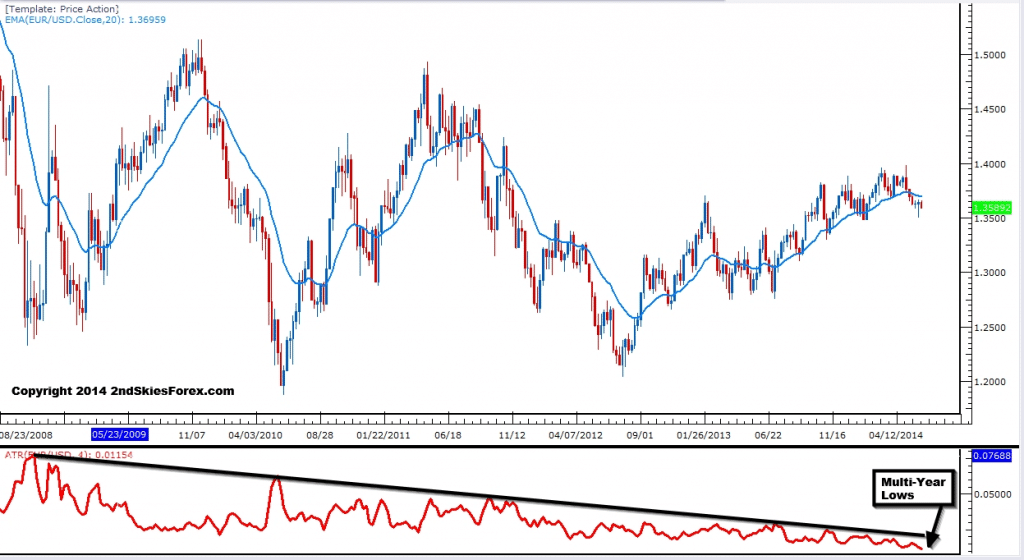
Below is the weekly chart for the EURUSD, the most heavily traded pair on the planet. Do you see that red line under the price action part of the chart? That is the weekly ATR which measures the average trading range (in pips) per week.

eurusd atr weekly chart

The average range of the pair on a week to week basis has been declining for years with it currently being at an all time low. It is the same for most majors, including the USDJPY and GBPUSD. If you are expecting a few hundred pip move on any of the above pairs, you could be sitting on your hand for days which is not the best use of your time. So what can you do about this?

My suggestion is to switch pairs that are more volatile. For example, instead of trading the GBPUSD or the AUDUSD, why not switch to the GBPAUD? It is far more volatile due to the ‘weighting‘ of the pair. If you can learn to spot good moves on the AUDUSD, then it will usually correspond to a directionally opposite move in the GBPAUD.

Take a look at the two charts below to get a better idea of this concept. In the first chart, we are looking at the AUDUSD 1hr intra-day chart. You’ll see the pair selling off heavy in the middle of the chart after a breakout pullback setup around 9330.

audusd 1hr chart breakout pullback setup

The trade happened in the Tokyo session, and took about 1.5 days to drop 135 pips. Now take a look at the chart below of the GBPAUD at that same time and notice the pattern.

gbpaud breakout pullback setup 2ndskiesforex

As you can see. the GBPAUD also make a breakout pullback setup off the role reversal level, yet it runs for +300 pips (a larger move by 2.2x). The size of each stop would have been relatively similar, which would have led to more profit on the second trade, and money in your account. Even an every day 40-50 pip directional move in the AUDUSD can lead to a +120 pip move in the GBPAUD.

Thus start looking at pairs which are naturally more volatile, and will be less affected by the lack of ‘flow information‘ shared by bank traders who are currently less active.

An additional suggestion would be to add other instruments, such as global indices and commodities. The Asian indices such as the Nikkei 225 and Hang Seng tend to have consistent volatility.

Along those lines, recently spent time with an HFT trader at IMC (Chicago). He mentioned how IMC is quite active in trading the Asian indices because of the higher volatility. Gold and WTI Crude Oil will also offer some greater volatility. Same with the German Dax and FTSE 100, so consider expanding your instruments giving you multiple options to trade.

Summer Forex Currency Trading Tip #2: Spend More Time Training
Since you are naturally less active during the summer months, why not use that time to build your trading skill set? Forget the idea of walking away when there is no trades to play golf, watch a movie, or read a book.

You want to be a professional trader who has the freedom of working from home, not having a boss who tells you what to do, what to wear and how much you get paid.

Do you get better at golf by sitting on the beach? Do you get better at playing guitar by reading novels? Do you get better at martial arts by playing video games? No, so why in the world do you think this applies to trading? It doesn’t, hence take advantage of the time available.

For those not familiar with it, Forex Tester 2 is a fantastic live simulation platform. You can take virtually any pair, and load up 13+ years of data on any time frame, then live forward trade it as if the price action was forming in real time.

I did a great video on forex training with Forex Tester 2 which shares several ideas how to accelerate your learning curve. This is especially relevant for those trading daily and 4hr strategies.

Ask yourself how long would it take you to log 500 trades if you only trade the higher time frames? Years perhaps? In less than a week, you can log the same amount of trades in FT2.

Think of it being the equivalent training of the golfer at the driving range, hitting ball after ball. Professional golfers on average will hit 500 balls a day. Do you think that helps their golf game and perfect their swing? Ponder that a moment for those of you only trading 3-5x a month, and how long it will take you to build your skill set.

I’ve had several students log thousands of trades after a few months using FT2. Go figure their trading is improving the most, and showing the greatest profits over the last few months.

NOTE: In the link I shared above to the video on FT2, there is a link where you can get a $50 discount on it.

Along the lines of using FT2 to improve your trading performance, I recently did a private member webinar, where we showed a myfxbook account from one of our students. He is trading over 70% accuracy, and up about +96% on his live trading account, with his average wins well out-sizing their average losses. He profit factor is currently +3.08 and is up +1780 pips for the last 4 months.

Below is a screenshot from their myfxbook page we discussed in the webinar.

2ndskiesforex student profit live myfxbook account using price action

They trained over and over again in FT2 and are a member of my price action course.

While others are being lazy traders, they are building their skill set. If anyone is going to really trade for a living, it will be the ones who put in the hours and properly train.

In Summary
These are just a few tips you can use to help stay consistently profitable trading forex in the summer, while using the time effectively to build your trading skill set.

There are many more tips which I share with my course members, along with more ways to utilize Forex Tester 2, building a successful trading mindset, how to train properly, along with adjusting to the ever evolving markets in real time.

Without a doubt, the learning process to successful trading is not a short one. It is one that takes time, akin to virtually all other skill based endeavors. Be it sports, playing a musical instruments, or martial arts.

Although we want to become black belt traders, or virtuoso readers of price action in a jiffy, in 99% of the cases, your time line from here to success will likely not be as quick as you’d prefer.
Because of the extended time on our journey from A to B, it is common as bikes in Amsterdam for us to lose perspective, and go off the rails.
Putting Things In Perspective
Take a look at the graph below. What you are seeing is a snapshot of an equity curve from one of the strategies in my price action course.
snapshot equity curve 1
Upon first glance, it looks incredibly unimpressive…that it loses money. And you would be correct in this assumption…for this period of time.
Now take a look at the second image below, which is the entire equity curve over several years.
price action strategy equity curve 2ndskiesforex complete
What you are now seeing is something totally different.
When you look at its entirety, you are seeing is a price action strategy that made 108% return! This is across only one ONE PAIR, and only ONE TIME FRAME.
Some highlights of the performance are below:
+108.9% profit
Profit Factor of 2.3
Expected Payoff of 112.28
Maximal Drawdown of 14.27%
% Profitable Trades 68.04%
Greatest Win 36% Larger Than Greatest Loss
Max Consecutive Profit Almost 200% Greater than Max Consecutive Loss

Without a doubt, this is a strategy that makes money, consistently, preserves capital, with a balanced risk to reward ratio.

Below is the table from the performance test, showing you the same performance.
total performance profitable strategy 2ndskiesforex price action

Most Un-Successful Traders Make This Mistake
For those who are not trading profitably, most likely when you are in a draw down, you don’t give the strategy enough time to work itself out. You see the equity curve falling, and think something has to be changed.

In reality, there could be nothing wrong with the strategy. Maybe this particular strategy won’t perform well in that market, yet this price action strategy makes money over time.

Now imagine if you changed strategies at the end of the first graph. You would have missed out on over 85% of the entire profit that strategy made. You would have lost several years of consistently profitable trading. That alone would have put you in top 5% of all traders. Food 4 thought.

Building A Healthy Perspective
Generally developing traders are more hyper-sensitive to every single trade, each win and loss. But look at this from a different perspective:

Imagine being a new archer having this same approach – that you gauge your confidence based on each shot.

That map would be all over the place, and drive a person batty as to how they are doing, because naturally one will be an inconsistent shooter in the beginning.

Instead, look to a great basketball player, and tell me if their confidence wanes from missing one free throw. They don’t make this mistake. They keep the right perspective and mindset by focusing on the process, not result. They keep the right perspective.

Constantly Changing
Changing strategies every month or so will take you in circles (like the dog that chases its tail).

dog chasing its tail
Quarterbacks don’t change throwing motions every month, nor do musicians change instruments every time things go bad. Why would you think the path to successful trading would be any different?
So avoid changing your trading plan and strategy every month. Stick to the one you got for at least 90 days, once you’ve refined it. Commit to learning/trading it inside and out.
By doing this, you are (at the very least) building a skill set towards successful trading. Even if the strategy does not work out, you are developing one of the most important qualities in trading – discipline.
And with discipline comes confidence, which is something most un-successful traders lack. Remember, the draw down of the first chart was the prelude to a 108% return, (doubling your account in a few years).
Ask yourself if you have done this (changed strategies after a small losing period). Ask yourself if you’ve focused on result more than process. Then see how you can change this to keep the right perspective when trading.