Tag Archive for: myfxbook

What’s inside:
-How can you trade for a living without much capital?
-I want to make 6-7 figures trading professionally, but I don’t have much capital. What options do I have?
-How can I get funded as a trader with a small trading account and little experience?

I recently got a really good question from ‘Bill‘ asking about this important topic. Bill asked the following:

“Here’s the short version: I’ve been working hard. I’m super stoked because I’m on the right side of break even after 9 months and hundreds of trades in demo account. If things keep progressing which I am confident they will how will I make real money with no serious capital to trade and the important question is where do I get it? How do I get it? Who’s capital can I trade? What are the options for a guy like me who can make 50% on his 5000 dollar account if he devotes a lot of his time and effort to watching charts etc? I guess the idea of building capital over many years from crumbs seems quite daunting. Any help and info would be much appreciated……… Thank you, Bill”

I hear ya Bill. These are all very good questions many struggling traders have asked. How can you make a living if you only have $500, or $5000 to start with? You’re certainly not going to pay off a mortgage with a 50% gain on your $500 or $5K acct. So how do you get around this, and why start trading if you only have a small amount to start with?

Before I answer these questions, I need to take one step back and clarify an important part of making money trading for a living.

My model for trading and making a living from your trading starts with a simple model:

Sim, then Demo, then Live

It basically means you start building your skills on a trading simulator. Then you start applying them to a demo acct. Then after stabilizing in sim and demo, you move to live trading with a small amount. The key focus for this last part being on ‘consistency in execution and process‘.

Once you have done that, and have a steady baseline of performance, then you’re ready to start increasing your acct size. This can either be through personal capital, or the capital of other investors.

From what it sounds like for you Bill, you’re at the 2nd stage of this process. Hence before you even get to worrying about making a living off your $5K capital, you need to stabilize in live trading first.

But let’s assume you’re there. Let’s assume you’ve been trading a small account for 6mos – 1 year and are consistent in your execution, process and discipline.

How can you trade a large enough account to make a real living from this? How can you trade professionally for a living by starting with a small account?

There are several components you’ll need to start getting capital which I’m going to list below.

#1 – Get Your Trading Results Verified

For your live account trading, you’ll want to get your trading results verified. I shared my verified profitable trading results here.

For you, there are many ways to verify your performance, such as:

1) Have your accounting firm audit your results and give you a document that is stamped/dated by them, the accountant who performed the audit, and the results of your performance listed on this document.

Not all accountants are trained to do this, so you might want to seek one of the big accounting firms for this (PWC, Deloitte, E&Y, KPMG, etc).

NOTE: Getting an audit can be quite expensive, sometimes up to $50K depending upon how much trading activity you’ve done. If you’re a day trader, expect it to be more expensive since you have more trades that need to be accounted for.

I’d recommended this if you have a) a large account, b) are looking for serious capital ($1MM+), and c) are courting serious/accredited investors.

If that’s not you, then you can use the cheaper (free) and simpler option #2 such as myfxbook or fxblue. Assuming your platform works with those services, you can connect your trading acct to them and they’ll analyze the data and verify it for you.

profitable-traders-2ndskiesforex

This is what most traders with small accounts (under $100K USD) should be considering, and other than your time, it’s free.

#2 After Verifying Your Results, It’s Time to Get Capital

Luckily there are many services and sites that have capital and are looking for traders. In this current investment climate, people are looking for traders with consistent risk management, a risk of ruin at zero, and solid returns.

Here are a few sites/services below that offer various methods to get you capital:

#1) Fundseeder (started by Jack Schwager)
Summary: Jack has great industry connections and a decent platform/services to help you get investors to invest in your trading and track record (which you’ll have to establish first with a live trading account).
You get connected into their system, trade away, and the platform will start to expose your trading to investors that are interested in investing with you.

Image: Jack Schwager (Author: Market Wizards)

#2) Etoro
Summary: A social trading platform that allows traders to trade demo or live, and have their trades copied by other traders. You get a % of the fees for each ‘copier/investor’ that signs up and follows your trading.

Keep in mind, no really good trader would choose this long term, because it means investors with large accounts can invest a very small amount in ‘copying’ your trades, then mirror/copy those same trades in a larger account. So you’re missing a huge portion of the pie by taking this route, but it’s a good place to start.

#3) Join A Funded Trading Program
There are many programs out there that have capital and training resources to help you become a profitable trader. They generally offer a suite of products, platform and training resources, and once you prove yourself to them, they’ll fund you.

In Closing

The most important thing is not to focus on the problem (“I don’t have much capital to start with”), but instead – focus on solutions. This is what a successful mindset does.

You not having a lot of capital to start with isn’t an issue. If you can trade, and you can manage risk, you can get capital. Capital is always looking for places to park and generate a return. There’s more than enough capital out there for you to trade. You just need to find the right outfit, program and investors for you.

I hope I answered your questions ‘Bill’, and to you all as well reading this who’ve wondered what Bill emailed me about.

This is a very important topic, but one that has many options and solutions for traders like yourself looking needing capital to trade for a living.

Any questions? Message me directly via my contact form here.

Until then, all the best and may you find real confidence and progress in your trading.

What You’ll Learn In This Article:

-why most online trading courses fail to give you enough data
-how we use quantitative data to improve your trading
-where we see technology being used to give you more quantitative data for your trading

When you survey most online trading courses and mentors out there today, about 97-99% of them fail to give you an essential component for your trading success. They fail to give you quantitative data to improve your trading performance.

The majority of courses just give you ‘information‘, so they give you lessons, pdf’s, videos, etc. But almost none of them actually require you to compile and build quantitative data around your trading performance to analyze it, then give recommendations based upon statistics and proper data.

To be clear, when we say ‘quantitative data‘, we are not talking about robots, quant trading, etc. We’re talking about hard data that can be taken from your trading and trading performance, which can be analyzed and utilized to identify your weak points/strengths, then make adjustments to your trading plan based upon the data.

Why Most Online Trading Courses Fail To Give You Enough Data

In my online trading courses, such as my price action course, we offer all members a free ‘Trading Analytics‘ session whereby I analyze 20+ metrics on a students trading performance to spot leaks, weaknesses, strengths, how close they are to becoming profitable, and what changes they need to make this happen. I then do a private skype session with this student and share my findings, recommendations, and what they need to change to become a profitable trader.

However, even I myself can find weaknesses in this model. This is because trading is a skill based endeavor which requires a proper trading feedback loop.

A feedback loop is a process whereby you perform an action (trade demo/live), your actions produce results (profits/losses/accuracy/risk, etc), and those results are analyzed and turned into feedback which is given back to the student.

Professional athletes have proper feedback loops, and its one of the biggest reasons they are so successful. This is because they’re getting constant feedback backed by data on how they’re performing, and how they can improve. You can see this below from the Tom vs Time series.

Tom Brady of the New England Patriots is considered to be one of the greatest quarterbacks of all time. He’s won the most Super Bowls of any quarterback (5), and is still playing at an elite level at the age of 41.

In the 2nd episode called The Mental Game, Tom is getting feedback on his throwing arm about 2 minutes in.

Keep in mind, he has one of the most accurate arms in the game, and still throws the ball like he did 10 years ago. Yet he’s getting continual feedback on his throwing mechanics to continually improve them. This is a proper feedback model, and it’s something all professional athletes get and know they need to stay at the top of their game.

With that being said, why should trading be any different?

Now while my feedback loop through the trading analytics session, and analyzing students trades, questions, etc. is good, it needs to go to the next level.

All professional grade feedback loops have the following characteristics:

1) quantified
2) automatic
3) ongoing
4) responsive
5) continually updating

When I analyze my feedback loop and process for my members, I realize its not automatic, is quantified, is voluntary, is ongoing, and is continually updating.

So I’m missing the automatic and non-voluntary aspects to my trading course and feedback model.

Granted, I cannot force students to give me their data, hence making it tough to be non-voluntary. And I cannot (as of yet), make this process automatic. Hence, even my courses and feedback models have their limitations.

Regardless, if you want to become a peak performing trader, you’ll need the above 5 characteristics of a professional grade feedback loop.

How We Use Quantitative Data to Improve Your Trading Performance

One of the most critical aspects of our online trading courses is the Trading Analytics session I do with my students. It’s the first time I can look at their trading over a period of time, and analyze their risk mgmt, Avg. +$ per trade, % accuracy, risk of ruin (RoR), and many more metrics about their trading.

The majority of my students trade on platforms that connect with myfxbook, so I have them connect their accounts to myfxbook which provides me the data.

Just from looking at the data, I can see their habits, level of discipline (or lack thereof), whether they are following their trading plan, entry locations, stop loss placement, trading with trend (or counter-trend) and more.

The data alone allows me to peer into your trading performance, habits and trading mindset, all via the numbers. The great thing about it is I can tell how close someone is to breaking through and being profitable.

Hence we use quantitative data to improve your trading performance. One simple data point I often examine is their ‘summary‘ tab (image below).

summary tab myfxbook 2ndskiesforex

And below this is the student’s performance since the beginning of this year on a live account (over +10% profit).

profitable traders myfxbook 2ndskiesforex

Now, when you look at the summary tab, you’ll see this traders entire performance by instrument since the beginning of this year. If you examine it closely, you should find something really useful.

This trader and student did incredibly poorly on the GBPUSD. They made a total of 8 trades (not a huge baseline by any means), and didn’t win a single trade. On top of it, their total losses for this pair alone (-$83.12) is larger than their next biggest losing pair by almost double the amount (EURJPY -$48.33).

The thing is, if you just look at the equity curve, you’d think everything was fine and there wasn’t much to change. But analyzing the data can reveal these things.

Now considering this account started at around $3000, if they had not traded this pair at all, they would be up another +5.4%, so almost a 50% increase from their +10% performance thus far. Add in the EURJPY pair, and now we’re talking an additional +8.8% added to their bottom line. That’s a huge shift in performance (+80% better return) which can make you a lot of money over time.

Most traders don’t even know this tab exists, let alone analyze it to see if there are some real under-performing instruments affecting their account. You can also take the flip side of this and trade the pairs/instruments you are most profitable with, thus maximizing your edge.

The great thing about this is it helps me find weak points and strengths within any particular trading plan, and make adjustments accordingly.

I usually follow up with my students every 3 mos and re-analyze their myfxbook accounts so I can see how their performance is changing over time as we make new recommendations.

If your trading performance is up from my recommendations, then I know we’re on the right track and can continue refining your trading plan over time. If we take a step back, then we can analyze individual variables to see which may be causing the under-performance, and make adjustments.

This is just one of 20+ metrics I analyze on all my students so we can use quantitative data to improve your trading performance.

Now ask yourself this:

If you’ve taken multiple trading courses from various forex trading mentors, how many of them are doing this type of analysis and quantitative data to isolate areas where you’re under-performing, and help you make adjustments? My guess is your answer will be close to zero, and maybe 1-2 at best.

I feel this is just a small way we continue to separate ourselves from other trading mentors, because we use actual data to analyze your performance over time, and help you make the adjustments needed to become a profitable trader.

How Technology Can Be Used To Get You Quantitative Data For Your Trading

While I think myfxbook is a fantastic tool, it is by no means sufficient. In fact, out of all the trading technological tools out there I’ve seen, I feel they are all limited in their application and what they can tell you about your trading performance, and what you need to change to make money trading.

When I look into the next evolution of trading education and online trading courses, I feel we’re just scratching the surface of how we can use technology to improve your trading performance.

What if we were to use technology to specifically test your price action trading skills over time, and demonstrate what parts of the price action you’re analyzing correctly, and missing completely?

What if we could tell you the optimal number of instruments you can trade to become profitable, and how many is too little, or too many?

What if we could tell you how you react to the price action of different instruments, and could recommend specifically which types of instruments you are most likely to make money trading (or lose money on)?

Would those be valuable tools for you to invest in? Would that be worth spending money on? My guess is yes, and we’re just scratching the surface of what technology can do to help you become a profitable trader.

My sentiments are that the future of trading education will no longer be about pdf’s, videos, and webinars, but about how we can use technology to improve your trading performance and turn you into a profitable trader.

Now Your Turn

How much quantitative data are you analyzing about your trading performance to make adjustments? Is your trading mentor even looking at your trading statistics, and giving you specific feedback based upon actual data? What ways can you see technology improving your trading performance?

Make sure to leave a comment below because I’m always looking for new ways to help more traders become profitable.

By now we have fully entered the summer trading months which are traditionally slower to begin with. When you combine the summer + the lack of ‘flow information‘ shared by bank traders under investigation, you have an environment of lesser volatility, smaller moves, and more false break setups.

With that being said, how can we maximize our time, while still remaining active and consistently profiting? Below is a mini how-to-guide for summer forex currency trading.

In this article, I will share 2 simple tips to help you trade pairs with stable volatility, larger moves, and also remain active during the slower summer months.

Summer Forex Currency Trading Tip #1: Switching Pairs & Instruments
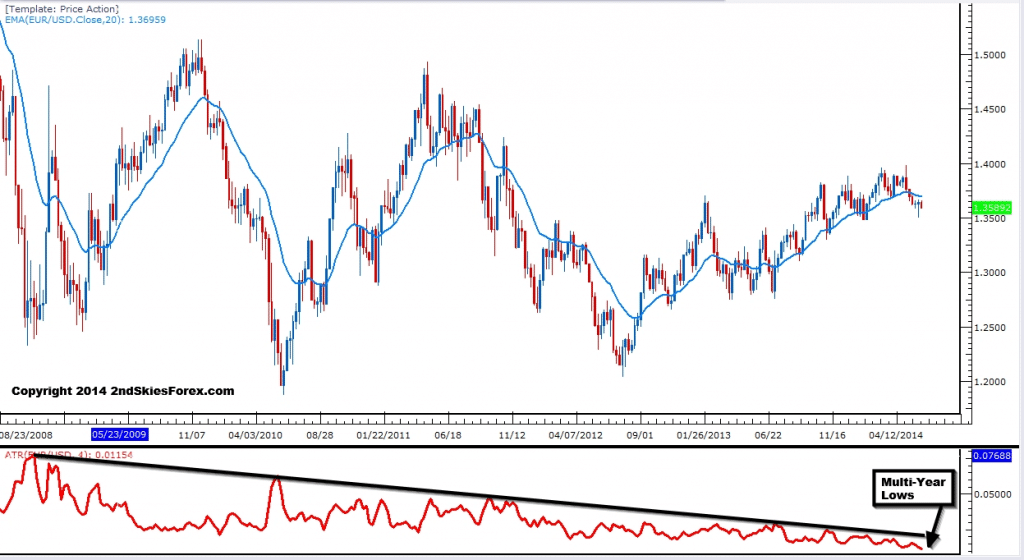
Below is the weekly chart for the EURUSD, the most heavily traded pair on the planet. Do you see that red line under the price action part of the chart? That is the weekly ATR which measures the average trading range (in pips) per week.

eurusd atr weekly chart

The average range of the pair on a week to week basis has been declining for years with it currently being at an all time low. It is the same for most majors, including the USDJPY and GBPUSD. If you are expecting a few hundred pip move on any of the above pairs, you could be sitting on your hand for days which is not the best use of your time. So what can you do about this?

My suggestion is to switch pairs that are more volatile. For example, instead of trading the GBPUSD or the AUDUSD, why not switch to the GBPAUD? It is far more volatile due to the ‘weighting‘ of the pair. If you can learn to spot good moves on the AUDUSD, then it will usually correspond to a directionally opposite move in the GBPAUD.

Take a look at the two charts below to get a better idea of this concept. In the first chart, we are looking at the AUDUSD 1hr intra-day chart. You’ll see the pair selling off heavy in the middle of the chart after a breakout pullback setup around 9330.

audusd 1hr chart breakout pullback setup

The trade happened in the Tokyo session, and took about 1.5 days to drop 135 pips. Now take a look at the chart below of the GBPAUD at that same time and notice the pattern.

gbpaud breakout pullback setup 2ndskiesforex

As you can see. the GBPAUD also make a breakout pullback setup off the role reversal level, yet it runs for +300 pips (a larger move by 2.2x). The size of each stop would have been relatively similar, which would have led to more profit on the second trade, and money in your account. Even an every day 40-50 pip directional move in the AUDUSD can lead to a +120 pip move in the GBPAUD.

Thus start looking at pairs which are naturally more volatile, and will be less affected by the lack of ‘flow information‘ shared by bank traders who are currently less active.

An additional suggestion would be to add other instruments, such as global indices and commodities. The Asian indices such as the Nikkei 225 and Hang Seng tend to have consistent volatility.

Along those lines, recently spent time with an HFT trader at IMC (Chicago). He mentioned how IMC is quite active in trading the Asian indices because of the higher volatility. Gold and WTI Crude Oil will also offer some greater volatility. Same with the German Dax and FTSE 100, so consider expanding your instruments giving you multiple options to trade.

Summer Forex Currency Trading Tip #2: Spend More Time Training
Since you are naturally less active during the summer months, why not use that time to build your trading skill set? Forget the idea of walking away when there is no trades to play golf, watch a movie, or read a book.

You want to be a professional trader who has the freedom of working from home, not having a boss who tells you what to do, what to wear and how much you get paid.

Do you get better at golf by sitting on the beach? Do you get better at playing guitar by reading novels? Do you get better at martial arts by playing video games? No, so why in the world do you think this applies to trading? It doesn’t, hence take advantage of the time available.

For those not familiar with it, Forex Tester 2 is a fantastic live simulation platform. You can take virtually any pair, and load up 13+ years of data on any time frame, then live forward trade it as if the price action was forming in real time.

I did a great video on forex training with Forex Tester 2 which shares several ideas how to accelerate your learning curve. This is especially relevant for those trading daily and 4hr strategies.

Ask yourself how long would it take you to log 500 trades if you only trade the higher time frames? Years perhaps? In less than a week, you can log the same amount of trades in FT2.

Think of it being the equivalent training of the golfer at the driving range, hitting ball after ball. Professional golfers on average will hit 500 balls a day. Do you think that helps their golf game and perfect their swing? Ponder that a moment for those of you only trading 3-5x a month, and how long it will take you to build your skill set.

I’ve had several students log thousands of trades after a few months using FT2. Go figure their trading is improving the most, and showing the greatest profits over the last few months.

NOTE: In the link I shared above to the video on FT2, there is a link where you can get a $50 discount on it.

Along the lines of using FT2 to improve your trading performance, I recently did a private member webinar, where we showed a myfxbook account from one of our students. He is trading over 70% accuracy, and up about +96% on his live trading account, with his average wins well out-sizing their average losses. He profit factor is currently +3.08 and is up +1780 pips for the last 4 months.

Below is a screenshot from their myfxbook page we discussed in the webinar.

2ndskiesforex student profit live myfxbook account using price action

They trained over and over again in FT2 and are a member of my price action course.

While others are being lazy traders, they are building their skill set. If anyone is going to really trade for a living, it will be the ones who put in the hours and properly train.

In Summary
These are just a few tips you can use to help stay consistently profitable trading forex in the summer, while using the time effectively to build your trading skill set.

There are many more tips which I share with my course members, along with more ways to utilize Forex Tester 2, building a successful trading mindset, how to train properly, along with adjusting to the ever evolving markets in real time.